Northeast Monsoon
India's Winter Rain Season
The northeast monsoon is the rainy season that comes to the south-eastern part of India in October, November and December. It is called "northeast" because the winds blow from the north-east towards the south-west at this time of year. For India as a whole it is the smaller monsoon, but for Tamil Nadu and nearby areas it is the main rainy season. When people in Chennai talk about "the monsoon", they usually mean this one.
Why does it matter?
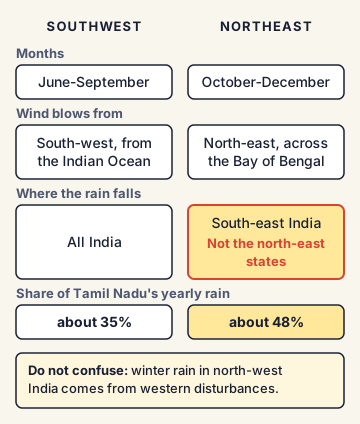
Tamil Nadu and Puducherry get about 48% of their annual rainfall from the northeast monsoon, against about 35% from the southwest monsoon. This is because the Western Ghats block much of the June-September rain from reaching Tamil Nadu. So the state's drinking water reservoirs, groundwater, tanks, and its main rice crop (the samba crop in the Cauvery delta) depend heavily on these three months. A weak northeast monsoon can mean water shortage and crop loss for the whole next year.
How does it work? The wind reversal
Monsoon simply means a seasonal reversal of winds.
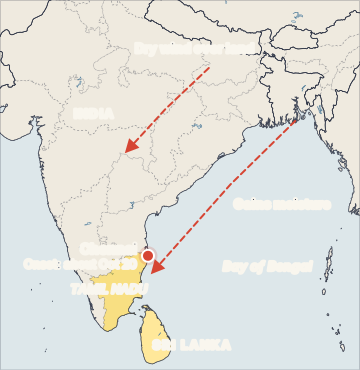
- In summer (June-September), the land of north India heats up strongly and creates a low-pressure area. Moist winds from the Indian Ocean rush in from the south-west. This is the southwest monsoon.
- From September onwards, the land cools faster than the sea. The low pressure over north India weakens and moves south, and high pressure builds over the land.
- Winds now reverse and blow from land towards the sea, from the north-east. This is the retreating or withdrawing monsoon phase.
- Over most of India these north-east winds are dry, because they come from the land. But on their way to Tamil Nadu, they cross the Bay of Bengal and pick up moisture. When they hit the Tamil Nadu and south Andhra coast, they drop this moisture as rain.
A simple picture: the same wind that is dry in Delhi becomes a rain-bearer by the time it reaches Chennai, because it has travelled over the sea.
The role of cyclones and low-pressure systems
A large share of northeast monsoon rain comes from low-pressure areas, depressions and cyclones that form over the Bay of Bengal in October-December. These systems bring very heavy rain in a few days. That is why the season is known for extremes: one cyclone can turn a deficit into a surplus, and its absence can leave the season dry. The Intertropical Convergence Zone (ITCZ), the belt where winds from both hemispheres meet, also sits near south India at this time and helps form these systems.
When and where
- Normal onset date: about October 20 over coastal Tamil Nadu and south coastal Andhra Pradesh. The actual date can vary by about a week either way.
- Season: October to December (the IMD calls it the post-monsoon season, also written as OND).
- Main regions: the IMD tracks it over five meteorological subdivisions: Tamil Nadu, Puducherry and Karaikal; Coastal Andhra Pradesh and Yanam; Rayalaseema; South Interior Karnataka; and Kerala and Mahe.
- Kerala gets rain in both monsoons, but the northeast monsoon is much smaller there than the southwest monsoon.
- Sri Lanka's north and east also get their main rain in this season (Sri Lanka calls it the Maha season).
Rain in winter elsewhere: do not confuse
North-west India also gets some winter rain, but from western disturbances. These are storms that start over the Mediterranean region and travel east. They bring rain to Punjab, Haryana and Delhi, and snow to the Himalayas. This small winter rain helps the wheat (rabi) crop. It is not the northeast monsoon.
How it links to world climate
Two ocean patterns affect the northeast monsoon:
- El Niño (unusual warming of the central and eastern Pacific) is often linked to a weaker southwest monsoon but tends to favour a normal or better northeast monsoon.
- A positive Indian Ocean Dipole (warmer western Indian Ocean than eastern) also tends to support more northeast monsoon rain. These are tendencies, not fixed rules.
India's position and examples
- The IMD's Regional Meteorological Centre in Chennai declares the onset and gives seasonal updates for south India.
- The IMD issues a seasonal forecast for the northeast monsoon, usually stated for south peninsular India and for Tamil Nadu.
- Rain is classified against the long-period average (LPA) as deficient, normal or excess.
- Chennai's floods of 2015 came in this season from very heavy rain in November-December.
- Tamil Nadu relies on thousands of traditional eris (irrigation tanks) to store this short burst of rain.
Commonly confused concepts
- Southwest monsoon vs northeast monsoon: Southwest = June-September, all-India, winds from the sea in the south-west. Northeast = October-December, mainly south-east India, winds from the north-east that gain moisture over the Bay of Bengal.
- Retreating monsoon vs northeast monsoon: Retreating monsoon is the phase when the southwest monsoon withdraws (September-October). The northeast monsoon is the rainy season that follows in south-east India. The two overlap in time and are often discussed together.
- Northeast monsoon vs north-east India: The northeast monsoon does not bring rain to the north-eastern states. The name is about wind direction, not region.
- Western disturbances vs northeast monsoon: Western disturbances give winter rain to north-west India; the northeast monsoon gives winter rain to south-east India.
Issues, criticism and the way forward
- Very uneven rain: Much of the season's rain can come in a few days from one storm. This causes floods and then long dry spells, making water storage hard.
- Urban flooding: Cities like Chennai face flooding because tanks, wetlands and drainage channels have been built over.
- Forecast difficulty: Because cyclones drive so much of the rain, seasonal forecasts for the northeast monsoon are less reliable than for the southwest monsoon.
- Long-term change: Studies show a rising trend in rainfall over parts of the peninsula. Experts suggest that water and crop planning in Tamil Nadu should use updated rainfall normals, restore tanks and wetlands, and expand early warning for cyclones.
Concepts to Know
- Low-pressure area: A region where air pressure is lower than around it. Air rises there, cools and forms clouds and rain. Stronger forms are called depressions and cyclones.
- Long-period average (LPA): The average rainfall of a region over a long reference period. Each season's rain is compared with it to say whether the season was normal.
- Intertropical Convergence Zone (ITCZ): A belt near the equator where winds from the northern and southern hemispheres meet, causing rising air, clouds and rain. It moves north and south with the seasons.
- Samba crop: The main long-duration rice crop of Tamil Nadu, especially in the Cauvery delta, grown from about August to January.
- Season: October-December (post-monsoon season)
- Tamil Nadu and Puducherry: about 48% of annual rain from the northeast monsoon; about 35% from the southwest monsoon
- Normal onset over coastal Tamil Nadu and south coastal Andhra Pradesh: about October 20
- Five subdivisions tracked: Tamil Nadu-Puducherry-Karaikal, Coastal Andhra Pradesh-Yanam, Rayalaseema, South Interior Karnataka, Kerala-Mahe
- Moisture comes from the Bay of Bengal; cyclones and depressions are a major rain source
- Not the same as western disturbances (winter rain in north-west India)
● Tracked since November 03, 2026 · last seen November 03, 2026 · updates as the daily brief publishes