North Korea's Nuclear Programme
North Korea's nuclear programme is the effort by North Korea (official name: the Democratic People's Republic of Korea, or DPRK) to build nuclear weapons and the missiles to carry them. It has carried out six nuclear tests between 2006 and 2017 and now has missiles that experts believe can reach the mainland United States. It is the only country to have joined the NPT and then announced it was leaving. Today North Korea says its nuclear status is permanent and not open to bargaining.
Why did North Korea want nuclear weapons?
The Korean Peninsula was divided after World War II. The Korean War (1950–1953) between North and South ended only with an armistice (a ceasefire) on 27 July 1953, not a peace treaty. So, technically, the two Koreas are still at war. The United States keeps troops in South Korea and protects both South Korea and Japan under its "nuclear umbrella".
North Korea's leaders see nuclear weapons as the best guarantee that no outside power will try to remove them. They often point to countries that gave up weapons programmes and later faced attacks or regime change.
Where did it come from? A timeline
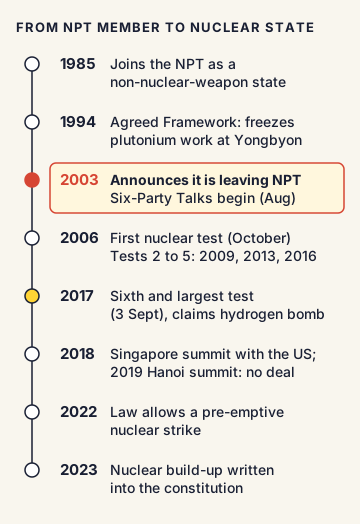
- 1985: North Korea joins the NPT as a non-nuclear-weapon state.
- January 1992: North and South Korea sign a Joint Declaration on the Denuclearization of the Korean Peninsula. North Korea declared it void in 2013.
- 1993: The IAEA finds North Korea is not following its safeguards duties. North Korea announces it will leave the NPT, then suspends that decision.
- 1994: The Agreed Framework. North Korea agrees to freeze its plutonium work at Yongbyon in return for two light-water reactors (a type harder to use for bombs) and fuel oil from the US and its partners. This deal broke down in 2002–03.
- 10 January 2003: North Korea announces its withdrawal from the NPT.
- August 2003: Six-Party Talks begin. The six were North Korea, South Korea, the US, China, Japan and Russia. In a Joint Statement of September 2005, North Korea promised to give up nuclear weapons in return for aid and security promises. North Korea quit the talks in April 2009.
- 2006 to 2017: Six nuclear tests. The first was in October 2006 and the last, and largest, was on 3 September 2017. North Korea claimed it was a hydrogen bomb, with an estimated yield of about 140–250 kilotons.
- 2018–2019: Summits. The US and North Korean leaders met in Singapore (June 2018), where they signed a statement to "work toward complete denuclearization". A second summit in Hanoi (February 2019) ended without any deal. A short meeting at the DMZ (the border zone between the two Koreas) followed in June 2019, but talks then stalled.
- September 2022: North Korea passed a law allowing the use of nuclear weapons, including a pre-emptive strike (striking first) if it senses an attack on its leadership. Its leader said this draws a line so there can be "no bargaining" over its nuclear weapons.
- September 2023: North Korea amended its constitution to include its policy of building up nuclear forces.
How does a country make a nuclear bomb?
There are two main paths, and North Korea uses both:
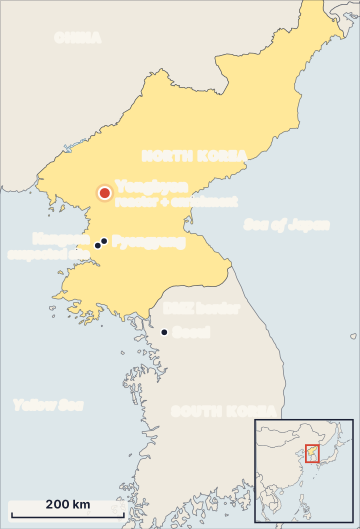
- Plutonium path: Plutonium is made inside a nuclear reactor from uranium fuel. North Korea's reactor at Yongbyon can produce about 6 kg of weapons-grade plutonium a year.
- Uranium path: Natural uranium is "enriched" in fast-spinning machines called centrifuges until it becomes highly enriched uranium (HEU), which can be used in a bomb. North Korea has enrichment plants at Yongbyon and, experts suspect, at a hidden site called Kangson.
A bomb alone is not enough. A country also needs a delivery system, usually a ballistic missile. North Korea has developed long-range missiles called ICBMs (intercontinental ballistic missiles). It showed a new one, the Hwasong-20, at a military parade in October 2025 and called it its "most powerful nuclear strategic weapon system".
How big is the arsenal?
Exact numbers are secret. As of January 2024, one widely cited estimate put North Korea's stock at about 50 warheads, with enough nuclear material for roughly 70–90 weapons. These are estimates, not official figures.
How did it get the technology?
Pakistani scientist A.Q. Khan ran a secret network that sold nuclear technology to several countries. In 2004 he admitted selling technology abroad, and Pakistan's then President later said Khan had supplied centrifuges and designs to North Korea. India has long pointed to this network as an example of proliferation risk in its neighbourhood.
Who supports North Korea now?
China is North Korea's largest trading partner and main economic lifeline. Russia signed a Treaty on Comprehensive Strategic Partnership with North Korea on 19 June 2024 in Pyongyang. Its Article 4 promises military help "without delay" if either side is attacked. Both China and Russia hold a veto in the UN Security Council, which makes new UN action against North Korea very difficult.
India's position
India supports the goal of a denuclearised Korean Peninsula and wants the issue settled through dialogue and diplomacy. India keeps diplomatic relations with both Koreas. India also has a direct interest because of the North Korea–Pakistan proliferation links.
Commonly confused concepts
- Denuclearisation vs freeze vs arms control: Denuclearisation means giving up all nuclear weapons and programmes. A freeze means stopping new production and tests but keeping what already exists. Arms control means agreed limits on numbers, without giving them up completely.
- CVID: "Complete, Verifiable and Irreversible Dismantlement", a demand the US and its allies have long used. It means removing everything in a way that inspectors can check and that cannot be undone.
- North Korea vs Iran: Iran is still an NPT member and has no declared nuclear weapons; its programme was limited under the 2015 JCPOA deal. North Korea has left the NPT and has tested nuclear weapons.
- Armistice vs peace treaty: An armistice only stops the fighting. A peace treaty formally ends a war. The Korean War has only an armistice.
Issues, criticism and the way forward
- Sanctions have not stopped the programme. North Korea has kept testing missiles and making nuclear material despite many rounds of UN sanctions.
- Weaker enforcement: Russia vetoed the renewal of the UN expert panel that monitored sanctions in March 2024. China and Russia have also blocked new punishments.
- Freeze vs full disarmament debate: Some experts argue that a freeze is a realistic first step. Others warn that it rewards North Korea and quietly accepts it as a nuclear power.
- Regional arms race: Some voices in South Korea and Japan have raised the idea of their own nuclear weapons, which could weaken the NPT further.
- Way forward: Most experts suggest step-by-step deals (some sanctions relief for verified limits), direct talks, keeping the US-South Korea-Japan alliance strong, and keeping China and Russia involved.
Concepts to Know
- ICBM (Intercontinental Ballistic Missile): A missile that can travel more than 5,500 km, enough to go from one continent to another.
- Yield (kilotons): The explosive power of a nuclear bomb. One kiloton equals the force of 1,000 tonnes of TNT explosive.
- Hydrogen bomb: A more powerful type of nuclear weapon that uses a first nuclear blast to start a second, much larger reaction.
- Nuclear umbrella (extended deterrence): A promise by a nuclear power to defend its allies, even with nuclear weapons, so that enemies do not attack them.
- Pre-emptive strike: Attacking first because you believe the enemy is about to attack you.
- Joined NPT: December 1985; announced withdrawal: 10 January 2003
- Agreed Framework: 1994 (freeze at Yongbyon for light-water reactors and fuel)
- Six-Party Talks: started August 2003 (North Korea, South Korea, US, China, Japan, Russia); September 2005 Joint Statement; North Korea quit April 2009
- Six nuclear tests: 2006, 2009, 2013, two in 2016, and 3 September 2017
- Singapore summit June 2018; Hanoi summit February 2019 (no deal)
- 2022 nuclear law allows pre-emptive use; constitution amended in September 2023
- Russia–North Korea strategic partnership treaty: 19 June 2024 (Article 4: mutual military help)
- Estimated about 50 warheads as of January 2024
● Tracked since October 31, 2026 · last seen October 31, 2026 · updates as the daily brief publishes