National Power Grid of India
One Nation, One Grid
India's National Grid is the huge network of high-voltage power lines and substations that links almost every power plant in the country to almost every consumer. Since 31 December 2013, the whole country runs as one synchronous grid: all generators turn in step, at one common frequency of about 50 Hz. This is called "One Nation, One Grid, One Frequency". It lets electricity made in one part of India, say solar power from Rajasthan, flow to homes in another part, say Tamil Nadu.
Why does India need one national grid?
Electricity cannot easily be stored in large amounts, so it must be produced at the same moment it is used. India's resources are unevenly spread: coal is mostly in the east and centre, sun in the west and south, wind on the coasts, and hydropower in the Himalayas and the north-east. Demand also peaks at different times in different regions.
A single grid works like a big water tank shared by many houses: a region with extra power can help a region that is short. Without it, one region might waste power while another faces power cuts.
Where did it come from?
India's grid grew in steps:
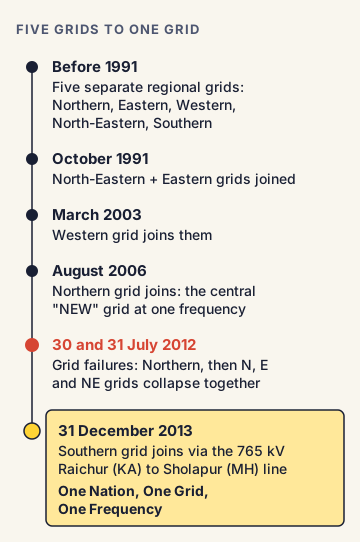
- At first, each State had its own grid. They were later grouped into five regional grids: Northern, Eastern, Western, North-Eastern and Southern.
- October 1991: the North-Eastern and Eastern grids were joined.
- March 2003: the Western grid joined them.
- August 2006: the Northern grid joined, forming the central "NEW" grid (Northern, Eastern, Western and North-Eastern) at one frequency.
- 31 December 2013: the Southern grid was synchronised through the 765 kV Raichur (Karnataka) to Sholapur (Maharashtra) line, built by POWERGRID. India became one national synchronous grid.
The 2012 grid failures: the big lesson
On 30 July 2012, the Northern grid collapsed. On 31 July 2012, the Northern, Eastern and North-Eastern grids collapsed together. Hundreds of millions of people (over 600 million, by many estimates) lost power, and trains, hospitals and water pumps stopped. A three-member inquiry committee led by S.C. Srivastava submitted its report on 16 August 2012.
It found that no single cause was responsible. Key reasons included weak links between regions, overloading of inter-regional lines, some States drawing more power than scheduled (poor "grid discipline"), and protection systems that did not work as planned. The lesson: a connected grid shares power, but it also spreads trouble fast if rules are not followed.
How does the grid stay balanced?
Every second, the power produced must match the power used. The frequency shows whether they match:
- If demand is more than supply, frequency falls below 50 Hz.
- If supply is more than demand, frequency rises above 50 Hz.
Think of a cyclist on a flat road: if the load on the cycle suddenly increases, the pedals slow down; if the load drops, they spin faster. Under the Indian Electricity Grid Code (IEGC), 2023 (in force from 1 October 2023), the allowed band is 49.90 Hz to 50.05 Hz. The grid code is made by the Central Electricity Regulatory Commission (CERC).
Who runs the grid? (The key institutions)
The Electricity Act, 2003 sets up a chain of "load despatch centres", like air-traffic control for electricity:
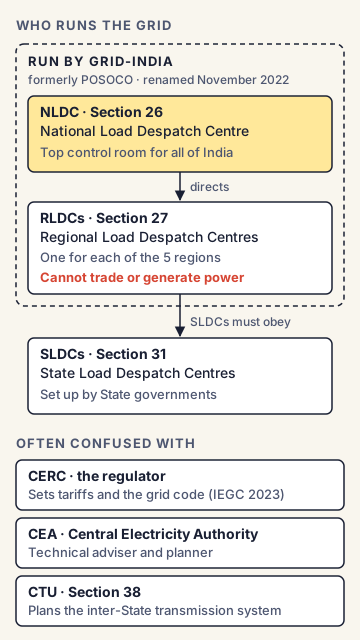
- National Load Despatch Centre (NLDC), Section 26: the top control room for the whole country.
- Regional Load Despatch Centres (RLDCs), Section 27: one for each of the five regions. They are the top authority for running the grid in their region. RLDCs cannot trade or generate electricity.
- State Load Despatch Centres (SLDCs), Section 31: set up by State governments, and they must follow the directions of their RLDC.
- Central Transmission Utility (CTU), Section 38: plans and coordinates the inter-State transmission system.
The NLDC and the five RLDCs are run by Grid Controller of India Limited (Grid-India). It was earlier called Power System Operation Corporation (POSOCO), and was renamed in November 2022. It became a separate government company, apart from POWERGRID, in 2017. POWERGRID (Power Grid Corporation of India) builds and owns most inter-State transmission lines.
India's position and the numbers
India's grid is one of the largest single synchronous grids in the world. Inter-regional transmission capacity (the ability to move power from one region to another) was about 119 GW in early 2025, and is planned to grow to about 143 GW by 2026-27 and 168 GW by 2031-32. Peak demand has risen fast: from about 123 GW in 2012 to a record 250 GW on 30 May 2024, and then to an all-time high of about 270.8 GW on 21 May 2026, met without shortage.
Programmes such as the Green Energy Corridor add special lines to carry solar and wind power from where it is made to where it is used.
Commonly confused concepts
- Installed capacity vs peak demand vs generation: Installed capacity is the maximum all plants can produce (over 550 GW in 2026). Peak demand is the highest power used at one moment (about 270 GW). Generation is the total energy actually produced over time, measured in units (kWh).
- GW vs GWh (units): GW measures power at an instant, like the speed of a car. GWh measures energy used over time, like the distance travelled.
- Transmission vs distribution: Transmission is the high-voltage "highway" carrying bulk power over long distances (POWERGRID, State transmission companies). Distribution is the low-voltage "local road" bringing power to homes (DISCOMs).
- One Nation One Grid vs One Sun One World One Grid (OSOWOG): One Nation One Grid is India's national grid, completed in 2013. OSOWOG is an India-backed international idea, promoted through the International Solar Alliance, to link power grids across countries to share solar power.
- NLDC vs CEA vs CERC: NLDC runs the grid in real time. The Central Electricity Authority (CEA) is the technical adviser and planner. CERC is the regulator that sets tariffs and the grid code.
Issues, criticism and the way forward
- Solar and wind are variable: Solar power drops sharply in the evening, just when home demand rises. Balancing this needs storage, flexible plants and faster forecasting.
- Transmission lag: New solar and wind parks are sometimes ready before the lines needed to carry their power, so clean power gets stuck or wasted.
- State discipline: Some States still overdraw or underdraw from the grid. The grid code and penalties under the Deviation Settlement Mechanism try to stop this.
- Weak DISCOM finances: Loss-making distribution companies delay payments to generators, which slows investment in the whole system.
- Cyber and climate risks: A national grid is a target for cyber attacks and can be hit by heatwaves, cyclones and floods.
- Way forward: Experts and the CEA suggest more battery and pumped-storage capacity, faster inter-regional lines, better forecasting of solar and wind, smart meters, and stronger cyber security.
Concepts to Know
- Synchronous grid: A grid in which all connected generators run at exactly the same frequency, like dancers moving to one beat.
- Frequency (Hz): How many times per second alternating current changes direction. In India, the standard is 50 times a second (50 Hz).
- kV (kilovolt): A unit of voltage. 765 kV lines are the highest-voltage AC lines in India and carry huge amounts of power over long distances with less loss.
- Load despatch: Deciding, minute by minute, which plants should produce how much power to meet demand safely.
- DISCOM: A distribution company that supplies electricity to homes and businesses and collects bills.
- Peak demand: The highest electricity use at any single moment, usually on hot summer afternoons or evenings.
- Five regional grids: Northern, Eastern, Western, North-Eastern, Southern
- Integration: NE and East (October 1991); West (March 2003); North (August 2006); South (31 December 2013, via the 765 kV Raichur to Sholapur line)
- Grid failures: 30 July 2012 (Northern) and 31 July 2012 (Northern, Eastern, North-Eastern); inquiry report by the S.C. Srivastava committee on 16 August 2012
- Electricity Act, 2003: Section 26 (NLDC), Section 27 (RLDC), Section 31 (SLDC), Section 38 (CTU)
- Grid-India (formerly POSOCO), renamed in November 2022; runs NLDC and 5 RLDCs
- IEGC 2023 (CERC), in force from 1 October 2023; frequency band 49.90 to 50.05 Hz
- Peak demand: 123 GW (2012); 250 GW (30 May 2024); all-time high about 270.8 GW (21 May 2026)
- Inter-regional transmission capacity: about 119 GW (early 2025); planned 143 GW (2026-27) and 168 GW (2031-32)
● Tracked since November 13, 2026 · last seen November 13, 2026 · updates as the daily brief publishes