National Payments Corporation of India (NPCI)
The Organisation Behind UPI and RuPay
The National Payments Corporation of India, or NPCI, is the organisation that builds and runs most of India's retail digital payment systems. UPI, RuPay cards, IMPS, FASTag, the ATM network that lets you use any bank's ATM, and many more are all run by NPCI. It is not a bank and it does not hold your money.
It works like the "railway track" on which banks and apps move money between each other. It was set up by the RBI and the Indian Banks' Association (IBA) and is owned by banks.
Why does India need NPCI?
Imagine each bank building its own payment system. A customer of Bank A could not easily pay a customer of Bank B, and every bank would spend money building the same thing again and again. Before 2008, India's retail payment systems were scattered across different operators. The RBI wanted one common body that all banks could share, so that payments would be cheap, safe and interoperable (meaning any bank's customer can pay any other bank's customer). NPCI fills that role.
Where did it come from?
- The RBI's Vision for Payment Systems 2005-08 called for a single umbrella organisation for all retail payment systems in India.
- NPCI was set up as an initiative of the RBI and the IBA under the Payment and Settlement Systems Act, 2007 (PSS Act), the law that gives the RBI power to regulate payment systems.
- It was incorporated on 19 December 2008 as a not-for-profit company. At that time this was a "Section 25 company" under the Companies Act, 1956. Today it is a Section 8 company under the Companies Act, 2013.
- It started with 10 promoter banks: State Bank of India, Punjab National Bank, Canara Bank, Bank of Baroda, Union Bank of India, Bank of India, ICICI Bank, HDFC Bank, Citibank and HSBC.
- In 2016, its shareholding was widened to bring in many more public sector, private, foreign, co-operative and regional rural banks.
How does it work?
Think of a toll highway owned jointly by many transport companies. The companies (banks) run their own buses (customer apps and accounts). NPCI owns and maintains the highway (the switch and rules) that every bus uses. When you pay a shop through UPI, your app sends the request to NPCI's switch. NPCI routes it to your bank to debit your account and to the shop's bank to credit theirs, in a few seconds.
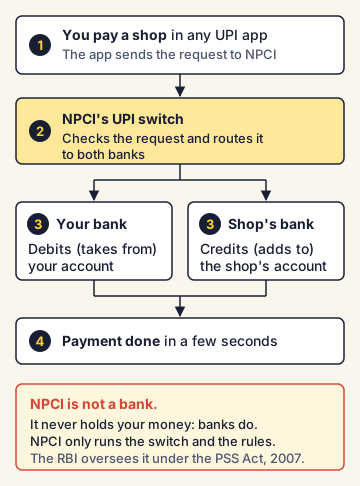
NPCI also writes the rules for everyone on the network: who can join, technical standards, transaction limits, dispute handling and fees between participants. As a not-for-profit body, it does not pay dividends to its bank owners; surplus is put back into the systems.
NPCI's main products
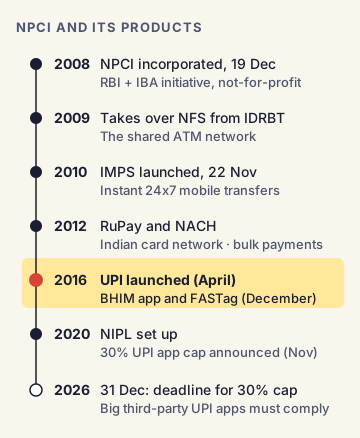
- National Financial Switch (NFS): the shared ATM network. NPCI took it over from IDRBT (a research institute of the RBI) in 2009.
- IMPS (Immediate Payment Service): instant 24x7 bank transfers by mobile, launched publicly on 22 November 2010.
- RuPay: India's own card network (launched in 2012), an Indian alternative to Visa and Mastercard.
- NACH (National Automated Clearing House): for bulk payments such as salaries, subsidies, EMIs and dividends (implemented December 2012).
- AePS (Aadhaar Enabled Payment System): lets people do basic banking at a local agent's device using their Aadhaar number and fingerprint.
- *99# USSD service: basic mobile banking on simple feature phones without internet.
- UPI (2016) and the BHIM app (December 2016).
- NETC FASTag: electronic toll collection on highways (launched December 2016; mandatory at national highway toll plazas since 2019).
Subsidiaries
- NPCI International Payments Ltd (NIPL), 2020: takes UPI and RuPay abroad, for example by linking UPI with payment systems of other countries.
- NPCI Bharat BillPay Ltd (NBBL): runs the Bharat Bill Payment System (BBPS) for paying electricity, water, phone and other bills.
Who controls NPCI?
NPCI runs payment systems, so it needs permission from the RBI under the PSS Act and works under the RBI's oversight. The RBI sets the big policy, while NPCI sets the detailed operating rules for its systems. The Central Government also plays a role in charges: under Section 10A of the PSS Act, it decides which payment modes must stay free of charges for users and merchants.
The 30% market-share cap
In November 2020, NPCI announced that no single third-party UPI app (such as a non-bank app) should handle more than 30% of total UPI transaction volume, measured over the past three months. The aim was to reduce concentration risk: if one or two apps carry most payments and one of them fails, the whole country's payments could be hit.
Bank-run apps are exempt. Existing apps above the cap were given time to comply; in December 2024 the deadline was extended by two years to 31 December 2026.
Commonly confused concepts
- NPCI vs RBI: The RBI is the regulator (the umpire who makes and enforces the rules). NPCI is an operator (the company that runs the payment systems) and works under RBI oversight.
- NPCI vs a bank: NPCI does not keep deposits or give loans. Banks hold your money; NPCI only connects banks so money can move.
- IMPS vs NEFT vs RTGS: IMPS is NPCI's instant mobile transfer system. NEFT and RTGS are run by the RBI, not NPCI. RTGS is mainly for large payments (minimum ₹2 lakh).
- RuPay vs Visa/Mastercard: all are card networks. RuPay is Indian and run by NPCI; Visa and Mastercard are foreign companies.
- MDR vs interchange: MDR is the total fee the merchant pays. Interchange is the part of that fee passed from the merchant's bank to the customer's bank (the card issuer). They are not the same thing.
Issues, criticism and the way forward
- Who pays for the rails? Under zero MDR, banks and apps earned nothing on most UPI payments, yet had to spend heavily on servers, security and fraud control. The government paid some of this through yearly incentive schemes. The new MDR on larger payments is one answer; critics worry it could push some merchants back to cash.
- Concentration risk: A few apps still carry most UPI volume. Enforcing the 30% cap without disturbing users is a hard balancing act.
- Single point of failure: Because NPCI runs so many critical systems, an outage at NPCI can stop payments across the country. Experts call for strong backup systems and cyber-security.
- Governance: NPCI is owned by banks but sets rules that affect fintech companies who are not owners. Some fintechs have asked for a bigger say. Others argue bank ownership keeps the system safe and neutral.
- Fraud and consumer protection: Faster, easier payments have also made fraud faster. Better dispute resolution and user awareness are needed as UPI grows.
- Way forward: Sustainable funding for the system, more players to reduce concentration, strong cyber resilience, and expanding UPI abroad through NIPL.
Concepts to Know
- Interoperable: Systems that can work with each other. A UPI app of one company can pay a customer of any bank.
- Payment system operator: A company that runs the technology and rules through which payments move between banks, like the operator of a shared ATM network.
- Not-for-profit company (Section 8 company): A company whose aim is not to make profits for its owners. Any surplus is used for its objectives, not paid out as dividends.
- Concentration risk: The danger that comes when too much activity depends on one or two players. If one fails, the whole system suffers.
- USSD: A simple mobile code system (like dialling *99#) that works on basic phones without internet.
- Merchant Discount Rate (MDR): The fee a shop pays to banks and payment companies on each digital payment it receives, usually a small percentage of the payment.
- Incorporated 19 December 2008; not-for-profit, now a Section 8 company (Companies Act, 2013); earlier Section 25 (Companies Act, 1956)
- Set up as an initiative of the RBI and IBA under the Payment and Settlement Systems Act, 2007
- 10 promoter banks at the start; shareholding widened in 2016
- Headquarters: Mumbai
- Products: NFS (from 2009), IMPS (22 November 2010), RuPay (2012), NACH (December 2012), UPI (April 2016), BHIM (December 2016), NETC FASTag, AePS, *99#, BBPS (via NBBL)
- Subsidiaries: NIPL (international, 2020) and NBBL (Bharat BillPay)
- UPI third-party app market-share cap: 30% (announced November 2020); compliance deadline 31 December 2026
● Tracked since September 16, 2026 · last seen October 13, 2026 · updates as the daily brief publishes