National List of Essential Medicines (NLEM)
The National List of Essential Medicines, or NLEM, is the government's official list of the medicines India considers most important for public health. These are the medicines that treat the most common and serious diseases, that are proven safe and effective, and that give good value for money. The list is prepared by the Ministry of Health and Family Welfare.
Once a medicine is in the NLEM, it comes under price control, so it must be sold at or below a price fixed by the government.
What does "essential medicine" mean?
The idea comes from the World Health Organization (WHO). It describes essential medicines as those that meet the priority health-care needs of the population. In simple words: if a country can afford only a limited set of medicines, these are the ones it must always have, in the right forms and doses, at prices people and the health system can pay. Think of it like the basic items a ration shop must always keep, such as rice, wheat and oil, before anything else.
Why does India need such a list?
India has thousands of medicine brands. Many are copies of the same medicine, sold at very different prices. Doctors, hospitals and patients can get confused. The NLEM helps in four ways:
- Price control: NLEM medicines are put in Schedule I of the DPCO, 2013, and the NPPA fixes their ceiling prices.
- Government buying: Central and state governments use it to decide which medicines to buy and stock in public hospitals and health centres.
- Rational prescribing: It guides doctors towards proven, cost-effective medicines.
- Training and policy: It shapes medical teaching, insurance packages and health programmes.
Where did it come from?
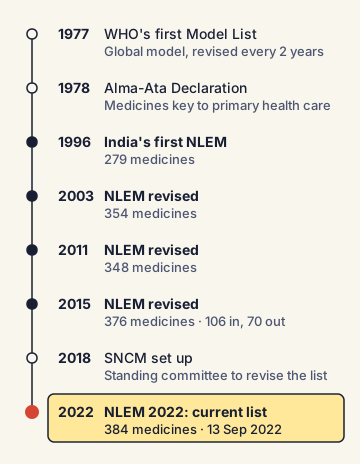
- 1977: WHO published its first Model List of Essential Medicines. WHO updates it every two years.
- 1978: The Alma-Ata Declaration on primary health care named the supply of essential medicines as a key part of basic health care.
- 1996: India's Health Ministry released the first NLEM, with 279 medicines.
- 2003: revised to 354 medicines.
- 2011: revised to 348 medicines.
- 2015: revised to 376 medicines (106 added, 70 dropped; coronary stents were added later, in July 2016).
- 2018: The Health Ministry set up a permanent expert body, the Standing National Committee on Medicines (SNCM), chaired by the Secretary of the Department of Health Research and Director General of the Indian Council of Medical Research (ICMR), to review and revise the list.
- 2022: The current list, NLEM 2022, was released on 13 September 2022.
What is in NLEM 2022?
- 384 medicines in 27 therapeutic categories (groups by the kind of disease treated, such as anti-cancer, anti-infective or heart medicines).
- 34 medicines added and 26 dropped compared with 2015.
- Additions included ivermectin, mupirocin, nicotine replacement therapy and four anti-cancer medicines.
- Deletions included ranitidine, sucralfate, atenolol and methyldopa, mainly because better or more cost-effective options exist.
- Each medicine is marked by the level of health care where it should be available: P (primary, like a village health centre), S (secondary, like a district hospital) and T (tertiary, like a big specialty hospital).
How is a medicine chosen?
The committee looks at several things together:
- Is the disease a major public health problem in India?
- Is the medicine approved (licensed) for sale in India?
- Is it proven to be safe and effective?
- Is it cost-effective compared with other options for the same disease?
- Is it in the WHO list, in national health programmes, the Indian Pharmacopoeia or the National Formulary?
A medicine may be dropped if it has been banned, has safety problems, or if a better or cheaper option is now available.
How does the NLEM lead to price control?
The steps are:
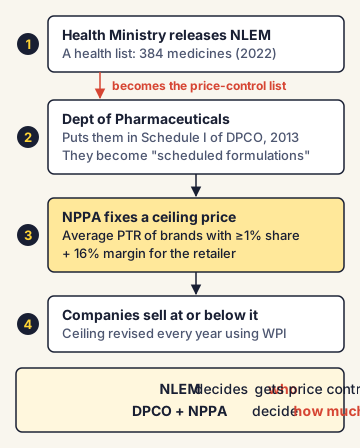
- The Health Ministry releases the NLEM.
- The Department of Pharmaceuticals puts these medicines into Schedule I of the DPCO, 2013. They are now called scheduled formulations.
- The NPPA fixes a ceiling price for each. It takes the simple average price to retailer of all brands with at least 1% market share, and adds a 16% margin for the retailer.
- Every company must sell at or below this ceiling price. Each year the ceiling is adjusted using the Wholesale Price Index (WPI).
So the NLEM is the "who gets price control" list, and the DPCO and NPPA decide "how much".
India's position and examples
As of November 2024, ceiling prices were in force for 926 scheduled formulations. Cancer medicines in the NLEM have ceiling prices, but many newer cancer drugs are not in the NLEM. These newer drugs are often the most costly ones, which is why the government uses other tools, such as trade margin caps, for them.
Commonly confused concepts
- NLEM vs WHO Model List: The WHO list is a global model, updated every two years (its 24th edition in 2025 has about 523 medicines). The NLEM is India's own list, chosen for India's diseases and budget. India is not bound to follow the WHO list.
- NLEM vs Schedule I of the DPCO: The NLEM is a health list made by the Health Ministry. Schedule I is the price-control list in the DPCO, run by the Department of Pharmaceuticals. Schedule I is built from the NLEM.
- Scheduled vs non-scheduled medicines: Scheduled medicines (from the NLEM) have a ceiling price. Non-scheduled medicines have no ceiling, but their MRP cannot rise by more than 10% a year, and the government can still act on them under Paragraph 19.
- Ceiling price vs trade margin cap: A ceiling price fixes the maximum final price. A trade margin cap fixes the maximum gap between the company's selling price and the MRP, and the final price follows from that.
- Essential medicines vs generic medicines: "Essential" is about public health priority. "Generic" means a copy of a medicine sold under its chemical name after the patent ends. An essential medicine can be sold as a brand or a generic.
- NLEM vs Jan Aushadhi: Jan Aushadhi (Pradhan Mantri Bhartiya Janaushadhi Pariyojana) is a scheme of shops selling low-cost generic medicines. It is a supply channel, not a list for price control.
Issues, criticism and the way forward
- Slow revisions: The list went seven years without revision between 2015 and 2022. As of mid-2026, it had not been revised since 2022, while the WHO list was updated in 2023 and 2025. Health groups say slow updates leave out newer, life-saving medicines.
- Costly new drugs left out: Many modern cancer, rare disease and other specialty drugs are under patent or very costly, and are not in the NLEM. So they escape ceiling prices.
- Company workarounds: Makers sometimes shift to slightly different combinations or strengths that are not on the list, to avoid price control.
- Shortage risk: The industry argues that very low ceiling prices can make some medicines unprofitable, which may cause makers to stop supply.
- Way forward: Experts suggest regular, time-bound revisions (for example, every two to three years like the WHO), clear published reasons for every addition and deletion, linking the list to public buying and free-medicine schemes, and using other tools like trade margin caps for costly non-listed drugs.
Concepts to Know
- Formulation: The final form of a medicine that a patient takes, such as a tablet, syrup or injection, at a certain strength.
- Therapeutic category: A group of medicines used for the same type of disease, for example "anti-cancer medicines" or "medicines for heart disease".
- Ceiling price: The highest price at which a medicine can be legally sold. Companies can sell below it, but never above it.
- Price to retailer (PTR): The price at which a wholesaler sells a medicine to a chemist shop.
- Wholesale Price Index (WPI): A number that tracks how prices of goods change at the wholesale (bulk-sale) level. It is used to adjust ceiling prices every year.
- Pharmacopoeia: An official book that lists medicines and the quality standards they must meet. India's is the Indian Pharmacopoeia.
- Cost-effective: Giving good health benefit for the money spent, compared with other options.
- WHO Model List of Essential Medicines: first in 1977; revised every two years; 24th list in 2025
- India's first NLEM: 1996 (279 medicines); revisions in 2003 (354), 2011 (348), 2015 (376), 2022 (384)
- NLEM 2022: released 13 September 2022; 384 medicines; 27 therapeutic categories; 34 added, 26 dropped
- Levels of care: P (primary), S (secondary), T (tertiary)
- Prepared by the Ministry of Health and Family Welfare through the Standing National Committee on Medicines (set up 2018)
- NLEM medicines form Schedule I of the DPCO, 2013; NPPA fixes their ceiling prices
- Ceiling price = simple average PTR of brands with at least 1% market share + 16% retailer margin; revised yearly by WPI
- Ceiling prices in force for 926 scheduled formulations (as of November 2024)
● Tracked since March 17, 2026 · last seen October 17, 2026 · updates as the daily brief publishes