Muziris and the Pattanam Excavations
Muziris was a busy port on the Malabar coast of Kerala about 2,000 years ago. Ships from the Roman Empire came here to buy black pepper and other goods, and paid in gold. For centuries, scholars knew Muziris only from old books and poems, because nobody could find its remains. Since 2007, digging at a village called Pattanam, near the Periyar river in Kerala, has given the strongest physical evidence of where this lost port may have stood.
Why does Muziris matter?
Muziris shows that South India was part of a world trade network long before European ships came in 1498. Pepper from the Western Ghats travelled from here to Egypt, Rome and beyond. Finding the port helps us check what ancient writers said against real objects from the ground. It also shows how early Kerala grew from Iron Age villages into a town linked to the world.
What do the old texts say?
Muziris (called Muciri in Tamil) appears in three kinds of sources:
- Tamil Sangam poems: A poem in the Akananuru (commonly cited as poem 149) describes the fine ships of the Yavanas coming up the Periyar (called Culli in the poem) with gold and going back with pepper. Yavana came from the word "Ionian" and was used for Greeks, Romans and other western traders.
- Greek and Roman writers: The Periplus of the Erythraean Sea, a Greek sailing guide from the 1st century CE, lists Muziris as a major market. Pliny the Elder, in his Natural History (about 77 CE), called it the "first emporium of India" (primum emporium Indiae), but also warned of pirates nearby at a place he called Nitrias.
- The Muziris Papyrus: A 2nd-century CE document, now in the Austrian National Library in Vienna. One side is a loan agreement made in Alexandria for a trading trip. The other side lists the cargo of a ship called the Hermapollon returning from Muziris, including 167 elephant tusks and large amounts of what scholars believe was mostly pepper.
Why was it "lost"?
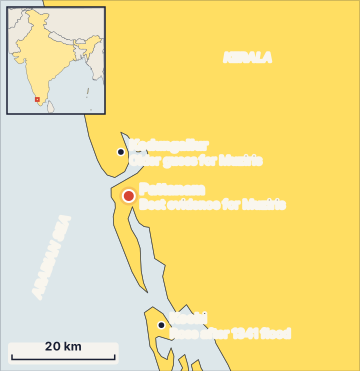
Trade with Rome declined after about the 5th century CE, though the port stayed active. In 1341 CE, a great flood changed the course of the Periyar river and is believed to have silted up the old harbour. Trade then moved to newer ports such as Kochi (Cochin) and Kozhikode (Calicut). For a long time, people believed Muziris lay at Kodungallur (Thrissur district), but digging there did not find the expected early remains.
How was Pattanam found?
Local people at Pattanam kept finding old bricks, broken pots and beads after heavy rain. In 2006, archaeologists K.P. Shajan and V. Selvakumar suggested Pattanam could be Muziris. Pattanam lies about 2 to 3 km from North Paravur and about 5 km south of Kodungallur, roughly 4 km inland from the Arabian Sea. Its mound covers a large area, and only a small part has been dug.
What did the digging find?
KCHR ran nine seasons (2007 to 2015), described as the first multidisciplinary excavation in Kerala. Major finds include:
- Roman goods: pieces of amphorae (tall jars used to carry wine and olive oil) and fine red Roman tableware called terra sigillata.
- West Asian pottery: Sassanian (Persian), Yemeni and other wares, showing links with Arabia and the Persian Gulf.
- Indian links: rouletted ware (pottery with a ring pattern, probably from the Ganga plains) and beads of agate, carnelian and glass.
- Port features: a brick wharf (a landing platform) with bollards (posts to tie ships) and a 6-metre wooden dugout canoe lying beside it.
- Writing and coins: a pot piece with Tamil-Brahmi script, dated to about the 2nd century CE, and mostly early Chera coins with elephant and bow-and-arrow symbols.
The earliest layers belong to the Iron Age (megalithic people). The town reached its peak in the early historic period, around the 1st century CE, when Roman trade was at its height.
How do we know dates and links?
Archaeologists study the layers of soil, one above another, like pages in a book. They compare pottery styles with known dated pottery from Rome and Egypt. They also use scientific dating and study where materials like glass and stone came from. Pattanam used many such sciences together, which is why it is called multidisciplinary.
India's position and related sites
In India, excavation needs a licence from the Archaeological Survey of India (ASI), which works under the Ministry of Culture. Kerala runs the Muziris Heritage Project, which links Pattanam with nearby forts, synagogues, churches, temples and mosques along a heritage trail. Other ancient trade sites to remember:
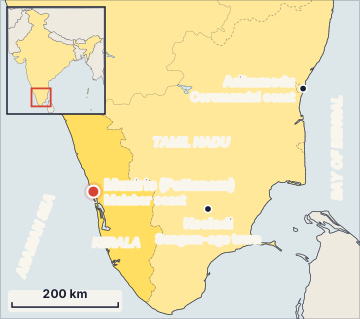
- Arikamedu (near Puducherry, east coast): excavated by Mortimer Wheeler in 1945; Roman pottery found.
- Kodumanal (Erode, Tamil Nadu): a bead-making and iron-working centre on the inland trade route.
- Keeladi (near Madurai, Tamil Nadu): a Sangam-age urban settlement.
- Berenike (Red Sea coast, Egypt): a Roman port where Indian goods, including pepper and Indian pottery, have been found.
Commonly confused concepts
- Muziris vs Kodungallur vs Pattanam: Muziris is the ancient port's name. Kodungallur was the older guess for its location. Pattanam is the site where digging has found the best evidence so far.
- Muziris vs Arikamedu: Muziris is on the west (Malabar) coast in Kerala and mainly traded pepper. Arikamedu is on the east (Coromandel) coast near Puducherry.
- Muziris vs Kochi-Muziris Biennale: The Biennale is a modern contemporary art festival held in Kochi since 2012. It only borrows the ancient port's name.
- Muziris vs Nelcynda: Both were Malabar ports in the Periplus. Muziris was in the Chera land; Nelcynda was further south, in the Pandya-controlled area.
Issues, criticism and the way forward
- Identification is not fully settled: Some senior archaeologists argue that more work, including at Kodungallur, is needed before calling Pattanam Muziris with certainty.
- Disruption and disputes: Licence suspensions in 2015 and 2021 and the legal case that followed stopped steady research for about a decade.
- Publication and access: Many finds still need full scientific reports so that scholars worldwide can study them.
- Community and conservation: The site sits in a populated village, so land use, conservation and local involvement must be balanced.
- Way forward suggested by experts: a stable, long-term research programme, open data and publications, a site museum and teaching centre, and partnership with local people and global universities.
Concepts to Know
- Archaeology: The study of the human past through objects, buildings and remains dug out of the ground.
- Excavation: Careful, layer-by-layer digging of a site to find and record what lies below.
- Artefact: Any object made or used by humans, such as a pot, bead, coin or tool.
- Amphora: A tall clay jar with two handles, used by Romans to carry wine, olive oil and fish sauce by sea.
- Megalithic (Iron Age) culture: Early people of South India known for burials marked with big stones and for using iron tools, from about 1000 BCE.
- Tamil-Brahmi: The early script used to write Tamil, found on pots, coins and cave inscriptions of the Sangam age.
- Sangam literature: The oldest Tamil poems, written roughly between the 3rd century BCE and the 3rd century CE, which describe life, war, love and trade.
- Papyrus: A paper-like writing material made from a reed plant in ancient Egypt.
- Muziris (Muciri): ancient port on the Malabar coast, near the Periyar river, Kerala
- Pattanam: Ernakulam district; first proposed as Muziris in 2006 (Shajan and Selvakumar)
- KCHR excavations: 9 seasons, 2007 to 2015; over 1.29 lakh artefacts
- Key texts: Akananuru (Sangam), Periplus of the Erythraean Sea (1st century CE), Pliny's Natural History (about 77 CE), Muziris Papyrus (2nd century CE, Vienna; ship Hermapollon)
- Port decline linked to the Periyar flood of 1341 CE; trade shifted to Kochi and Kozhikode
- Finds: amphorae, terra sigillata, West Asian pottery, rouletted ware, Tamil-Brahmi sherd, early Chera coins, wharf and dugout canoe
- Excavation licences in India are given by the ASI (Ministry of Culture)
● Tracked since October 19, 2026 · last seen October 19, 2026 · updates as the daily brief publishes