Multi-State Co-operative Societies Act, 2002
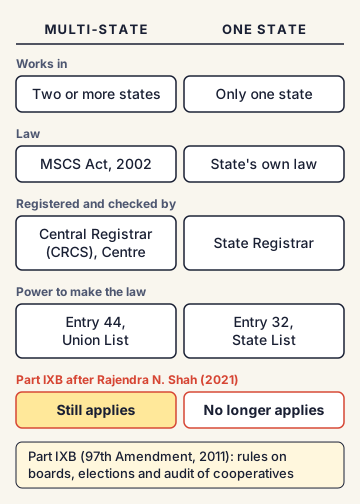
The Multi-State Co-operative Societies (MSCS) Act, 2002 is the central law for cooperative societies whose work and members are spread over more than one state. Examples include large dairy, sugar, fertiliser, housing and credit cooperatives. Such a society is registered and supervised by the Central Registrar of Co-operative Societies (CRCS), an office under the Union Ministry of Cooperation, not by any single state.
Why does it exist?
Most cooperatives work inside one state, so state cooperative laws are enough for them. But think of a credit cooperative with members in Maharashtra, Karnataka and Goa. Which state's Registrar should check it? If each state checked only its own part, nobody would see the whole picture. A single central law gives one set of rules and one regulator for such societies. It also lets a cooperative grow across state borders without being registered again in every state.
Where does the power come from?
Cooperative societies are a State subject under Entry 32 of the State List. But Entry 44 of the Union List lets Parliament make laws on corporations whose objects are not confined to one state. In Union of India v. Rajendra N. Shah (2021), the Supreme Court confirmed that Parliament has the power to make laws on multi-state cooperatives.
Where did it come from?
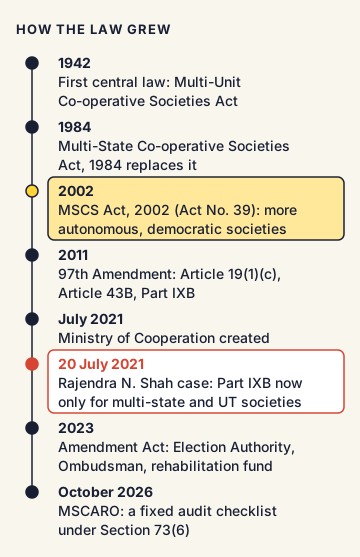
- 1942: The Multi-Unit Co-operative Societies Act, 1942 was the first central law for cooperatives working in more than one province.
- 1984: It was replaced by the Multi-State Co-operative Societies Act, 1984.
- 2002: The present MSCS Act, 2002 (Act No. 39 of 2002) replaced the 1984 Act. It aimed to make these societies more autonomous (free to run their own affairs) and democratic.
- 2011: The 97th Constitutional Amendment made forming cooperative societies a Fundamental Right under Article 19(1)(c), added Article 43B (a Directive Principle asking the State to promote cooperatives) and added Part IXB (Articles 243ZH to 243ZT) with rules on boards, elections and audit.
- 2021: In Union of India v. Rajendra N. Shah (20 July 2021), the Supreme Court held that Part IXB was passed without the approval of half the state legislatures, which Article 368(2) requires when state powers are affected. So Part IXB no longer applies to state cooperatives. It still applies to multi-state cooperatives and to societies in Union Territories. The changes to Article 19(1)(c) and Article 43B were not affected.
- July 2021: A separate Ministry of Cooperation was created at the Centre.
- 2023: The Multi-State Co-operative Societies (Amendment) Act, 2023 (Act No. 11 of 2023, dated 3 August 2023) made major changes (below).
How does it work, step by step?
- A group of people or societies from two or more states applies to the Central Registrar to register a multi-state society. The Registrar must decide within a fixed time.
- The society runs under its bye-laws (its own rulebook) and the Act.
- Members elect a board of directors. The board can have up to 21 directors.
- Every year, its accounts are checked by a statutory auditor chosen by its general body (the meeting of all members) from a panel approved by the Central Registrar.
- The Central Registrar can inspect, inquire, settle disputes and, in serious cases, order winding up (closure). Some powers, such as inspection, have been delegated to state Registrars.
What did the 2023 amendment change?
These are the points most likely to be tested:
- Co-operative Election Authority: An independent body to hold board elections, so the existing board does not control its own re-election. It has a chairperson, a vice-chairperson and up to three members, appointed by the Centre on a selection committee's advice.
- Reserved board seats: One seat for a Scheduled Caste or Scheduled Tribe member and two seats for women.
- Co-operative Ombudsman: One or more ombudsmen to hear members' complaints. The ombudsman must finish the inquiry within 3 months. Appeals go to the Central Registrar within one month.
- Co-operative Rehabilitation, Reconstruction and Development Fund: A fund to revive sick (loss-making, failing) societies. Societies that made profits in the last three years pay into it: ₹1 crore or 1% of net profit, whichever is less.
- Co-operative Information Officer: Each society must have one, so members can get information about its working.
- Stronger audit: Societies with turnover or deposits above ₹500 crore must have a concurrent audit (a running check during the year) besides the yearly audit. The Central Government got power under Section 73(6) to lay down auditing and accounting standards.
- Mergers: State cooperative societies can merge into an existing multi-state society, subject to state laws.
- Digital filing: Applications, returns and accounts are to be filed electronically.
The new audit order (MSCARO, 2026)
Using its power under Section 73(6), the Ministry of Cooperation mandated the Multi-State Co-operative Societies (Auditor's Report) Order, 2026 on 14 October 2026. It is modelled on the Companies (Auditor's Report) Order (CARO), which tells company auditors what extra points to report. Under MSCARO:
- Auditors answer a fixed checklist (Yes/No answers with remarks), so reports are the same in form for every society.
- They must report on NPAs, overdue loans, liquidity, deposits, advances, repayment defaults and borrowings.
- They must check governance: board composition, eligibility of directors, general meetings, committees and related-party transactions (deals with insiders and their relatives).
- They must check cyber security safeguards and anti-money laundering compliance where relevant, including customer identification under the Prevention of Money Laundering Act (PMLA).
- It applies first to societies above ₹1,000 crore in gross receipts, deposits plus borrowings, or loans and advances, from 2026-27. The limit drops to ₹250 crore from 2028-29, with a long-term aim of ₹50 crore.
- The Central Registrar can use these reports for risk-based supervision: spotting high-risk societies and inspecting them first.
India's position and Indian examples
India has about 1,800 multi-state cooperative societies (1,779 were reported to Parliament in 2025). Maharashtra has the largest number. Well-known multi-state cooperatives include big fertiliser cooperatives like IFFCO and KRIBHCO. In 2023 the Centre also set up three new national-level multi-state cooperatives for exports, seeds and organic products. At the same time, some credit societies misused the weak oversight to run Ponzi-like schemes. The CRCS-Sahara Refund Portal, launched in July 2023, was created to repay depositors of four Sahara group multi-state cooperatives.
Commonly confused concepts
- Multi-state society vs state cooperative society: A multi-state society works in two or more states and is under the Central Registrar and the MSCS Act. A state society works in one state and is under that state's Registrar and cooperative law.
- Multi-state credit society vs Urban Cooperative Bank: A credit society is registered under the MSCS Act and lends to members, but has no RBI banking licence and no DICGC deposit insurance. A UCB has both. Under the new licensing plan, a strong credit society can apply to become a UCB.
- Statutory audit vs concurrent audit: A statutory audit is the yearly check required by law after the year ends. A concurrent audit checks transactions while they are happening during the year.
- CARO vs MSCARO: CARO applies to companies under the Companies Act, 2013. MSCARO applies to multi-state cooperative societies under the MSCS Act, 2002.
- Article 19(1)(c) vs Article 43B: Article 19(1)(c) gives citizens the Fundamental Right to form cooperatives (courts can enforce it). Article 43B is a Directive Principle asking the State to promote them (courts cannot enforce it).
Issues, criticism and the way forward
- Thin oversight: The Central Registrar has few officers and offices in the states, so close supervision of hundreds of societies is hard. Experts suggest more staff, technology and data-based risk scoring.
- Federalism concerns: Some states argue that letting state societies merge into multi-state ones, and growing central control, eats into a State subject. The Centre's position is that multi-state bodies need uniform central rules.
- Fraud by credit societies: Ponzi-like schemes hurt small savers, who often think these societies are banks. Clear public warnings, strict audit and quick action by the Registrar are needed.
- Audit quality: Auditors chosen and paid by the society may go easy on it. Standard checklists like MSCARO, rotation of auditors and action against negligent auditors are suggested fixes.
- Way forward: Use audit data on the CRCS portal for early warnings, train cooperative auditors (with support from bodies like ICAI), hold elections on time through the Election Authority, and keep cooperatives democratic while protecting members' money.
Concepts to Know
- Registrar of Cooperative Societies: The government officer who registers cooperatives and checks that they follow the law, a bit like the Registrar of Companies for companies.
- Bye-laws: The rules a society makes for itself, such as who can be a member and how the board is chosen.
- Sick society: A society that has made heavy losses and cannot pay its debts or run properly.
- Ombudsman: An official who hears complaints from the public against an organisation and suggests or orders a fix, without the cost of going to court.
- Ponzi scheme: A fraud where old investors are paid "returns" using money from new investors, not from real profit. It collapses when new money stops coming in.
- Institute of Chartered Accountants of India (ICAI): The statutory body, set up under the Chartered Accountants Act, 1949, that regulates chartered accountants and sets auditing standards in India.
- Entry 44, Union List: The entry in the Seventh Schedule that lets Parliament make laws on corporations whose objects are not limited to one state.
- MSCS Act, 2002: Act No. 39 of 2002; replaced the MSCS Act, 1984 (which replaced the Multi-Unit Co-operative Societies Act, 1942)
- Regulator: Central Registrar of Co-operative Societies, under the Ministry of Cooperation (created July 2021)
- Constitutional basis: Entry 44, Union List (cooperatives are otherwise Entry 32, State List)
- 97th Amendment, 2011: Article 19(1)(c), Article 43B, Part IXB (Articles 243ZH to 243ZT)
- Union of India v. Rajendra N. Shah (20 July 2021): Part IXB valid only for multi-state cooperatives and societies in UTs
- MSCS (Amendment) Act, 2023: Act No. 11 of 2023, dated 3 August 2023
- Board: up to 21 directors; 1 seat SC/ST, 2 seats women
- Ombudsman: inquiry within 3 months; appeal to Central Registrar within 1 month
- Rehabilitation fund contribution: ₹1 crore or 1% of net profit, whichever is less
- Concurrent audit: turnover or deposits above ₹500 crore
- MSCARO, 2026: under Section 73(6); thresholds ₹1,000 crore (from 2026-27), ₹250 crore (from 2028-29), long-term ₹50 crore
- About 1,779 multi-state societies (reported to Parliament, 2025); Maharashtra has the most
● Tracked since November 03, 2026 · last seen November 03, 2026 · updates as the daily brief publishes