Mahakali Treaty, 1996 and the Pancheshwar Multipurpose Project
The Mahakali Treaty is an agreement between India and Nepal to jointly use and develop the waters of the Mahakali river, which forms the border between the two countries in the far west of Nepal. It covers three projects: the old Sarada Barrage, the Tanakpur Barrage, and a planned giant dam called the Pancheshwar Multipurpose Project.
The treaty was signed in 1996. But Pancheshwar, its biggest promise, has still not been built because the two countries have not agreed on how to share its water and benefits.
Which river is this?
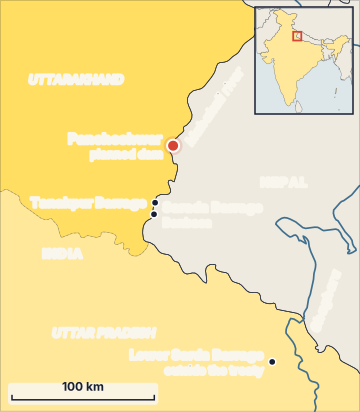
The Mahakali rises in the high Himalaya. For a long stretch it is the boundary between Nepal and India's Uttarakhand. In India, once it comes down into the plains, it is called the Sharda (Sarda). It later joins the Ghaghra, which flows into the Ganga. So it is part of the Ganga river system.
Why was a treaty needed?
When a river is the border, both countries have a right to its water. Any dam on it needs land on both banks. Before 1996, there were only piecemeal deals. One was an exchange of letters in 1920, under which Nepal let the British build the Sarada Barrage and was to get some water from it.
The other was a disputed understanding over India's Tanakpur Barrage, built in the 1980s. Part of Tanakpur's bund (embankment) had to rest on Nepali land. In Nepal this caused a big political row about whether such a deal needed Parliament's approval. The Mahakali Treaty replaced these older understandings with one complete agreement.
Where did it come from?
- 12 February 1996: the treaty was signed in New Delhi by the Prime Ministers of Nepal (Sher Bahadur Deuba) and India (P.V. Narasimha Rao).
- 20 September 1996: Nepal's Parliament ratified (formally approved) it in a joint sitting of both Houses, by a two-thirds majority of the members present. Under Nepal's 1990 Constitution, a treaty on sharing natural resources needed this special majority.
- 5 June 1997: the two countries exchanged the instruments of ratification (the formal papers saying each country has approved the treaty). The treaty came into force on this date, not on the date of signing or of Nepal's vote.
- It is valid for 75 years from that date. It must be reviewed every 10 years, or earlier if either country asks.
What does the treaty say? (key articles)
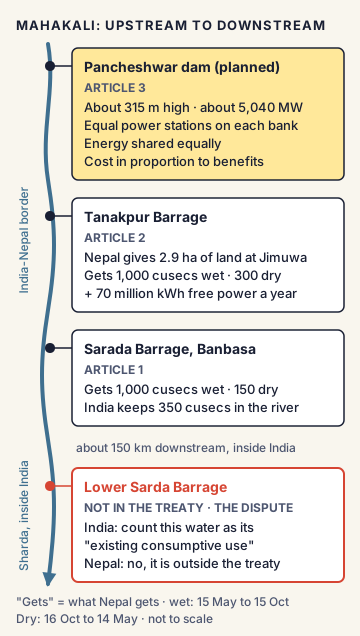
- Article 1, Sarada Barrage: Nepal gets 1,000 cusecs of water in the wet season (15 May to 15 October) and 150 cusecs in the dry season (16 October to 14 May). India must keep at least 350 cusecs flowing in the river below the barrage to protect the river's ecosystem.
- Article 2, Tanakpur Barrage: Nepal allows India to use about 2.9 hectares (a 577-metre strip) of its land at Jimuwa for the barrage's eastern bund. The land stays under Nepal's sovereignty. In return, Nepal gets 1,000 cusecs in the wet season and 300 cusecs in the dry season, plus 70 million units (kWh) of electricity every year, free of cost. Both start from the date the treaty came into force.
- Article 3, Pancheshwar: Both countries have equal entitlement to use the Mahakali's water, without affecting each one's existing consumptive uses (the water each country was already taking out of the river and using). The project is to be designed for the maximum total net benefit. It will have power stations of equal capacity on each bank, and the total energy will be shared equally. The cost will be shared in proportion to the benefits each country gets. Part of Nepal's share of power will be sold to India at an agreed price.
- Article 4: India will supply 350 cusecs for irrigating the Dodhara-Chandani area of Nepal.
- Article 5: Nepal's water needs get "prime consideration".
- Article 7: Neither side may divert or block the river in a way that harms its natural flow, except by agreement. Local communities on both banks may still use water, up to 5% of the average annual flow at Pancheshwar.
- Article 9: A Mahakali River Commission, with equal members from both sides, will oversee the treaty.
- Article 10: Joint bodies may be set up for projects. The Pancheshwar Development Authority (PDA) is such a joint body. Its terms of reference were agreed in 2014.
- Article 11: A difference between the two sides goes first to the Commission. It becomes a dispute for arbitration if the Commission does not give its recommendation within 3 months of the difference being referred to it, or if either side does not accept its recommendation. The dispute then goes to a three-member arbitration tribunal. If the two sides cannot agree on the third (presiding) arbitrator within 90 days of receiving a proposal, either side may ask the Secretary-General of the Permanent Court of Arbitration at The Hague to appoint one.
How would Pancheshwar work?
The plan is a very tall dam, about 315 metres high, on the Mahakali just below the point where the Sarju river joins it, at Pancheshwar. A large lake would form behind it. Two power houses, one on each bank, would together have about 5,040 MW of capacity, according to the latest joint plans (older studies gave larger figures).
A smaller "re-regulating" dam downstream would even out the water released from the main dam. Besides power, the stored water would help irrigation in both countries and reduce floods in the plains.
Why is it stuck?
The joint Detailed Project Report (DPR) was to be finalised within six months of the treaty coming into force (5 June 1997). It is still not final.
- India's state-owned firm WAPCOS submitted a draft DPR in 2016, after combining the reports of both countries.
- The main fight is over water rights, and it turns on the words "existing consumptive uses" in Article 3. India already draws a lot of Mahakali water through the Lower Sarda barrage, about 150 km downstream inside India. India wants this counted as its existing use, which Article 3 protects outside the equal sharing. Nepal says this barrage is not part of the treaty, so its water should not be treated as existing use.
- The answer also changes the money. If this water is not counted as India's existing use, India's measured benefit from Pancheshwar is larger, so India's share of the cost is larger.
- There is also a dispute over cost sharing. India would get most of the irrigation and flood-control benefits, so Nepal wants India to pay a larger share of the cost.
India's position and examples
India sees the Mahakali Treaty as a model of joint river development with Nepal. The other big India-Nepal river deals are the Kosi Agreement (1954) and the Gandak Agreement (1959). Under these, India built barrages on rivers flowing from Nepal. Many in Nepal feel these older deals gave India more benefits, and this history shapes Nepal's caution on Pancheshwar.
Commonly confused concepts
- Mahakali Treaty (1996) vs Ganga Water Treaty (1996): Both were signed in 1996. The Mahakali Treaty is with Nepal and covers joint development of a boundary river. The Ganga Water Treaty is with Bangladesh and covers sharing the Ganga's dry-season water at Farakka.
- Sarada Barrage vs Tanakpur Barrage: Sarada is the older barrage, built under the 1920 arrangement. Tanakpur is the newer one, with a power station, and needed Nepali land at Jimuwa.
- Pancheshwar Development Authority vs Mahakali River Commission: The PDA is a joint body meant to build and run the Pancheshwar project. The Commission oversees the whole treaty and examines differences between the two sides.
- Mahakali/Sharda river vs the Kalapani dispute: The Kalapani boundary dispute is about where the Mahakali begins, high up in the mountains. The Mahakali Treaty is about using its water lower down. They are linked by the same river but are separate issues.
Issues, criticism and the way forward
- A treaty on paper only: More than 30 years after signing, the Mahakali River Commission and Pancheshwar have made very slow progress. Critics in both countries call it a missed chance.
- Disagreement on "existing use": Without a common definition, the two sides cannot fix each one's water share, and so cannot fix the costs.
- Environmental and social costs: A 315-metre dam in an earthquake-prone Himalayan zone would flood a large area and displace many families. Experts call for full environmental and safety studies.
- Way forward: Experts suggest finalising the DPR quickly, agreeing on a clear formula for existing use, valuing irrigation and flood-control benefits openly, and holding regular meetings of the bilateral water bodies.
Concepts to Know
- Barrage: A low wall across a river with many gates. It raises the water level a little so water can be sent into canals. Unlike a big dam, it stores very little water.
- Cusec: A unit of water flow: one cubic foot of water passing a point every second. 1,000 cusecs is about 28 cubic metres per second.
- Ratification: The formal approval of a signed treaty by a country's Parliament or government. A treaty binds a country only after it is ratified. The Mahakali Treaty itself came into force on the day the two countries exchanged their ratification papers (5 June 1997).
- Detailed Project Report (DPR): The full technical and financial plan of a project, including design, cost and benefits. Construction cannot start without an agreed DPR.
- Arbitration: Settling a dispute by sending it to neutral judges (arbitrators) whose decision both sides accept as binding.
- Multipurpose project: A dam that serves more than one purpose, such as electricity, irrigation, drinking water and flood control.
- Signed: 12 February 1996, New Delhi; ratified by Nepal: 20 September 1996 (two-thirds of members present, joint sitting of both Houses); in force: 5 June 1997
- Valid for 75 years from entry into force; review every 10 years
- Sarada: Nepal gets 1,000 cusecs (wet season) and 150 cusecs (dry season); India keeps at least 350 cusecs downstream
- Tanakpur: Nepal gives about 2.9 ha at Jimuwa; gets 1,000 cusecs (wet), 300 cusecs (dry) and 70 million kWh of free power a year
- Pancheshwar: equal entitlement to water, without affecting existing consumptive uses; equal power stations on each bank; energy shared equally; cost in proportion to benefits
- Pancheshwar plan: about 5,040 MW, dam about 315 m high; DPR due within 6 months of entry into force; draft DPR by WAPCOS in 2016, still not final
- Dodhara-Chandani irrigation: 350 cusecs (Article 4)
- Disputes: Mahakali River Commission (3 months from reference), then a 3-member arbitration tribunal
● Tracked since November 20, 2026 · last seen November 20, 2026 · updates as the daily brief publishes