Lakhpati Didi Initiative
The Lakhpati Didi initiative is a central government effort to help women in rural Self-Help Groups earn at least ₹1 lakh a year for their household, and keep earning it year after year. "Lakhpati" means a person who earns or owns a lakh of rupees, and "Didi" means elder sister. It is not a separate scheme with its own budget. It is a target and a method that runs inside the government's main rural livelihood programme, DAY-NRLM, run by the Ministry of Rural Development.
Why does it exist?
By the early 2020s, crores of rural women had joined Self-Help Groups and were taking small loans and saving money. But many were still earning very little. A 2022 survey of SHG households found that more than half earned less than ₹60,000 a year. Saving and borrowing alone do not lift a family out of poverty.
The family needs a steady income from farming, animals or a small business. The Lakhpati Didi idea moves the focus from "how many women are in groups" to "how much each woman's household actually earns".
Where did it come from?
The milestones are:
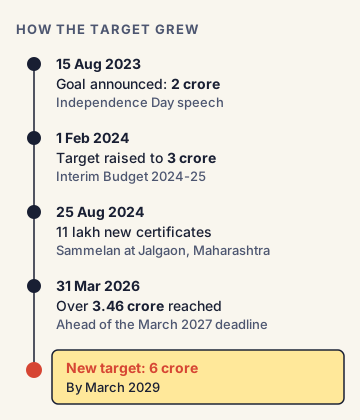
- 15 August 2023: In the Independence Day speech, the government announced a goal of creating 2 crore Lakhpati Didis in villages through women's SHGs. The same speech announced drones for women's SHGs, which became the Namo Drone Didi scheme.
- 1 February 2024: In the Interim Budget 2024-25, the target was raised from 2 crore to 3 crore. At that time, about 1 crore women had already become Lakhpati Didis.
- 25 August 2024: At a Lakhpati Didi Sammelan (gathering) in Jalgaon, Maharashtra, certificates were given to 11 lakh new Lakhpati Didis.
- 2026: The 3 crore target, originally due by March 2027, was reached ahead of time. A new target of 6 crore Lakhpati Didis was set (by March 2029 as per official statements). As of 31 March 2026, more than 3.46 crore SHG members had reached Lakhpati status, as per a reply in the Lok Sabha.
Who counts as a Lakhpati Didi?
The definition is strict on purpose, so that one lucky month does not count. A Lakhpati Didi is an SHG member whose:
- annual household income is ₹1 lakh or more, and
- average monthly income is ₹10,000 or more,
- sustained over at least four agricultural seasons or four business cycles.
Think of a woman who rears goats and runs a small tailoring shop. If her family earns ₹1.2 lakh this year from these, but the next season the goats fall sick and income drops, she does not yet count. Only income that holds steady over four seasons counts. This is why it is about sustainable income, not a one-time jump.
How does it work, step by step?
The Ministry's guidelines lay out a clear process:
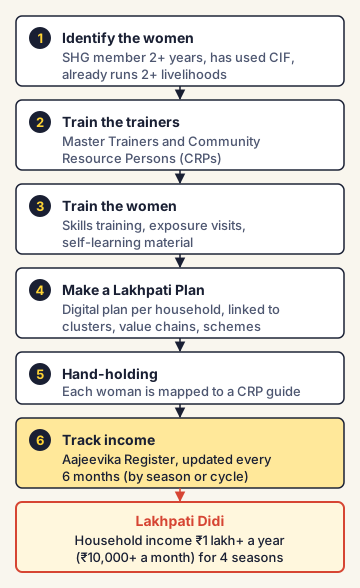
- Identify potential Lakhpati Didis. A suggested rule: the woman has been an SHG member for at least two years, has used the Community Investment Fund, and already practises at least two livelihood activities.
- Train trainers: build a pool of Master Trainers and Community Resource Persons (CRPs), who are usually experienced SHG women themselves.
- Train the women: skills training, exposure visits to see successful models, and self-learning material.
- Make a Lakhpati Plan for each household using a digital tool. These plans are then grouped into product or service clusters and linked to value chains, government schemes and private partners.
- Hand-holding: each woman is mapped to a CRP who guides her regularly.
- Track income in the Aajeevika Register, updated every six months in line with crop seasons or business cycles.
Most women earn from more than one activity, for example a mix of crops, dairy and a small shop. This spreads risk: if one source fails, the others keep the income going.
What support do the women get?
Most of it comes from the existing DAY-NRLM system, plus links with other schemes:
- Revolving Fund: ₹20,000 to ₹30,000 per eligible SHG, as starting capital.
- Community Investment Fund (CIF): up to ₹2.5 lakh per SHG, lent to members through SHGs and their federations.
- Bank loans: collateral-free (without any security) loans up to ₹20 lakh per SHG, with interest subvention that brings the effective rate to 7% on loans up to ₹3 lakh.
- Overdraft of ₹5,000 for each member who has a Jan Dhan account.
- Enterprise support: the Start-up Village Entrepreneurship Programme (SVEP), block-level One Stop Facilities for incubation, Producer Groups (₹2 lakh each) and artisan clusters.
- New-skill livelihoods: for example, Namo Drone Didi gives drones to women SHGs so they can earn by renting out drone spraying services to farmers.
India's position and Indian examples
Lakhpati Didi depends on the scale of India's SHG movement, which is one of the largest women's community networks in the world, with about 10 crore households in about 90 lakh SHGs. As per data shared in Parliament in December 2024, Andhra Pradesh had the most Lakhpati Didis (about 14.9 lakh), followed by Bihar (about 13.5 lakh) and West Bengal (about 11.8 lakh).
States with older, stronger SHG movements, such as Andhra Pradesh's women's federations and Bihar's JEEViKA programme, have led the way. The initiative links to the wider goal of women-led development, where women are not just receivers of welfare but earners and business owners.
Commonly confused concepts
- Lakhpati Didi vs DAY-NRLM: DAY-NRLM is the parent programme (since 2011) that builds SHGs and links them to banks. Lakhpati Didi is an income target and method within it. It has no separate funding line.
- Lakhpati Didi vs Namo Drone Didi: Namo Drone Didi is a separate Central Sector Scheme (outlay ₹1,261 crore, 2023-24 to 2025-26) to give drones to 15,000 women SHGs, with central help of 80% of the drone cost up to ₹8 lakh. It is one of many ways a woman can become a Lakhpati Didi.
- Lakhpati Didi vs Stand-Up India: Stand-Up India (2016) helps women and SC/ST entrepreneurs get bank loans of ₹10 lakh to ₹1 crore for a new business. It is a bank loan scheme run by the Department of Financial Services, not an SHG-based programme.
- Household income vs individual income: The ₹1 lakh test is on the household's income, not only what the woman earns herself.
Issues, criticism and the way forward
- Measuring income honestly: Counts are partly based on self-reported data from SHG members. Some independent reports have questioned how survey forms were filled, and figures from different sources do not always match. Clear third-party checks would make the numbers more trustworthy.
- ₹1 lakh is a modest bar: For a family of four or five, ₹1 lakh a year (about ₹8,000 to ₹10,000 a month) is still a low income. Critics say crossing it does not mean the family is out of poverty, and inflation reduces its real value over time.
- Debt risk: Pushing women to borrow for businesses can lead to over-borrowing if the business fails. Strong training and market links are needed so that loans create income, not debt traps.
- Markets and value chains: Many women make similar products (pickles, papad, garments) for the same small local market. Without branding, e-commerce links and buyers, prices stay low.
- Women's time and control over money: Women in rural homes already carry heavy household and care work. Studies stress that income must come with real control over money and decisions, or the burden simply increases.
- Way forward: Experts and the Ministry point to stronger value chains and clusters, digital tools for tracking, more non-farm enterprises, convergence with other ministries, and independent impact studies to see what kind of support works best.
Concepts to Know
- Self-Help Group (SHG): A small group, usually of 10 to 20 women from similar backgrounds, who save small amounts regularly, lend to each other and together take bank loans.
- Livelihood: The way a person or family earns a living, such as farming, dairy, a small shop or a craft.
- Community Resource Person (CRP): A trained local person, often an experienced SHG woman, who guides other women in their villages.
- Interest subvention: When the government pays part of the interest on a loan, so the borrower pays a lower rate.
- Value chain: All the steps a product goes through, from raw material to making, packing, transport and final sale. Earning more often means moving up this chain, for example selling packed spices instead of raw chillies.
- Central Sector vs Centrally Sponsored Scheme: A Central Sector Scheme is fully paid for by the Centre. A Centrally Sponsored Scheme is shared between the Centre and states.
- Announced on 15 August 2023; target 2 crore, raised to 3 crore in the Interim Budget (1 February 2024)
- Runs under DAY-NRLM, Ministry of Rural Development
- Definition: SHG member with annual household income of ₹1 lakh or more, average ₹10,000 a month, sustained for at least 4 agricultural seasons or business cycles
- Income tracked in the Aajeevika Register every six months
- 3 crore target met ahead of the March 2027 deadline; new target 6 crore (by March 2029)
- Over 3.46 crore Lakhpati Didis as of 31 March 2026 (Lok Sabha reply)
- Top states (December 2024 data): Andhra Pradesh, Bihar, West Bengal
- Support: Revolving Fund ₹20,000 to ₹30,000; CIF up to ₹2.5 lakh per SHG; collateral-free loans up to ₹20 lakh
● Tracked since October 07, 2026 · last seen October 07, 2026 · updates as the daily brief publishes