Khadi and Village Industries Commission (KVIC)
The Khadi and Village Industries Commission, or KVIC, is a government body that promotes khadi (hand-spun and hand-woven cloth) and village industries (small units in villages, like making soap, honey, pottery or processed food). Its job is to create jobs in rural India, especially for poor artisans, so that people can earn a living near their homes.
It is a statutory body, which means it was created by a law passed by Parliament: the Khadi and Village Industries Commission Act, 1956. It works under the Ministry of MSME and has its head office in Mumbai.
Why does it exist?
Most poor families in India live in villages. Farming alone cannot give work to everyone all year, because farm work is seasonal and land is limited. Without other work, people either sit idle for months or move to cities and live in slums. KVIC tries to solve this by helping people earn money from small, low-cost work in their own village. Think of it as a "rural jobs engine" that does not need big factories or big money.
Where did it come from?
The idea goes back to the freedom struggle. Mahatma Gandhi made the charkha (spinning wheel) and khadi a symbol of swadeshi, the idea of using things made in India instead of British mill cloth. In 1925, the All India Spinners' Association was set up to spread hand-spinning. After Independence, the government set up the All India Khadi and Village Industries Board in 1953.
Parliament then passed the KVIC Act in 1956, and KVIC was formed in April 1957, taking over the Board's work. The Act was changed in 1987 and again in 2006.
What do the key words mean in law?
The Act gives exact definitions, and UPSC can ask them:
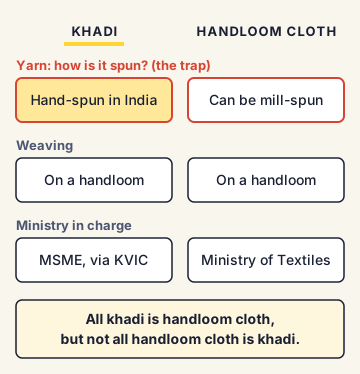
- Khadi (Section 2(d)): any cloth woven on handlooms in India from cotton, silk or woollen yarn that was hand-spun in India, or from a mix of these yarns. So both the spinning and the weaving must be by hand. Cloth woven on a handloom from mill-made yarn is not khadi.
- Rural area (Section 2(ff)): any village, and any town whose population is not more than 20,000 (or another figure the Centre may set). The 2006 amendment raised this limit from 10,000 to 20,000.
- Village industry (Section 2(h)): an industry in a rural area that makes goods or gives a service, with or without power, where the fixed capital investment per artisan or worker is not more than ₹1 lakh (or another sum the Centre may notify). "Fixed capital investment" means money put into land, building, plant and machinery.
Who runs it?
After the 2006 amendment, Section 4 of the Act says the Commission has these members, all appointed by the central government:
- Six non-official members, one from each of six geographical zones, each with at least 10 years of experience in khadi or village industries
- Four non-official expert members, one each from Science and Technology, Marketing, Rural Development, and Technical Education and Training
- The Chairman of the State Bank of India (or a nominee not below Deputy Managing Director rank), as an ex officio member
- A Chief Executive Officer and a Financial Adviser, both ex officio
The government picks one of the six zonal members as the Chairman, who works full time. "Ex officio" simply means a person is a member because of the post they already hold. KVIC has six zonal offices: Delhi, Bhopal, Bengaluru, Kolkata, Mumbai and Guwahati. Each zone also has a Zonal Committee that must meet at least once every three months.
How does it work?
KVIC does not run factories itself. It works through a chain of partners:
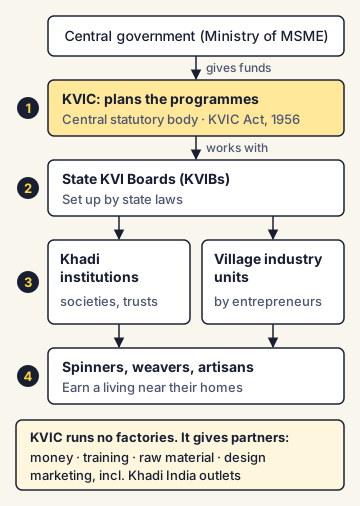
- At the top, KVIC plans programmes and gets money from the central government.
- It works with State Khadi and Village Industries Boards (KVIBs), which are set up by state laws.
- On the ground, registered khadi institutions (societies and trusts) employ spinners and weavers, and individual entrepreneurs set up village units.
- KVIC gives them money, training, raw material support, design help and marketing help, including sales through Khadi India outlets and exhibitions.
The Act asks KVIC to prepare three separate budgets every year: a khadi budget, a village industries budget and a general budget.
Which schemes does KVIC run?
The biggest is the Prime Minister's Employment Generation Programme (PMEGP), for which KVIC is the national nodal agency. KVIC also supports khadi artisans through marketing help for khadi sales, and helps run clusters of traditional industries. It also runs activity-based programmes such as giving bee boxes to beekeepers and electric potter's wheels to potters, so that artisans earn more from the same work.
India's experience and results
For FY 2024-25, KVIC reported its highest-ever turnover of about ₹1,70,551 crore (₹1.70 lakh crore) from khadi and village industry products, up from about ₹31,154 crore in 2013-14. Sales of khadi garments alone were about ₹7,146 crore in 2024-25. KVIC said the cumulative employment linked to its sector reached about 1.94 crore people in 2024-25.
"Cumulative" means the total number of people working in units it has supported over time, not new jobs in one year. KVIC set a sales target of ₹2 lakh crore for 2025-26.
Commonly confused concepts
- KVIC vs KVIB: KVIC is a central body made by a central Act (1956). A KVIB is a state body made by a state law. KVIC funds and guides; KVIBs work within each state.
- Khadi vs handloom: All khadi is woven on handlooms, but not all handloom cloth is khadi. Khadi also needs hand-spun yarn. Handloom cloth can use mill-spun yarn.
- KVIC vs Ministry of Textiles: Khadi falls under the Ministry of MSME through KVIC. Handloom and powerloom fall under the Ministry of Textiles.
- Statutory body vs constitutional body: KVIC comes from an Act of Parliament, so it is statutory. A constitutional body, such as the Election Commission, is created by the Constitution itself.
- Village industry vs micro enterprise: A village industry is defined by location (rural, population up to 20,000) and capital per worker (₹1 lakh). A micro enterprise under the MSME Act is defined by total investment and turnover of the business.
Issues, criticism and the way forward
- Old definitions: The Act was last changed in 2006. The ₹1 lakh capital limit per worker and the population rule look outdated to many. The Ministry of MSME has been working on a fresh amendment, including aligning the village industry definition with the MSME definition based on investment and turnover.
- Low earnings of spinners and weavers: Hand-spinning is slow and pays little. Many artisans, mostly women, earn far less than other workers, so young people do not join.
- Fake khadi: Mill-made or powerloom cloth is sometimes sold as khadi. This cheats buyers and hurts genuine artisans. Stronger quality checks and certification are needed.
- Survival of PMEGP units: Studies have raised doubts about how many units set up under PMEGP keep running after a few years. Better training, handholding and physical checks of units are often suggested.
- Overlap and governance: KVIC, KVIBs, DICs and other agencies sometimes do similar work. Clear roles, better data and digital tracking can reduce waste.
- Way forward: Commonly suggested steps include modern design and branding of khadi, online sales, better tools that raise artisans' output, and more representation of women and weaker sections in KVIC's own structure.
Concepts to Know
- Statutory body: An organisation created by a law passed by Parliament or a state legislature. Its powers come from that law.
- Nodal agency: The main agency put in charge of running a scheme and coordinating all other agencies involved. It is like the class monitor who collects work from everyone and reports to the teacher.
- Swadeshi: The freedom-movement idea of using goods made in India, to support Indian workers and to protest against British goods.
- Turnover: The total value of sales in a year. It is not profit; costs are not removed.
- Ex officio member: A person who becomes a member automatically because of the post they hold, for example the SBI Chairman.
- KVIC Act, 1956; KVIC formed in April 1957; took over from the All India Khadi and Village Industries Board (1953)
- Statutory body under the Ministry of MSME; head office Mumbai; six zonal offices
- Act amended in 1987 and 2006 (2006 amendment in force from 15 May 2006)
- Rural area: village or town with population up to 20,000 (raised from 10,000 in 2006)
- Village industry: fixed capital investment per artisan/worker up to ₹1 lakh
- Khadi: handloom-woven cloth from hand-spun cotton, silk or woollen yarn, both done in India
- Members: 6 zonal non-official members + 4 expert members + SBI Chairman (or nominee) + CEO + Financial Adviser; Chairman chosen from the zonal members, full time
- National nodal agency for PMEGP since 2008
- FY 2024-25 turnover: about ₹1.70 lakh crore; khadi garment sales about ₹7,146 crore; cumulative employment about 1.94 crore
● Tracked since May 07, 2026 · last seen October 28, 2026 · updates as the daily brief publishes