Kesariya Stupa
The Tallest Excavated Buddhist Stupa
The Kesariya Stupa is a huge brick Buddhist stupa at Kesariya in the East Champaran district of Bihar, about 110 km north-west of Patna. A stupa is a dome-shaped structure built to honour the Buddha or to keep his relics or belongings. Kesariya is about 31.5 to 32 metres (about 104 feet) tall, and is often called the tallest excavated Buddhist stupa in the world. It is a centrally protected monument under the ASI.
Why is it important?
Kesariya is linked to the last journey of the Buddha. According to Buddhist tradition, after the Buddha announced at Vaishali that his end (Mahaparinirvana) was near, he set out for Kushinagar. The Licchavis of Vaishali, who loved him, followed him and did not want to let him go. At Kesariya, he persuaded them to go back and gave them his alms bowl (begging bowl) as a memento.
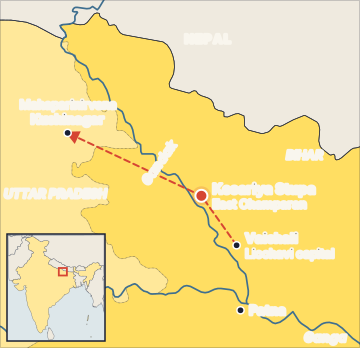
The stupa is believed to mark this event. So it is a place of deep meaning for Buddhists, and it is part of the Buddhist circuit in Bihar along with Bodh Gaya, Rajgir, Nalanda and Vaishali.
Where did it come from? The history
- Earliest phase: Many scholars think the first stupa here goes back to around the 3rd century BCE, the time of Ashoka; remains of an Ashokan pillar capital have been reported from the site. The ASI dates an early phase to the Sunga-Kushana period (around the 1st-2nd century CE).
- Main phase: The big terraced structure seen today was mainly built and enlarged around the Gupta period (about the 5th-6th century CE), with later additions.
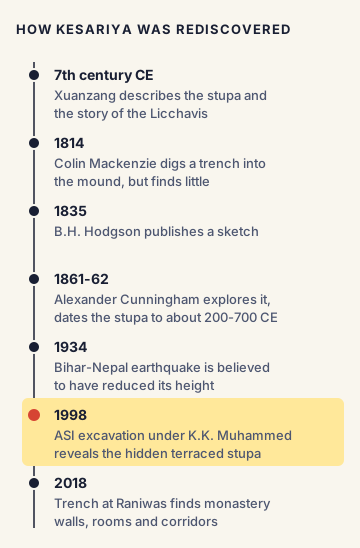
- Chinese travellers: Faxian (Fa-Hien), who visited India in the early 5th century CE, mentions a pillar here. Xuanzang (Hiuen Tsang), in the 7th century CE, described the stupa and the story of the Licchavis.
- Local name: Local people called the mound "Raja Ben ka Deora", after a legendary great king called Raja Ben Chakravarti.
How was it rediscovered?
- In 1814, Colonel Colin Mackenzie had a trench dug into the mound, but found little.
- In 1835, Brian Houghton Hodgson published a sketch of it.
- In 1861-62, Alexander Cunningham explored and excavated the site. He dated the visible stupa to about 200-700 CE and believed it was built over the ruins of an older one. Near it, at a mound called Raniwas, he found a temple with a colossal Buddha image and a monastery, and suggested it was a large vihara (monastery) connected with the stupa.
- In 1998, the ASI began proper excavation under archaeologist K.K. Muhammed. This revealed the terraced stupa that was hidden under earth and jungle. Work has continued in phases since then. In 2018, a trench at Raniwas found walls, rooms and corridors of a monastery.
How is it built? The key features
- It is made of brick, on a polygonal base, with several circular terraces rising one above another, like a stepped cake.
- Its base circumference is about 400 feet (around 120 metres).
- The terraces have small cells (shrines) at regular intervals. Large stucco (lime plaster) images of the Buddha sat in these cells, many showing the bhumisparsha mudra (touching the earth) and the dhyana mudra (meditation).
- A tall solid brick tower once rose from the top.
- The 1934 Bihar-Nepal earthquake is believed to have reduced its height; some sources say it was about 123 feet tall before that.
Kesariya and Borobudur
Kesariya is often compared with Borobudur in Java, Indonesia, the world's largest Buddhist monument. Both are terraced, mandala-shaped monuments with Buddha images in niches, built on raised ground, and the top of each cannot be seen from the ground. Scholars see the similarities as a sign of contact between eastern India (under the Pala kings) and the Srivijaya kingdom of South-East Asia.
Commonly confused concepts
- Kesariya vs Vaishali: Vaishali was the Licchavi capital, where the Buddha preached often and announced his coming end. Kesariya is the place, on the road towards Kushinagar, where he gave the Licchavis his alms bowl.
- Kesariya vs Sanchi: The Great Stupa at Sanchi (Madhya Pradesh), built in Ashoka's time and enlarged later, is a UNESCO World Heritage Site famous for its stone gateways (toranas). Kesariya is a brick stupa famous for its height and terraces, and is not on the World Heritage List.
- Relic stupa vs memorial stupa: A relic (saririka) stupa holds bodily remains of the Buddha. A stupa like Kesariya, linked to an object he used (his bowl), is called a paribhogika stupa.
- Mudras: Bhumisparsha (right hand touching the earth, the moment of enlightenment) is different from dhyana (both hands in the lap, meditation) and dharmachakra (hands turning the wheel, the first sermon).
Issues, criticism and the way forward
- Incomplete excavation: Large parts of the stupa and its surroundings, including Raniwas, are still not fully excavated.
- Damage to images: Many stucco Buddha images were damaged over centuries, and exposed brick needs constant care against rain and plants.
- Tourism gap: Despite its fame, Kesariya receives far fewer visitors than Bodh Gaya, because of weak roads, facilities and promotion.
- Way forward: Experts suggest completing scientific excavation of the whole complex, careful conservation of brick and stucco, a site museum, and linking Kesariya better into the Buddhist circuit.
Concepts to Know
- Stupa: A dome-shaped Buddhist monument built to hold relics or to mark a holy event.
- Mahaparinirvana: The final passing away of the Buddha at Kushinagar, after which he is believed to be free from the cycle of rebirth.
- Licchavis: A powerful clan of ancient India with its capital at Vaishali, part of the Vajji confederacy, often seen as an early republic (gana-sangha).
- Vihara: A Buddhist monastery where monks lived and studied.
- Stucco: Fine lime plaster used to make sculptures and decorations on walls.
- Location: Kesariya, East Champaran district, Bihar; about 110 km north-west of Patna
- Height: about 31.5-32 m (about 104 ft); circumference about 400 ft
- Legend: Buddha gave his alms bowl to the Licchavis of Vaishali here
- Main phase: Gupta period (5th-6th century CE); earlier Sunga-Kushana phase; possible Ashokan origin
- Mentioned by Faxian (5th century) and Xuanzang (7th century)
- Explored by Cunningham (1861-62); excavated by ASI under K.K. Muhammed from 1998
- Local name of the mound: Raja Ben ka Deora
- Compared with Borobudur (Java, Indonesia)
● Tracked since November 07, 2026 · last seen November 07, 2026 · updates as the daily brief publishes