Integrated Check Posts (ICPs) and Land Ports Authority of India (LPAI)
An Integrated Check Post (ICP) is a modern land border crossing where all the government checks on people and goods happen inside one fenced complex. Immigration, customs, security, plant and animal health checks, warehouses, parking and banking are all in one place. India calls these complexes land ports. They are built and run by the Land Ports Authority of India (LPAI), a statutory body under the Ministry of Home Affairs.
Why does India need ICPs?
India shares land borders with Pakistan, Nepal, Bhutan, Bangladesh, Myanmar, China and Afghanistan. For a long time, trucks and travellers crossed at old Land Customs Stations with poor roads, little parking and offices spread far apart. A truck could wait for days. Each agency (customs, immigration, security) worked separately, so there was no single owner of the crossing.
Think of an old bus stand where every counter is in a different lane, versus a modern airport where everything is under one roof. ICPs try to turn border crossings into that "one roof" model, so trade becomes faster and cheaper and security becomes stronger.
Where did the idea come from?
- In 2003, a Committee of Secretaries recommended setting up ICPs at India's land borders as single-window facilities housing immigration, customs, border security and other agencies.
- Parliament passed the Land Ports Authority of India Act, 2010. The Bill was introduced in Lok Sabha on 7 August 2009, passed by Lok Sabha on 6 May 2010 and by Rajya Sabha on 19 August 2010.
- The LPAI came into being on 1 March 2012.
- The first ICP, at Attari (Amritsar, Punjab) on the Pakistan border, became operational on 13 April 2012.
What does the LPAI do?
The 2010 Act gives the Authority the job of managing facilities for the movement of passengers and goods at border points that the central government notifies as ICPs. Its main functions are:
- building and maintaining roads, terminals and other buildings inside an ICP (but not National Highways, State Highways or railways, which belong to other authorities);
- providing warehouses, container depots and cargo-handling equipment;
- giving space to immigration, customs, security and tax authorities to work from;
- setting up communication and security equipment, and facilities like rest rooms and eateries;
- charging fees and rent for its services, and borrowing (with central government approval) to build new facilities.
The Authority is headed by a Chairperson, and it includes members from government along with representatives of traders and workers.
How does an ICP work, step by step?
Picture a truck carrying goods from Bihar to Nepal.
- The truck enters the ICP and is parked in a fixed bay instead of on the highway.
- Customs officers check the papers and goods; cargo can be scanned or unloaded in a warehouse.
- Quarantine officers check plant or animal products if needed.
- Security agencies check the vehicle and driver.
- The cleared truck crosses to the matching check post on the other side.
Travellers similarly pass immigration and security in a passenger terminal. Since 9 June 2026, India's land ports also use a digital platform, the Land Port Management System (LPMS), named "Vinimay". It handles cargo and passenger processing online and links with the customs portal ICEGATE and the logistics platform ULIP (Unified Logistics Interface Platform). When it was launched in June 2026, India had 15 operational land ports, and the government said 11 more land ports would become operational over the next two to three years.
Important ICPs to know
The ICPs that LPAI runs include:
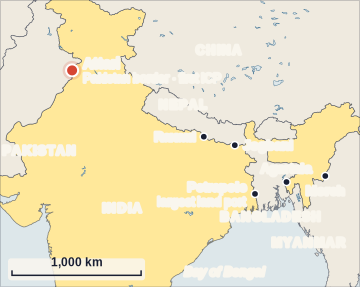
- Attari (Punjab), Pakistan border: India's first ICP (2012).
- Petrapole (West Bengal), Bangladesh border: often described as the largest land port in South Asia; it handles the biggest share of India-Bangladesh land trade.
- Agartala (Tripura), Sutarkandi (Assam), Srimantapur (Tripura) and Dawki (Meghalaya): Bangladesh border.
- Raxaul and Jogbani (Bihar) and Rupaidiha (Uttar Pradesh): Nepal border.
- Moreh (Manipur): Myanmar border.
- Passenger Terminal Building at Dera Baba Nanak (Gurdaspur, Punjab): the Indian end of the Kartarpur Sahib Corridor, opened in November 2019, which lets Indian pilgrims visit Gurdwara Darbar Sahib in Kartarpur, Pakistan.
India's ICPs with Nepal
India has also built check posts on Nepal's side of the border with Indian funding. Under an understanding reached in 2005, four such ICPs were planned in Nepal: Birgunj, Biratnagar, Nepalgunj and Bhairahawa.
- Birgunj (opposite Raxaul): opened in April 2018.
- Biratnagar (opposite Jogbani): opened in January 2020, built at a cost of about ₹140 crore.
- Nepalgunj (opposite Rupaidiha): came into operation in May 2024.
- Bhairahawa (opposite Sunauli, Uttar Pradesh): planned.
Each pair works like two halves of one bridge: the Indian ICP on one side and the matching check post on the other.
Who guards which land border?
The ICP is the crossing point, but the border itself is guarded by different forces:
- Border Security Force (BSF): Pakistan and Bangladesh borders.
- Sashastra Seema Bal (SSB): Nepal and Bhutan borders.
- Assam Rifles: Myanmar border.
- Indo-Tibetan Border Police (ITBP): China border.
Commonly confused concepts
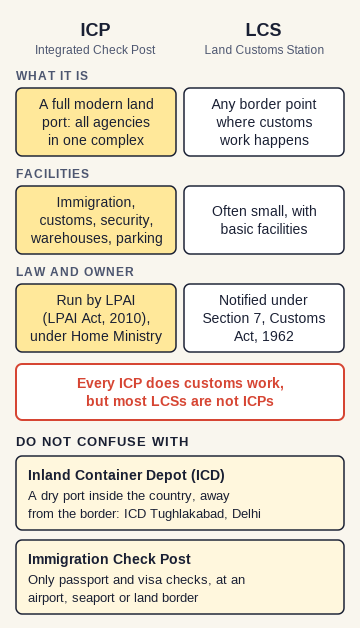
- ICP vs Land Customs Station (LCS): An LCS is any land border point where customs work happens; it is notified under Section 7 of the Customs Act, 1962. Many LCSs are small and have basic facilities. An ICP is a full, modern complex with all agencies and facilities together, run by the LPAI. Every ICP does customs work, but most LCSs are not ICPs.
- ICP vs Inland Container Depot (ICD): An ICD (also called a dry port) is a cargo yard inside the country, away from the border and from seaports, where customs clearance of goods is done. An example is ICD Tughlakabad in Delhi. An ICP sits on the border itself.
- Integrated Check Post vs Immigration Check Post: Both are shortened to "ICP". An Immigration Check Post is only the point where passports and visas are checked, at an airport, seaport or land border. An Integrated Check Post is a complete land port that includes immigration and much more.
- LPAI vs Indian Ports Association / seaport authorities: LPAI works only on land borders. Seaports are run by Major Port Authorities and state maritime boards.
Issues, criticism and the way forward
- Congestion and delays: Busy ports like Petrapole still see long truck queues, because traffic has grown faster than parking and warehouse space.
- Uneven use: Some ICPs carry little trade because of politics. Trade through Attari has been very low since 2019, after India raised customs duty on Pakistani goods to 200% and Pakistan suspended bilateral trade.
- Mismatch across the border: An ICP works well only if the facility on the other side is equally good, with matching hours and procedures. Poor roads on either side reduce the benefit.
- Coordination: Many agencies still work in their own systems. Digital tools such as LPMS "Vinimay" and links with ICEGATE aim to bring them onto one platform.
- Way forward: Experts suggest more ICPs at busy crossings, joint or "single-stop" checking with neighbours, better rail links to land ports, and regional transport deals such as the BBIN Motor Vehicles Agreement (Bangladesh, Bhutan, India, Nepal, signed in 2015) so trucks can move across borders without reloading.
Concepts to Know
- Statutory body: An organisation created by a law passed by Parliament (here, the LPAI Act, 2010). Its powers come from that law.
- Customs: The government department that checks goods entering or leaving the country and collects duties (taxes) on them.
- Quarantine check: An inspection of plants, seeds, animals or animal products to stop pests and diseases from entering the country.
- Transit trade: Goods that pass through one country on their way to or from another. Nepal's imports from Japan, for example, land at an Indian port and travel through India to Nepal.
- ICEGATE: The online portal of Indian Customs where traders file their import and export papers and pay duties.
- ULIP (Unified Logistics Interface Platform): A government digital platform that joins data from many transport and logistics systems so goods can be tracked in one place.
- Committee of Secretaries recommended ICPs: 2003
- Land Ports Authority of India Act, 2010 (Rajya Sabha passed it on 19 August 2010); LPAI set up on 1 March 2012; under the Ministry of Home Affairs
- First ICP: Attari (Punjab), operational 13 April 2012
- LPAI does not build National Highways, State Highways or railways inside ICPs
- Land Port Management System "Vinimay" launched 9 June 2026; at launch, India had 15 operational land ports; 11 more land ports to become operational over the next two to three years
- Nepal-side ICPs built with Indian help: Birgunj (2018), Biratnagar (2020), Nepalgunj (2024); Bhairahawa planned
- Kartarpur Sahib Corridor and the Dera Baba Nanak passenger terminal: opened November 2019
- Land Customs Stations notified under Section 7, Customs Act, 1962
● Tracked since November 23, 2026 · last seen November 23, 2026 · updates as the daily brief publishes