Insurance Distribution in India
Agents, Brokers, Bancassurance and Commissions
Insurance distribution means the ways in which insurance reaches the buyer. Most people do not walk into an insurance company's office to buy a policy. Instead, a seller reaches them: an agent, a bank, a broker, a car dealer or a website. These sellers are called intermediaries, and they are usually paid a commission, a share of the premium the customer pays.
Why does distribution matter?
Insurance is a product people need but rarely go looking for. Nobody wakes up wanting to think about death or illness. So sellers play a big role in reaching people, especially in villages and small towns. But the same commission that motivates a seller can also tempt them to sell the wrong product, or to sell where it is not needed. That is why the rules around distribution decide whether customers are protected or exploited.
Who sells insurance? The main channels
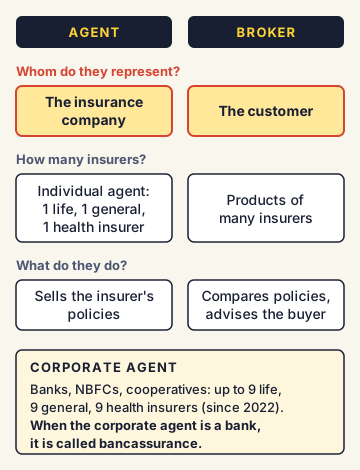
- Individual agents: People licensed to sell for an insurer. They represent the insurance company. Under the agent regulations, an individual agent can work for only one life, one general and one health insurer at a time.
- Corporate agents: Companies such as banks, NBFCs and cooperative societies that sell insurance. Since 2022, a corporate agent can tie up with up to nine life, nine general and nine health insurers.
- Bancassurance: Insurance sold through banks, acting as corporate agents. Banks have many customers and branches everywhere, so this has become one of the biggest channels, especially for life insurance.
- Brokers: Licensed firms that represent the customer, not the insurer. They compare products from many insurers and advise the buyer.
- Web aggregators: Websites that let you compare policies online.
- Insurance Marketing Firms (IMFs) and Point of Sales Persons (POSPs): Smaller sellers who mostly sell simple products.
- Motor Insurance Service Providers (MISPs): Mostly car and bike dealers who sell motor insurance when you buy a vehicle.
- Direct sales: Buying straight from the insurer, often online, with lower costs.
How do commissions work?
When you pay a premium, part of it goes to the seller as commission, part to the insurer's running costs, and the rest to the pool that pays claims. All selling and running costs together are called Expenses of Management (EoM). Imagine a ₹100 premium. If ₹30 goes on commission and running costs, only ₹70 is left to cover risk and give returns. So high commissions mean either costlier policies or poorer value for the customer.
How have the rules changed?
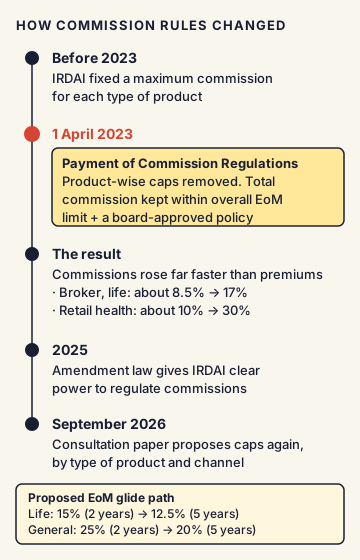
- Before 2023: IRDAI fixed a maximum commission for each type of product. For example, an agent could get only a set percentage on a given policy.
- From 1 April 2023: The IRDAI (Payment of Commission) Regulations, 2023 removed these product-wise caps. Instead, each insurer had to keep total commission within its overall EoM limit and follow a board-approved policy (a policy approved by its board of directors). The aim was to give insurers freedom to innovate and reach new markets.
- The result: IRDAI's own data later showed commissions rising far faster than premiums. Average broker commission in life insurance doubled from about 8.5% to 17%, and retail health commissions went from about 10% to about 30%.
- 2025-26: The 2025 amendment law gave IRDAI clear power to regulate commissions. The September 2026 consultation paper proposes to bring caps back, linked to the type of product and channel.
What is mis-selling?
Mis-selling means selling a product that does not suit the buyer, or hiding important facts about it. Common examples:
- Selling a long-term insurance-cum-investment plan as if it were a fixed deposit.
- Forcing a borrower to buy insurance to get a loan sanctioned, often from the lender's own partner insurer, with the premium added to the loan.
- Selling a policy whose premiums the buyer cannot keep paying.
How do we know mis-selling is happening? Persistency
The persistency ratio is the share of policies still active (premiums still being paid) after a set time, such as 13 or 61 months. Low persistency suggests buyers did not want or understand the policy. IRDAI's data shows 61st-month persistency of only about 48% for traditionally sold policies, against about 71% for policies bought online. In simple words, people who choose a policy themselves tend to keep it.
India's position and recent steps
- Free look period of 30 days lets a buyer return a life or health policy.
- Bima Sugam, launched by the Bima Sugam India Federation on 17 September 2025, is building one online platform to compare and buy policies from all insurers, which could reduce the need for high-cost middlemen.
- Rural and social sector obligations require insurers to sell a share of policies in villages and to weaker sections, which is why rural distribution costs are a key part of the debate.
Commonly confused concepts
- Agent vs broker: An agent represents the insurer. A broker represents the customer.
- Corporate agent vs bancassurance: Bancassurance is when the corporate agent is a bank. All banks selling insurance are corporate agents, but not all corporate agents are banks.
- Commission vs Expenses of Management: Commission is what the seller earns. EoM is the insurer's total cost of selling and running the business, which includes commission.
- Free look period vs grace period: The free look period (30 days) lets a new buyer cancel a policy. The grace period is extra time given after a premium's due date to pay without the policy lapsing.
Issues, criticism and the way forward
- Customer side: High commissions raise costs and encourage mis-selling, which hurts trust in insurance.
- Industry side: Brokers and agents argue that caps could make it unprofitable to sell in villages, where reaching each customer costs more. Some insurers say tight expense limits may favour big companies over small ones.
- Lenders: Banks and NBFCs earn fee income from bundled insurance, so a bundling ban hits that income.
- Way forward: Experts suggest paying more commission on renewals than in the first year (so sellers care about persistency), clawing back commission on proven mis-selling, full disclosure of commission to the buyer, a public record of sellers' conduct, and cheaper digital buying through Bima Sugam.
Concepts to Know
- Intermediary: A middleman who connects the seller (the insurer) and the buyer (the customer).
- Clawback: Taking back money already paid, for example recovering a commission if a sale turns out to be mis-selling.
- Board-approved policy: A set of internal rules approved by a company's board of directors, which the company must follow.
- Bundling: Selling two products together, such as a loan and an insurance policy, often without giving the buyer a real choice.
- Lapse: When a policy stops because premiums are not paid.
- Product-wise commission caps removed from 1 April 2023 (IRDAI Payment of Commission Regulations, 2023); commission kept within overall EoM limits and a board-approved policy
- Corporate agents (including banks): up to 9 life, 9 general and 9 health insurer tie-ups (since 2022)
- Individual agent: one life, one general and one health insurer
- Agent represents insurer; broker represents customer
- Free look period: 30 days (2024 regulations)
- 61st-month persistency: about 48% (traditional sales) vs about 71% (online)
- Proposed EoM glide path: life 15% (2 years) → 12.5% (5 years); general 25% (2 years) → 20% (5 years)
● Tracked since October 03, 2026 · last seen October 03, 2026 · updates as the daily brief publishes