Industries (Development and Regulation) Act, 1951
The Industries (Development and Regulation) Act, 1951, or IDR Act, is the main law that lets the Central Government control and develop important industries in India. Under it, certain kinds of factories can be set up only after getting a licence from the Centre. Today only a few industries still need this licence, such as defence equipment, explosives, hazardous chemicals, tobacco products and alcoholic drinks. For these, the IDR Act is the gatekeeper.
Why does this law exist?
After independence, India had very little money and very few factories. Leaders wanted the country's limited money, steel, power and foreign exchange to go to the industries the nation needed most, not just to whatever made quick profit. So the government decided it should decide who could open which factory, where, and how big. A licence was the tool for this. Think of it like a school principal deciding which clubs can use the only hall, so that the most important activities get it first.
Where does the Centre get the power?
Under the Constitution, "industries" are mainly a State subject (Entry 24 of the State List). But Entry 52 of the Union List lets Parliament take control of any industry if it declares by law that this control is "expedient in the public interest" (useful for the public good). Section 2 of the IDR Act makes exactly this declaration for all industries listed in its First Schedule. That is why the Centre, and not the states, licenses these industries.
Where did it come from?
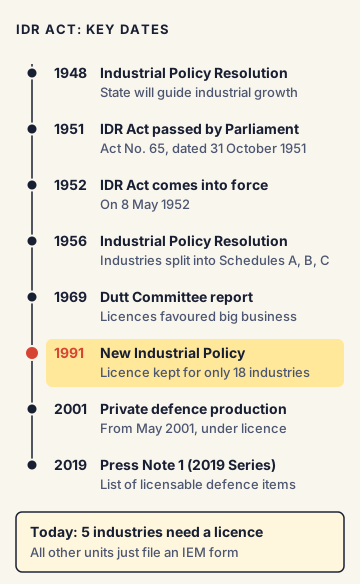
- The Industrial Policy Resolution of 1948 first said the state would guide industrial growth.
- Parliament then passed the IDR Act as Act No. 65 of 1951, dated 31 October 1951. It came into force on 8 May 1952.
- The Industrial Policy Resolution of 1956 divided industries into three groups (Schedule A, B and C), with Schedule A reserved for the public sector. The IDR Act became the main tool to enforce this plan.
- Over the next decades, licences became very hard to get. Businesses needed many permissions for even small changes. People started calling this system the "Licence Raj".
- The Hazari Committee (report around 1967) and the Dutt Committee (Industrial Licensing Policy Inquiry Committee, report in 1969, chaired by Subimal Dutt) found that licensing was not achieving its goals and that big business houses were getting an unfair share of licences.
- The New Industrial Policy of 24 July 1991 ended licensing for almost all industries. Only 18 industries kept compulsory licensing. This list was cut further over the years.
What does a company need a licence for?
The licence rules sit mainly in these sections:
- Section 11: No one other than the Central Government can set up a new industrial undertaking (a factory or business unit) in a scheduled industry without a licence from the Centre.
- Section 11A: A licence is also needed to make a "new article" (a product the unit was not allowed to make before).
- Section 13: A licence is needed for "substantial expansion" (a big increase in production capacity) or for changing the location of a unit.
- Section 10: Existing undertakings must register with the government.
Which industries still need a licence today?
Only 5 industries remain under compulsory licensing:
- Distillation and brewing of alcoholic drinks
- Cigars and cigarettes of tobacco and manufactured tobacco substitutes
- Electronic aerospace and defence equipment of all types
- Industrial explosives, including detonating fuses, safety fuses, gunpowder, nitrocellulose and matches
- Specified hazardous chemicals
There is also a location rule. A unit generally needs a licence if it is within 25 km of the city limits of a city with a population of more than 10 lakh (1 million), unless it is in an area marked for industry or is a non-polluting unit. Everything else only needs to file an Industrial Entrepreneur Memorandum (IEM), a simple form that tells the government about the project.
How does the government control an industry beyond licensing?
The Act gives the Centre strong powers over scheduled industries:
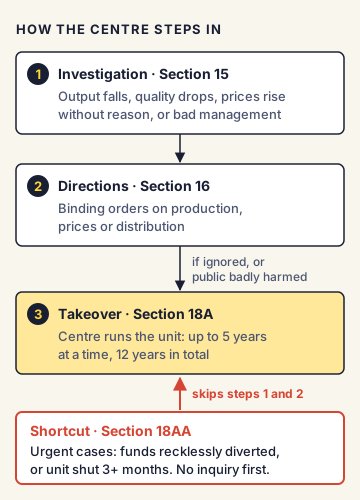
- Investigation (Section 15): The Centre can order an inquiry if production falls sharply without reason, quality drops, prices rise without reason, or the unit is badly managed.
- Directions (Section 16): After the inquiry, the Centre can give binding orders on production, prices or distribution.
- Takeover of management (Section 18A): If the directions are ignored, or the unit is managed in a way that badly harms the public, the Centre can take over its management. The order can last up to 5 years at a time, with a total limit of 12 years.
- Takeover without investigation (Section 18AA): In urgent cases, such as reckless diversion of funds or a unit closed for at least three months, the Centre can act without a full inquiry first.
- Advisory bodies: The Act allows a Central Advisory Council (Section 5) with a chairman and up to 30 members representing owners, workers and consumers. It also allows Development Councils (Section 6) for individual industries.
- Exemptions (Section 29B): The Centre can exempt units or industries from the Act, for example to help small industries.
- Penalty (Section 24): Breaking the Act can mean jail of up to 6 months, a fine of up to ₹5,000, or both, plus up to ₹500 per day if the offence continues.
How does defence licensing work under the IDR Act?
Defence is entry 37 ("Defence industries: arms and ammunition") of the First Schedule. India opened defence production to private companies in May 2001. Since then, private firms need a licence to make defence items.
- The list of defence items that need a licence is set by the Department of Defence Production (Ministry of Defence) and issued by DPIIT as Press Note 1 (2019 Series). It includes items such as tanks and armoured vehicles, defence aircraft, unmanned aerial vehicles (drones), military missiles and warships.
- Parts and components that are not on this list do not need an industrial licence (clarified by Press Note 2 of 2019).
- The licence is valid for 15 years, and can be extended by another 3 years case by case. Earlier the validity was only 3 years.
- Some arms and ammunition also need a licence under the Arms Act, 1959, which is a Home Ministry law. The Ministry of Home Affairs has delegated (handed over) many of these powers to DPIIT, so that one office handles most defence licences. Small arms and their ammunition up to 12.7 mm calibre stay with the Home Ministry.
- Applications are made online through the National Single Window System and DPIIT's licensing portal. The Ministry of Defence and the Ministry of Home Affairs give their views, mainly on security, before a licence is issued.
India's position and Indian examples
Licensing today is a light, targeted tool, not the heavy Licence Raj of the past. Its biggest use now is in defence, where the state wants to know who is making sensitive equipment and to keep security checks in place. Private firms making drones, radars, navigation systems and other military equipment hold IDR licences. The government links this licensing with its push for self-reliance in defence (Atmanirbhar Bharat), the Positive Indigenisation Lists and defence industrial corridors in Uttar Pradesh and Tamil Nadu.
Commonly confused concepts
- IDR Act, 1951 vs Arms Act, 1959: The IDR Act is an industrial law run by the Commerce and Industry Ministry. It controls who can set up a factory in listed industries. The Arms Act is a security law run by the Home Ministry. It controls making, selling and owning arms and ammunition. Some defence items need licences under both.
- Industrial licence vs IEM: A licence is a permission you must get before you start. An IEM is just an information form you file for industries that do not need a licence.
- IDR Act vs MMDR Act, 1957: The IDR Act regulates manufacturing industries. The Mines and Minerals (Development and Regulation) Act, 1957 regulates mining. Both use the same "Union control in public interest" idea from the Union List (Entries 52 and 54).
- Licensing vs public sector reservation: Licensing means private firms can enter, but only with permission. Reservation means only the government can run that industry at all. After 1991, reservation shrank to a very small list (atomic energy and railway operations).
Issues, criticism and the way forward
- History of delay and favouritism: The Licence Raj slowed growth, encouraged corruption and protected big players. The 1991 reforms removed most of it, but the old law still exists with wide powers.
- Outdated penalties: A maximum fine of ₹5,000 is very small today, so it does not really deter anyone.
- Overlap and confusion: Defence firms deal with DPIIT, the Department of Commerce, the Ministry of Defence and the Home Ministry. Confusion over which body issues which licence can slow projects. Clear single-window rules help.
- Security vs ease of business: The government must check who is making weapons and where. But too many checks can discourage new companies and startups. Experts suggest faster time-bound approvals while keeping security vetting strong.
- Way forward: Many experts suggest updating the old law, shortening the licensable list even further where safe, and making all approvals fully online with fixed timelines.
Concepts to Know
- Industrial licence: A written permission from the government that allows a company to set up or expand a factory in an industry that the law controls.
- First Schedule: The list at the end of the IDR Act that names all the industries under Central control. It has 38 headings, from metallurgy to defence.
- Licence Raj: A popular name for the strict system of licences and permits that controlled Indian industry from the 1950s to 1991.
- Union List, Entry 52: An entry in the Seventh Schedule of the Constitution. It lets Parliament take control of any industry by declaring that this is in the public interest.
- Press Note: An official notice issued by DPIIT to explain or change industrial or investment policy.
- National Single Window System (NSWS): A government website where investors can apply for many approvals in one place instead of visiting many offices.
- Act No. 65 of 1951; came into force on 8 May 1952
- Constitutional basis: Entry 52, Union List; declaration in Section 2 of the Act
- Section 11: licence for new undertakings; Section 11A: new articles; Section 13: substantial expansion and change of location
- Section 18A: takeover of management, up to 5 years at a time, 12 years in total
- Section 24: up to 6 months' jail, fine up to ₹5,000, or both
- New Industrial Policy, 24 July 1991: licensing kept only for 18 industries; now only 5 remain
- Defence licensable items: Press Note 1 (2019 Series); licence valid 15 years, extendable by 3 years
- Defence production opened to the private sector in May 2001
● Tracked since November 14, 2026 · last seen November 14, 2026 · updates as the daily brief publishes