India-US Counter-Narcotics Cooperation
India-US counter-narcotics cooperation is the set of agreements and regular meetings through which the two countries work together against drug trafficking. It covers sharing intelligence, joint action against cartels, control of precursor chemicals, safe medicine supply chains, and treatment of people who use drugs. It has grown from a working group into a broad "drug policy framework" over the last few years.
Why do the two countries need each other?
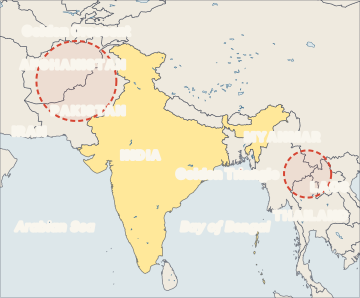
The US faces a deadly crisis of overdose deaths, driven mostly by illegal fentanyl. India is one of the world's largest makers of medicines and chemicals, so it matters a great deal where Indian chemicals end up. India, in turn, sits between the two big opium-growing regions of Asia (the Golden Crescent to its west and the Golden Triangle to its east), and faces drugs entering by land, sea and post.
Both countries also face drugs sold online and paid for with cryptocurrency. No country can track such networks alone, because they cross borders.
Where did it come from?
The cooperation has grown in stages:
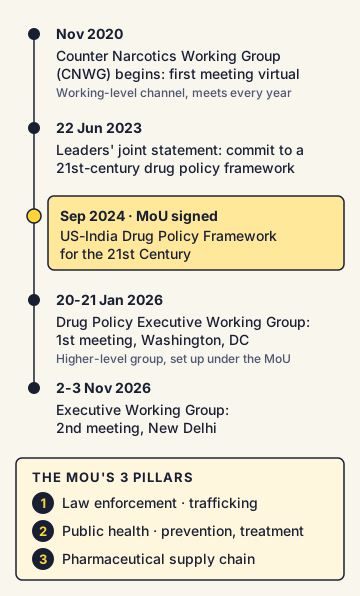
- Counter Narcotics Working Group (CNWG), 2020: The two countries began a bilateral working group on counter-narcotics in 2020. Its first meeting was held virtually in November 2020. It met every year after that; the fourth meeting was in Washington in July 2023 and the fifth in New Delhi in October 2024.
- Leaders' commitment, June 2023: In a joint statement on 22 June 2023, the leaders of both countries committed to a broader and deeper bilateral drug policy framework for the 21st century.
- Drug Policy Framework MoU, September 2024: The two countries signed a Memorandum of Understanding (MoU) in September 2024 to launch the US-India Drug Policy Framework for the 21st Century.
- Drug Policy Executive Working Group, 2026: A higher-level group was set up under the framework. Its first meeting was in Washington, DC, on 20 and 21 January 2026, and its second in New Delhi on 2 and 3 November 2026.
What are the three pillars of the framework?
- Pillar One, law enforcement: fight the illegal making and trafficking of drugs and their precursor chemicals. This includes sharing information for cases, real-time sharing of seizure data, joint training of narcotics officers, securing postal and courier systems, and tracking drug trade on websites, encrypted apps, social media and the dark net, along with the money behind it.
- Pillar Two, public health: prevention, treatment and rehabilitation of drug users. This includes training addiction-treatment workers, student and faculty exchanges, youth prevention programmes, telemedicine, and research, including on traditional medicine for addiction.
- Pillar Three, pharmaceutical supply chain: keep the medicine supply chain safe and growing. This includes monitoring dual-use raw materials, preventing diversion of legal medicines, fighting fake medicines, working with private companies, and sharing customs and shipping information.
Who represents each side?
- India: The Narcotics Control Bureau (NCB) leads. It was set up on 17 March 1986 under the NDPS Act, 1985, and works under the Ministry of Home Affairs. It is India's nodal agency for drug law enforcement and for coordination with other countries.
- United States: The Office of National Drug Control Policy (ONDCP), part of the White House, leads. It sets the US national drug control strategy. US enforcement agencies such as the Drug Enforcement Administration (DEA) also take part.
What is a "network-centric" approach?
Traditional drug policing counts seizures and arrests of carriers. But a carrier is easy to replace. A network-centric approach follows the money, the chemical suppliers, the financiers and the logistics, so that the whole organisation is broken, not just one link. India's roadmap for narcotics control for 2026 to 2029 puts this at the centre, along with precursor control, financial investigations and demand reduction.
The US "Majors List"
Every year, the US President sends Congress a list of "major drug transit or major illicit drug producing countries". India has appeared on it; the list for fiscal year 2026 (issued in September 2025) named 23 countries, including India. The US document itself says a country's presence on the list does not necessarily reflect its government's counter-drug efforts or cooperation with the US. This is different from being judged to have "failed demonstrably" in meeting counter-narcotics obligations; India was not among the countries flagged for failure.
Commonly confused concepts
- MoU vs treaty vs joint statement: An MoU, like the 2024 Drug Policy Framework MoU, records an agreement to cooperate but is usually not legally binding. A treaty, like the 1988 UN Convention, is legally binding. A joint statement, like the one in June 2023, is a political promise made by leaders.
- CNWG vs Drug Policy Executive Working Group: The CNWG (since 2020) is the long-running working-level channel. The Executive Working Group (first met in 2026) is a higher-level group set up to drive the wider framework.
- NCB vs Central Bureau of Narcotics (CBN): The NCB, under the Ministry of Home Affairs, coordinates enforcement against drug trafficking. The CBN, headed by the Narcotics Commissioner under the Ministry of Finance, supervises legal opium farming and issues licences and certificates for controlled chemicals.
Issues, criticism and the way forward
- Different priorities: For the US, fentanyl and its precursors are the main concern. For India, heroin from across its western border, methamphetamine from Myanmar, cannabis and misuse of medicines like tramadol matter as much. The cooperation must serve both sets of concerns.
- Burden on industry: Stricter checks on chemical and pharma exports can raise costs for honest Indian firms. Controls must be targeted at real risks.
- Evidence and legal hurdles: Sharing intelligence is easier than sharing evidence that can be used in court. Legal processes for mutual legal assistance and extradition are slow.
- Way forward: Faster real-time data sharing, joint training, common methods for scheduling new chemicals, closer work with online platforms and courier companies, and equal attention to treatment and prevention, so that demand falls along with supply.
Concepts to Know
- Memorandum of Understanding (MoU): A written document in which two sides agree on how they will cooperate. It is usually a statement of intent, not a binding legal contract.
- Bilateral: Between two countries only. Multilateral means among many countries.
- Demand reduction: Efforts to reduce the number of people who want and use drugs, through awareness, prevention, treatment and rehabilitation, as opposed to "supply reduction", which tries to stop drugs from being made and sold.
- Dark net: A hidden part of the internet that needs special software to access. It is often used for illegal trade because users are hard to identify.
- Extradition: Handing over a person accused or convicted of a crime by one country to another country so they can face trial or punishment there.
- India-US Counter Narcotics Working Group (CNWG): since 2020; first meeting held virtually in November 2020
- Leaders' joint statement of 22 June 2023: commitment to a 21st-century drug policy framework
- US-India Drug Policy Framework for the 21st Century: MoU signed September 2024; three pillars (enforcement, public health, pharmaceutical supply chain)
- Drug Policy Executive Working Group: 1st meeting Washington, DC (20 and 21 January 2026); 2nd meeting New Delhi (2 and 3 November 2026)
- NCB: set up 17 March 1986 under the NDPS Act, 1985; Ministry of Home Affairs
- ONDCP: White House office that sets US drug policy
- US list of major drug transit or producing countries for FY2026: 23 countries, including India
● Tracked since November 10, 2026 · last seen November 10, 2026 · updates as the daily brief publishes