India-New Zealand Relations
From Commonwealth Cousins to Strategic Partners
India and New Zealand are two democracies that share the Commonwealth, the English common law system and a deep love of cricket. They are far apart on the map: New Zealand is a small island country in the south-west Pacific Ocean, south-east of Australia, with about 5 million people. For many years the relationship was friendly but thin. In the last few years it has grown quickly, through a new trade agreement, defence ties and a "Strategic Partnership" agreed in 2026.
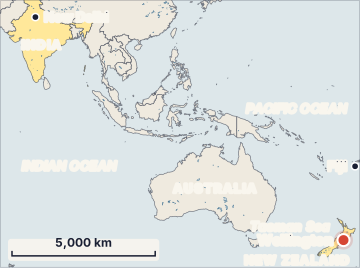
Why does New Zealand matter to India?
New Zealand is small, but it matters in four ways:
- The Indo-Pacific: It is an important voice in the South Pacific. India wants a free, open and rule-based Indo-Pacific region, and New Zealand shares this view.
- The Pacific Islands: New Zealand has close links with small Pacific island nations such as Fiji, Samoa and Tonga. India also works with these countries through the Forum for India-Pacific Islands Cooperation (FIPIC).
- Food and resources: New Zealand is a big exporter of dairy, meat, wool, fruit (apples, kiwifruit) and timber. Some of these, like timber and wool, are raw materials for Indian industry.
- People and education: A large Indian community lives there, and New Zealand is a popular study destination for Indian students.
Where did the relationship come from?
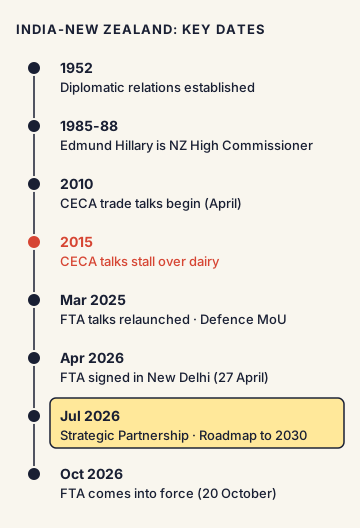
- India and New Zealand established diplomatic relations in 1952. India had set up a Trade Commission in New Zealand even earlier, in 1950, which was later upgraded to a High Commission.
- Sir Edmund Hillary, the New Zealander who climbed Mount Everest with Tenzing Norgay in 1953, served as New Zealand's High Commissioner to India from 1985 to 1988. He remains a well-loved figure in India.
- In 2011, New Zealand launched its "Opening Doors to India" policy, which named India a priority country. In 2020 it released a strategy paper, "India-NZ 2025: Investing in the Relationship".
- In April 2010, the two countries began talks on a trade deal called the Comprehensive Economic Cooperation Agreement (CECA). After about nine to ten rounds, the talks stalled in 2015, mainly because New Zealand wanted India to open its dairy market and India refused.
- After a gap of about ten years, the two sides relaunched FTA talks on 16 March 2025. Talks concluded on 22 December 2025, the agreement was signed on 27 April 2026 in New Delhi, and it comes into force on 20 October 2026.
- In July 2026, India's Prime Minister made an official visit to Auckland (10-11 July), the first by an Indian Prime Minister in about 40 years. The two sides raised their ties to a Strategic Partnership and adopted a "Roadmap to 2030".
How do the two countries work together?
The relationship now has several pillars:
- Trade and investment: Total trade in goods and services was about US$2.24-2.29 billion in 2025-26. Both sides aim to raise it to about NZ$7 billion by 2030. Indian IT companies such as TCS, Infosys, HCL and Tech Mahindra work in New Zealand.
- Defence and maritime security: A Defence Cooperation Memorandum of Understanding (MoU) was signed in March 2025, and the first Defence Strategic Dialogue took place in New Delhi in August 2025. A White Shipping Information Exchange arrangement (sharing data on commercial, non-military ships) was signed in 2022. Indian naval ships have visited New Zealand ports.
- Joining Indian-led groups: During the New Zealand Prime Minister's visit to India in March 2025, New Zealand joined the Coalition for Disaster Resilient Infrastructure (CDRI) and the Indo-Pacific Oceans Initiative (IPOI). In August 2024, during the Indian President's state visit to New Zealand, it handed over its ratification of the International Solar Alliance (ISA) agreement.
- Customs: A Customs Cooperation Arrangement (August 2024) and an Authorised Economic Operator Mutual Recognition Agreement (March 2025) make it easier for trusted traders to move goods.
- People-to-people ties: New Zealand's 2023 Census counted 292,092 people of Indian ethnicity, making Indians the third-largest ethnic group there. Hindi is among the most spoken languages in the country. India opened a Consulate in Auckland in September 2024.
What does the 2026 trade agreement add?
In simple words, it is the deal that finally made trade the strongest pillar:
- New Zealand removes duties on 100% of Indian exports from the first day.
- India removes or cuts duties on about 70% of its tariff lines, covering about 95% of New Zealand's exports, but protects dairy and sensitive farm goods. Some fruits, like apples and kiwifruit, get limited duty cuts through quotas.
- On mobility, New Zealand opened a new temporary employment visa pathway for up to 5,000 skilled Indian professionals (including AYUSH practitioners, yoga teachers and Indian chefs), 1,000 working holiday visas a year for young Indians, and better post-study work rights for Indian students.
- New Zealand committed to help bring US$20 billion of investment into India over 15 years.
Where do the two countries differ?
Relations have not always been smooth:
- Dairy: New Zealand's economy depends heavily on dairy exports. India has about 8 crore dairy farming families, most of them small. India has never opened dairy fully in any FTA. This was the main reason the 2010 talks failed.
- Nuclear Suppliers Group (NSG): At the NSG meeting in Seoul in June 2016, New Zealand was among the countries that wanted common rules for countries outside the Nuclear Non-Proliferation Treaty (NPT), which went against India's bid. Later in 2016, it said it would take a "constructive" approach.
- RCEP: New Zealand is a member of the Regional Comprehensive Economic Partnership (RCEP), the big Asia-Pacific trade bloc. India left the RCEP talks in November 2019, partly over fears of cheap imports and dairy competition. The bilateral FTA gives India access to New Zealand without joining RCEP.
Commonly confused concepts
- High Commission vs Embassy: Commonwealth countries call their missions in each other's capitals "High Commissions". With non-Commonwealth countries, the same mission is called an "Embassy". India has a High Commission in Wellington, not an embassy.
- India-New Zealand FTA vs India-Australia ECTA: Both are with neighbouring Pacific countries. The India-Australia Economic Cooperation and Trade Agreement (ECTA) came into force on 29 December 2022. The New Zealand FTA is a separate deal and comes into force on 20 October 2026.
- Strategic Partnership vs alliance: A strategic partnership is a political promise to work closely on many issues. It is not a military alliance. There is no duty to defend each other in war.
- Five Eyes: New Zealand is part of the "Five Eyes" intelligence-sharing group with the US, UK, Canada and Australia. India is not a member.
Issues, criticism and the way forward
- Small trade base: Trade is still small, around US$2.3 billion. New Zealand's average tariff is already low, so the FTA's gains for Indian goods may be modest unless exporters use it well.
- Using the FTA: Indian firms often under-use FTAs because of rules-of-origin paperwork. Awareness drives and simple online certificates can help.
- Students and mobility: Indian student numbers in New Zealand fell from a peak of about 30,000 (2015) to about 12,800, partly due to visa hurdles. The new post-study work rules aim to reverse this.
- Safety of the Indian community: Indian-owned small shops in New Zealand have faced retail crime, which India has raised with New Zealand.
- Way forward: Experts suggest early follow-through on the 2030 Roadmap, more defence and maritime exercises, closer work in the Pacific Islands, and joint research through bodies like the New Zealand Centre at IIT Delhi.
Concepts to Know
- Commonwealth: A voluntary group of 56 countries, most of them once ruled by Britain, that work together on shared values like democracy.
- Indo-Pacific Oceans Initiative (IPOI): An idea India launched in 2019 for countries to cooperate on seven areas of the Indo-Pacific, such as maritime security, ecology and disaster management.
- Coalition for Disaster Resilient Infrastructure (CDRI): A group India launched in 2019 to help countries build roads, power lines and buildings that can survive disasters.
- Nuclear Suppliers Group (NSG): A group of countries that control the export of nuclear materials and technology. Decisions need agreement of all members.
- White shipping information: Details about ordinary commercial ships (cargo ships, tankers) shared between navies to keep sea routes safe.
- Tariff-rate quota: A rule that allows a fixed quantity of a product in at a low tariff, and charges a higher tariff on anything above that quantity.
- Diplomatic relations: 1952; India's Trade Commission set up in 1950
- Sir Edmund Hillary: New Zealand High Commissioner to India, 1985-1988
- "Opening Doors to India" policy: 2011
- CECA talks: launched April 2010, stalled 2015 (dairy)
- FTA talks relaunched 16 March 2025; concluded 22 December 2025; signed 27 April 2026; in force 20 October 2026
- Strategic Partnership: July 2026 (Auckland visit, 10-11 July); trade target NZ$7 billion by 2030
- Defence Cooperation MoU: March 2025; White Shipping arrangement: 2022
- New Zealand joined CDRI and IPOI in March 2025; ratified ISA in August 2024
- Indian-ethnicity population in New Zealand (Census 2023): 292,092
● Tracked since October 16, 2026 · last seen October 16, 2026 · updates as the daily brief publishes