Immune Checkpoint Inhibitors
How Cancer Immunotherapy Works
Immune checkpoint inhibitors are a type of cancer medicine that help the body's own immune system attack cancer. Our immune cells have natural "brakes" that stop them from attacking healthy cells. Many cancers press these brakes to hide from the immune system. Checkpoint inhibitors block these brakes, so the immune cells can recognise and kill the cancer cells. Pembrolizumab and nivolumab, two medicines on the new price-cap list, are among the best known examples.
Why do our bodies need "checkpoints"?
The immune system is the body's army. Its key soldiers here are T cells, a kind of white blood cell that can find and kill infected or abnormal cells. An army that never stops fighting is dangerous: it could attack the body's own healthy tissue. This is what happens in autoimmune diseases such as type 1 diabetes.
So T cells carry special proteins on their surface that act as off switches. These are called immune checkpoints. When a checkpoint is switched on, the T cell calms down and stops attacking.
How does cancer misuse them?
Cancer cells are the body's own cells that have started growing out of control. A healthy immune system can often spot and destroy them. But many cancer cells learn a trick: they display a protein that switches off the T cells' checkpoint. Think of a thief who wears a police uniform, so the guards wave him through. The T cells reach the tumour but stand down, and the cancer keeps growing.
The main checkpoints to know
- PD-1 (Programmed cell Death protein 1): a brake found on T cells.
- PD-L1 (Programmed Death-Ligand 1): the protein many cancer cells display. When PD-L1 attaches to PD-1, the T cell is switched off.
- CTLA-4 (Cytotoxic T-Lymphocyte-Associated protein 4): another brake on T cells, which acts at an earlier stage, when T cells are first being activated in the lymph nodes.
How does the medicine work?
Checkpoint inhibitors are monoclonal antibodies: lab-made proteins designed to stick to one exact target, like a key that fits only one lock. (That is why their names end in "-mab", short for monoclonal antibody.) The medicine blocks the brake, so the "off" signal cannot be delivered.
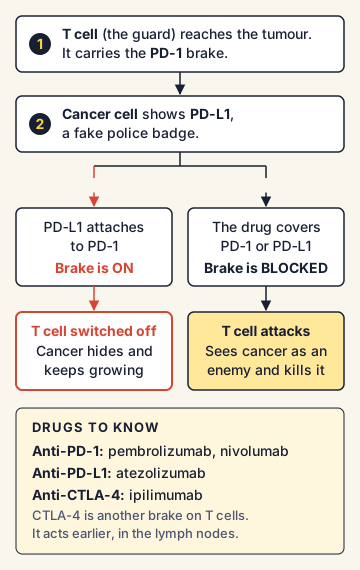
- An anti-PD-1 drug (pembrolizumab, nivolumab) covers the PD-1 brake on T cells.
- Or an anti-PD-L1 drug (such as atezolizumab) covers the PD-L1 protein on the cancer cell.
- Or an anti-CTLA-4 drug (ipilimumab) blocks the CTLA-4 brake.
- With the brake blocked, T cells recognise the cancer as an enemy again and attack it.
These medicines are usually given as an injection into a vein (an infusion) in hospital, every two to six weeks, often for months.
Where did it come from?
The science won the 2018 Nobel Prize in Physiology or Medicine. It was shared by James P. Allison (USA), who showed that blocking CTLA-4 helps the immune system attack tumours, and Tasuku Honjo (Japan), who discovered PD-1 in 1992 and showed that it works as a brake. Their work led to the first medicines:
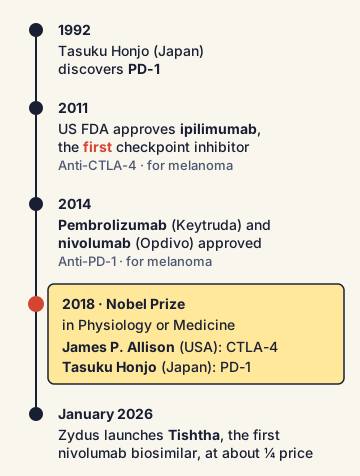
- 2011: the US Food and Drug Administration (FDA) approved ipilimumab, the first checkpoint inhibitor, for advanced melanoma (a serious skin cancer).
- 2014: pembrolizumab (brand Keytruda) and nivolumab (brand Opdivo), both anti-PD-1 drugs, were approved for advanced melanoma.
- Since then, their use has spread to lung, kidney, bladder, head and neck cancers and several others.
Why is it a big change?
Older treatments attack cancer directly. Immunotherapy instead trains the patient's own immune system. In some patients with advanced cancer, who earlier had a few months to live, the response lasts for years, because the immune system keeps "remembering" the cancer. But it does not work for everyone. Often only a minority of patients respond, and doctors use tests (such as checking PD-L1 levels in the tumour) to guess who is more likely to benefit.
Side effects
Because the brakes are removed, the immune system can also attack healthy organs. These are called immune-related adverse events. They can cause swelling and damage (inflammation) in the skin, gut, lungs, liver or hormone glands such as the thyroid. Most are manageable if caught early, but some can be serious.
India's position and Indian examples
- Cost is the biggest barrier. As of 2026, a standard 200 mg dose of pembrolizumab costs over ₹3 lakh per cycle in India, and treatment runs for many cycles. Most Indian patients pay from their own pocket.
- Low-dose research: Doctors at the Tata Memorial Centre, Mumbai tested a very low, flat dose of nivolumab (20 mg) with cheap oral medicines in advanced head and neck cancer. In a trial published in the Journal of Clinical Oncology, one-year survival improved to about 43%, compared with about 16% without nivolumab. This approach costs a small fraction of the full dose.
- Biosimilars: A biosimilar is a close copy of a biological medicine whose patent has ended. In January 2026, Zydus launched Tishtha, described as the world's first biosimilar of nivolumab, at about one-fourth of the original drug's price.
- Price regulation: Most of these medicines are non-scheduled and some are patented, so they were outside the normal price ceiling. The 2026 trade margin cap now covers them.
Commonly confused concepts
- Immunotherapy vs chemotherapy: Chemotherapy uses chemicals that kill fast-dividing cells, both cancer cells and some healthy ones (which is why hair falls). Immunotherapy does not kill cancer directly; it releases the immune system to do the job.
- Immunotherapy vs targeted therapy: Targeted drugs block a specific fault inside the cancer cell. On the new list, osimertinib blocks a faulty growth signal called EGFR in some lung cancers, and palbociclib blocks proteins (CDK4/6) that drive cell division in some breast cancers. Bevacizumab is a monoclonal antibody too, but it is a targeted drug: it blocks VEGF, a signal tumours use to grow new blood vessels. It does not release the immune system.
- Checkpoint inhibitors vs CAR-T therapy: Both are immunotherapy. Checkpoint inhibitors are ready-made medicines given to many patients. CAR-T therapy takes the patient's own T cells out, changes their genes in a lab so they target the cancer, and puts them back. India's first indigenous CAR-T therapy, NexCAR19, was approved in 2023.
- PD-1 vs PD-L1: PD-1 sits on the T cell (the guard). PD-L1 sits mostly on the cancer cell (the fake badge). Drugs can block either one.
- Biosimilar vs generic: A generic is an exact chemical copy of a simple, small-molecule drug. A biosimilar is a highly similar, but not identical, copy of a complex biological drug made in living cells, such as an antibody.
Issues, criticism and the way forward
- Affordability: Very high prices put these medicines out of reach of most patients. Price regulation (like the trade margin cap), biosimilars and low-dose approaches are all being tried.
- Patents: Patents give the original company the sole right to sell for about 20 years. Pembrolizumab's Indian patent is expected to last until around 2028–29, so cheaper copies cannot launch before that unless the law allows exceptions such as compulsory licensing.
- Not for everyone: Only some patients respond. Better tests to predict response would avoid spending large sums on treatments that will not help.
- Safety monitoring: Immune side effects need trained doctors and quick care, which is harder in smaller hospitals.
- Way forward: Experts suggest covering these drugs under public insurance such as Ayushman Bharat PM-JAY with dose-saving protocols, faster approval of quality biosimilars, and more Indian clinical trials so that treatment fits Indian patients and budgets.
Concepts to Know
- Immune system: The body's defence network of cells and organs that fights germs and abnormal cells.
- T cell: A type of white blood cell that can directly kill infected or cancerous cells.
- Antibody: A Y-shaped protein that sticks to a specific target. The body makes antibodies naturally; "monoclonal" antibodies are made in a lab, all identical, against one target.
- Melanoma: A dangerous form of skin cancer that starts in the cells that give skin its colour.
- Biosimilar: A close copy of a biological medicine, sold after the original's patent ends, usually at a lower price.
- Compulsory licence: Permission given by the government to a company to make a patented medicine without the patent owner's consent, in special situations like public health needs.
- Autoimmune disease: A disease in which the immune system wrongly attacks the body's own healthy tissue.
- Checkpoints: PD-1 and CTLA-4 (on T cells); PD-L1 (on many cancer cells)
- Anti-PD-1: pembrolizumab (Keytruda), nivolumab (Opdivo); anti-PD-L1: atezolizumab; anti-CTLA-4: ipilimumab
- 2018 Nobel Prize in Physiology or Medicine: James P. Allison (CTLA-4) and Tasuku Honjo (PD-1, discovered 1992)
- First approval: ipilimumab, 2011 (US FDA, melanoma); pembrolizumab and nivolumab: 2014
- Drug names ending in "-mab" are monoclonal antibodies
- Tata Memorial low-dose (20 mg) nivolumab trial: 1-year survival about 43% vs 16% in advanced head and neck cancer
- Zydus's Tishtha (January 2026): first biosimilar of nivolumab, about one-fourth of the reference price
● Tracked since October 17, 2026 · last seen October 17, 2026 · updates as the daily brief publishes