Illegal, Unreported and Unregulated (IUU) Fishing
IUU fishing is a broad name for fishing that breaks the rules, hides its catch, or takes place where no rules exist. "Illegal" means breaking a law, "unreported" means not telling the authorities (or giving false figures), and "unregulated" means fishing in areas or for fish stocks that no authority manages. Together, these practices empty the oceans, cheat honest fishers and make it impossible to know how many fish are really left.
Why is IUU fishing a big problem?
Fish stocks are like a shared bank account for the whole world. If some people keep withdrawing money secretly, the account runs dry and nobody knows why. IUU fishing does the same to the ocean. It leads to overfishing, damages coral reefs and sea beds through harmful gear, and kills endangered species like turtles and sharks.
It also hurts poor coastal fishers, because illegal boats take the fish from their waters. Often IUU fishing is linked to other crimes, such as forced labour on boats and smuggling. The UN estimates that about one in every five fish caught may come from IUU fishing. FAO-cited estimates put the loss at 11 to 26 million tonnes of fish a year.
What exactly counts as IUU?
The definition comes from the International Plan of Action to Prevent, Deter and Eliminate IUU Fishing (IPOA-IUU), adopted by the Food and Agriculture Organization (FAO) in 2001. It has three parts:
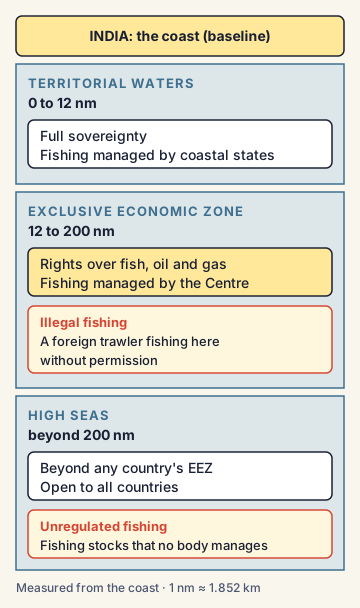
- Illegal fishing: Fishing without permission in another country's waters, or breaking the laws of a country or the rules of a regional fisheries body. Example: a foreign trawler secretly fishing inside India's Exclusive Economic Zone.
- Unreported fishing: Fishing that is not reported, or is wrongly reported, to the authorities. Example: a boat that catches 10 tonnes but reports only 3 tonnes.
- Unregulated fishing: Fishing by boats with no nationality (no flag), or flying the flag of a country outside a regional fisheries body, or fishing in areas or for stocks where there are no conservation rules. Example: fishing a rare deep-sea species on the high seas where no body manages it.
How did the world respond?
International action has built up step by step:
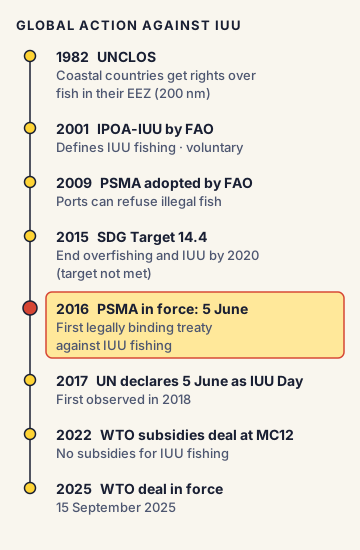
- UNCLOS (1982): The UN Convention on the Law of the Sea gives coastal countries rights over fish in their Exclusive Economic Zone (EEZ), up to 200 nautical miles from the coast, and the duty to conserve them.
- IPOA-IUU (2001): A voluntary FAO plan that defines IUU fishing and asks every country to prepare a National Plan of Action against it.
- Port State Measures Agreement (PSMA): Adopted by the FAO in 2009, it entered into force on 5 June 2016. It is the first legally binding international agreement focused on IUU fishing. It lets countries check foreign fishing boats in their ports and refuse to let them land illegal fish. The idea is simple: if illegal fish cannot be landed anywhere, illegal fishing stops paying.
- International Day for the Fight against IUU Fishing: The UN General Assembly declared 5 June as this day in 2017. It was first observed in 2018. The date marks the day the PSMA came into force.
- SDG 14.4: Under the UN Sustainable Development Goals (2015), Target 14.4 called for ending overfishing and IUU fishing by 2020. This target was not met.
- WTO Agreement on Fisheries Subsidies: Adopted at the 12th WTO Ministerial Conference (MC12) in Geneva in 2022, it entered into force on 15 September 2025. It bans government subsidies to boats or operators found doing IUU fishing, subsidies for fishing overfished stocks, and subsidies for fishing on the unregulated high seas. India had not ratified it as of late 2025.
How the EU fights IUU fishing: the catch certificate system
The EU is one of the world's largest seafood markets, so its rules affect fishers everywhere.
- Regulation (EC) No 1005/2008 set up the EU's system against IUU fishing. It has applied since 1 January 2010.
- Every consignment of wild-caught sea fish imported into the EU must come with a catch certificate. The exporting country's authority must validate (officially confirm) it. The certificate shows the boat, the fishing area, the dates and the catch.
- Fish farmed in ponds (aquaculture) does not need a catch certificate, because it is not caught from the wild.
- The carding system: The EU can warn a country that is not doing enough against IUU fishing with a yellow card. If things do not improve, a red card follows, and that country's seafood is banned from the EU. A green card lifts the warning once the country fixes the problems.
- The digital upgrade: Regulation (EU) 2023/2842 changed the system. From 10 January 2026, the EU's online system called CATCH became compulsory for EU importers and authorities. Paper-based checks are being replaced with digital records, and more data must be captured at the source.
India's position
- India has a long coastline and an EEZ of about 2 million sq km. Fishing up to 12 nautical miles (territorial waters) is managed by coastal states. Fishing in the EEZ beyond that is managed by the Centre.
- The Maritime Zones of India (Regulation of Fishing by Foreign Vessels) Act, 1981 controls fishing by foreign boats in Indian waters. The Indian Coast Guard and the Navy patrol these waters.
- In November 2025, the Centre notified the Sustainable Harnessing of Fisheries in the Exclusive Economic Zone Rules, 2025. They require an access pass for larger and mechanised vessels fishing in the EEZ, and they prohibit harmful practices such as LED light fishing, pair trawling and bull trawling. Vessels must also follow India's National Plan of Action against IUU fishing.
- India is also a victim of IUU fishing, with foreign trawlers entering its waters, and Indian fishers are often arrested for crossing the maritime boundary with Sri Lanka or Pakistan.
Commonly confused concepts
- IUU fishing vs overfishing: Overfishing means catching fish faster than they can breed back. It can happen even with legal fishing. IUU fishing is about breaking or escaping rules. IUU is one major cause of overfishing.
- Catch certificate vs health certificate: A catch certificate proves the fish was caught legally. A health certificate proves the fish is safe to eat. Exports to the EU need both.
- Wild-caught vs farmed (aquaculture): Only wild-caught sea fish need an EU catch certificate. Farmed shrimp, which makes up most of India's exports, does not.
- PSMA vs IPOA-IUU: PSMA (2009) is legally binding. IPOA-IUU (2001) is voluntary.
- Territorial waters vs EEZ: Territorial waters extend up to 12 nautical miles, where the country has full sovereignty. The EEZ extends up to 200 nautical miles, where the country has rights over resources like fish, oil and gas.
Issues, criticism and the way forward
- Burden on small fishers: India's fishing fleet is made up mostly of small boats. Recording every catch digitally is hard for poor fishers with little technology. This could push them out of export supply chains.
- Trade barrier concern: Developing countries argue that strict rules from rich markets sometimes act as non-tariff barriers (rules that block trade without being a tax).
- Weak monitoring at sea: Patrolling a huge ocean is costly. Satellite tracking, vessel monitoring systems and digital records can help.
- Way forward: Build simple, low-cost digital tools for fishers; train them; strengthen cooperation with neighbours; and align national rules with global standards so that Indian seafood keeps its market access.
Concepts to Know
- Traceability: The ability to follow a product step by step, from where it was caught or grown to the shop where it is sold.
- FAO (Food and Agriculture Organization): A UN agency, based in Rome, that works on food, farming and fisheries.
- Nautical mile: A unit of distance at sea. One nautical mile is about 1.852 km.
- High seas: Ocean areas beyond any country's EEZ, open to all countries.
- Trawling: Fishing by dragging a large net through the water or along the sea bed behind a boat. Pair trawling uses two boats pulling one net.
- IPOA-IUU (voluntary) adopted by FAO: 2001
- Port State Measures Agreement: adopted 2009, entered into force 5 June 2016; first binding treaty targeting IUU fishing
- International Day for the Fight against IUU Fishing: 5 June (declared 2017, first observed 2018)
- SDG Target 14.4: end overfishing and IUU fishing by 2020
- WTO Agreement on Fisheries Subsidies: adopted at MC12 (2022); in force from 15 September 2025
- EU IUU Regulation (EC) 1005/2008, applied from 1 January 2010; amended by Regulation (EU) 2023/2842; CATCH digital system compulsory from 10 January 2026
- EU carding: yellow (warning), red (ban), green (cleared)
- India's EEZ Fisheries Rules notified November 2025: access pass; ban on LED light fishing, pair trawling and bull trawling
● Tracked since November 09, 2026 · last seen November 09, 2026 · updates as the daily brief publishes