ICJ Advisory Opinion on "Obligations of States in Respect of Climate Change" (2025)
On 23 July 2025, the International Court of Justice (ICJ), the main court of the United Nations, gave its opinion on what countries are legally required to do about climate change. All the judges agreed (the opinion was unanimous). The Court said that protecting the climate is not only a political promise but a legal duty under international law. A country that fails to do enough may be breaking international law and may have to repair the harm it causes.
Why was it needed?
Climate treaties like the Paris Agreement let each country decide its own targets. Small island countries, which may lose their land to rising seas, felt these voluntary promises were not enough. They wanted the world's top court to say clearly what the law demands. An opinion from the ICJ cannot force anyone, but it carries great legal and moral weight. National courts, negotiators and lawyers can rely on it.
Where did it come from?
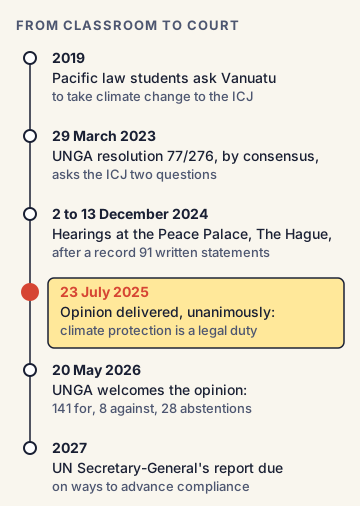
The idea began with law students in the Pacific. In 2019, students at the University of the South Pacific asked the government of Vanuatu, a small island country, to take climate change to the ICJ. Vanuatu built a coalition of countries. On 29 March 2023, the UN General Assembly adopted resolution 77/276 by consensus (no vote was needed because no country objected). It was co-sponsored by about 132 countries. The resolution asked the ICJ two questions.
What were the two questions?
- Question A: What are countries' legal duties to protect the climate system from greenhouse gas emissions, for present and future generations? The Court had to look at the UN Charter, human rights treaties, the climate treaties, the law of the sea and customary international law.
- Question B: What are the legal results for countries that, by their actions or failure to act, cause significant harm to the climate system? This includes harm to small island states and to people of present and future generations.
How did the case run?
The ICJ received a record 91 written statements from countries and international organisations. Public hearings were held at the Peace Palace in The Hague from 2 to 13 December 2024. About 96 to 97 countries and 11 international organisations spoke, the largest number ever in an ICJ case. The opinion was read out on 23 July 2025 by ICJ President Judge Yuji Iwasawa. It runs to about 140 pages.
What did the Court decide?
The main findings are:
- More than the climate treaties apply. Duties come from the UNFCCC, the Kyoto Protocol and the Paris Agreement, and also from customary international law (unwritten rules all countries follow), human rights law and the law of the sea. The Court rejected the argument that the climate treaties are the only law that applies.
- 1.5°C is the main goal. The Court said 1.5°C is now the primary temperature goal agreed by the parties, ahead of the older 2°C limit.
- NDCs are not a free choice. Countries still write their own climate plans, called Nationally Determined Contributions (NDCs). But their freedom is limited. Taken together, all NDCs must be able to meet the 1.5°C goal, and each must show the country's "highest possible ambition".
- Due diligence. Every country must take serious care (due diligence) to prevent significant harm to the climate system. This includes risk checks and environmental impact assessments. The standard is strict, but it depends on each country's capacity, in line with the principle of Common but Differentiated Responsibilities.
- Fossil fuels can be a breach. If a country fails to protect the climate system, for example through fossil fuel production, consumption, exploration licences or subsidies, this may be an internationally wrongful act. A country can also be responsible for not controlling emissions by private companies on its territory.
- Everyone has an interest. The key duties are owed to all parties together (the legal term is erga omnes partes). So any country can raise a complaint, even if it is not directly harmed.
- Human rights link. The Court said a clean, healthy and sustainable environment is necessary for enjoying other human rights.
What happens if a country breaks these duties?
The normal rules of "state responsibility" apply. The country must stop the wrongful act (cessation), promise not to repeat it, and give full reparation. Reparation can mean restoring things as they were (restitution), paying money (compensation) or formally admitting the wrong (satisfaction). To claim reparation, a link must be shown between a country's conduct and the harm. The Court said this is hard but not impossible, even when many countries contributed to the harm.
India's position
India took part in the hearings. Its oral statement was made on 5 December 2024 by Luther M. Rangreji, Joint Secretary and Legal Adviser in the Ministry of External Affairs. India stressed equity and Common but Differentiated Responsibilities and Respective Capabilities (CBDR-RC). It argued that developing countries contributed the least to the problem and should not carry equal burdens.
It called promised climate finance "too little, too distant" and said this fell short of Article 9 of the Paris Agreement (which says developed countries shall provide finance). India also urged the Court not to create new duties beyond the existing climate treaties.
What happened after?
On 20 May 2026, the UN General Assembly adopted a Vanuatu-led resolution welcoming the opinion, by 141 votes to 8, with 28 abstentions. It asks the UN Secretary-General for a report in 2027 on ways to advance compliance. The United States opposed it, arguing that the resolution wrongly treats the opinion as binding.
Commonly confused concepts
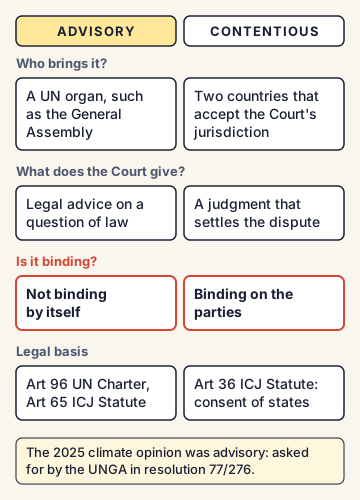
- Advisory opinion vs contentious case: In a contentious case, two countries that have accepted the Court's jurisdiction bring a dispute, and the judgment binds them. An advisory opinion is legal advice asked for by a UN body (here, the General Assembly, under Article 96 of the UN Charter and Article 65 of the ICJ Statute). It is not binding by itself.
- ICJ vs International Criminal Court (ICC): The ICJ settles disputes between countries. The ICC tries individual people for crimes like genocide and war crimes. Both sit in The Hague, but they are different courts.
- ICJ (2025) vs ITLOS (2024) climate opinion: In May 2024, the International Tribunal for the Law of the Sea (ITLOS) gave an advisory opinion that greenhouse gas emissions count as marine pollution under UNCLOS. The ICJ opinion is wider and covers all areas of international law.
- Paris Agreement goal vs ICJ reading: The Paris text says "well below 2°C" and "pursuing efforts" for 1.5°C. The ICJ read the later decisions of the parties as making 1.5°C the primary goal.
Issues, criticism and the way forward
- Not binding: The opinion cannot be enforced directly. Its strength depends on courts and governments choosing to use it.
- Unclear details: Commentators note the Court did not say exactly from when the duties apply, or how much harm counts as "significant". This leaves room for future disputes.
- Developing country concerns: Some developing countries worry the opinion could be used to push stricter duties on them, or to justify trade measures, without matching finance. Others, especially island states, see it as a tool for climate justice.
- Use in negotiations: Some countries want COP decisions to refer to the opinion; others reject this, saying COP texts should not import outside legal readings.
- Way forward: Experts suggest using the opinion to guide stronger NDCs, to support national climate cases, and to push for clearer rules on loss and damage finance.
Concepts to Know
- International Court of Justice (ICJ): The main court of the UN, set up in 1945, sitting at the Peace Palace in The Hague, Netherlands. It has 15 judges.
- Customary international law: Rules that are not written in one treaty but that countries follow because they accept them as law, like the rule that a country must not seriously harm its neighbours' environment.
- Due diligence: Taking all the reasonable care that can be expected. A country is judged on whether it tried hard enough with the means it had.
- Internationally wrongful act: An action or failure by a country that breaks its duty under international law. It makes the country legally responsible.
- Erga omnes partes: A Latin legal phrase meaning "owed to all the parties". It means every country in the treaty has a stake in its being followed.
- Nationally Determined Contribution (NDC): Each country's own climate action plan under the Paris Agreement, updated every five years.
- Reparation: Making up for harm done, by restoring, paying or apologising.
- Requested by UNGA resolution 77/276, adopted by consensus on 29 March 2023; campaign led by Vanuatu, idea from Pacific law students (2019)
- Record 91 written statements; oral hearings 2 to 13 December 2024 at the Peace Palace, The Hague
- Opinion delivered on 23 July 2025, unanimously; ICJ President Judge Yuji Iwasawa
- Findings: 1.5°C is the primary temperature goal; NDCs must reflect highest possible ambition; stringent due diligence; fossil fuel production, licences or subsidies may be an internationally wrongful act; obligations erga omnes partes
- Consequences of breach: cessation, guarantees of non-repetition, full reparation (restitution, compensation, satisfaction)
- India's oral statement on 5 December 2024 stressed equity and CBDR-RC and cited Article 9 of the Paris Agreement
- UNGA welcomed the opinion on 20 May 2026 (141 for, 8 against, 28 abstentions)
- Legal basis for advisory opinions: Article 96 of the UN Charter; Article 65 of the ICJ Statute
● Tracked since July 30, 2026 · last seen November 17, 2026 · updates as the daily brief publishes