Horizon Europe
The EU's Research and Innovation Programme
Horizon Europe is the European Union's biggest programme for paying for research and new inventions. It runs for seven years, from 2021 to 2027. Universities, research labs, companies and start-ups apply for its money, usually in teams spread across several countries. It is the ninth in a long line of EU "Framework Programmes" for research.
Why does the EU run such a programme?
Big problems like cancer, climate change, clean energy or artificial intelligence are too large and too costly for one lab or one country to solve alone. The EU pools money from all its members and gives it to the best teams, wherever they are. This helps Europe stay competitive with the United States and China in science and technology.
It also makes scientists from different countries work together, which spreads knowledge faster. You can think of it like a joint family fund: everyone puts money in, and the family pays for the most promising child's education, whichever house they live in.
Where did it come from?
The EU (then the European Communities) started its first Framework Programme (FP1) in 1984. Since then, a new programme has followed every few years, and each one has been bigger than the last.
- FP1 to FP7 (1984 to 2013): seven programmes that slowly grew in size and scope.
- Horizon 2020 (FP8), 2014 to 2020: budget of roughly €77 billion. It was the first to carry the "Horizon" name.
- Horizon Europe (FP9), 2021 to 2027: agreed in 2021 under Regulation (EU) 2021/695. When it was agreed, its budget was about €95.5 billion in current prices, including about €5.4 billion from NextGenerationEU, the EU's post-Covid recovery fund. After later changes to the EU's long-term budget, the amount is now usually given as about €93.5 billion.
- Next programme (FP10), 2028 to 2034: in 2025 the European Commission proposed a much bigger successor, with a proposed budget of about €175 billion. As of November 2026, this is still a proposal.
How is Horizon Europe organised? The three pillars
The programme is divided into three big parts, called pillars, plus one extra strand.
- Pillar I: Excellent Science. Funds the best "blue-sky" research, meaning research driven by curiosity rather than a fixed product. It includes the European Research Council (ERC), which gives large grants to individual top scientists, and the Marie Skłodowska-Curie Actions (MSCA), which fund the training and travel of researchers.
- Pillar II: Global Challenges and European Industrial Competitiveness. The largest pillar, with about €53.5 billion (more than half the money). It funds joint projects by teams from many countries on society's big problems.
- Pillar III: Innovative Europe. Helps turn research into products and businesses. It includes the European Innovation Council (EIC), which backs risky, breakthrough start-ups, and the European Institute of Innovation and Technology (EIT).
- Extra strand: Widening participation and strengthening the European Research Area. Helps EU countries that are weaker in research catch up.
The six clusters of Pillar II
Pillar II is split into six topic groups, called clusters:
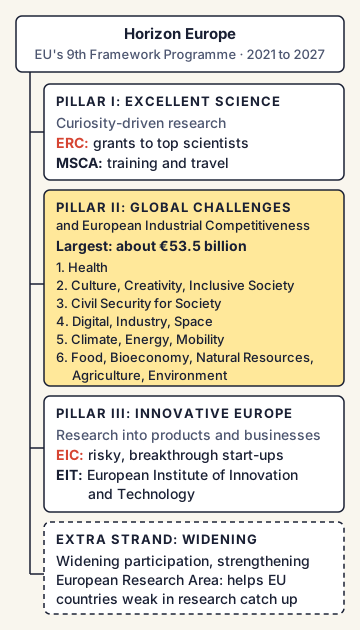
- Health
- Culture, Creativity and Inclusive Society
- Civil Security for Society
- Digital, Industry and Space
- Climate, Energy and Mobility
- Food, Bioeconomy, Natural Resources, Agriculture and Environment
Horizon Europe also has five EU Missions: focused, time-bound goals on cancer, adapting to climate change, healthy oceans and waters, climate-neutral and smart cities, and healthy soils.
How does a non-EU country take part?
There are three levels, and students often mix them up:
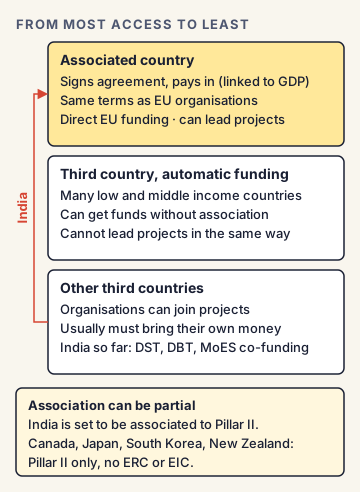
- Associated country: It signs a formal association agreement and pays money into the programme. Its organisations then take part on the same terms as EU organisations in the parts covered: they can receive funding directly and can lead (coordinate) projects. The payment is linked to the size of the country's economy (its GDP).
- Third country with automatic funding: Many low and middle income countries can get funds without association, but they cannot lead projects in the same way.
- Other third countries (like India so far): Their organisations can join projects, but usually must bring their own money. For India, ministries such as the Department of Science and Technology (DST), the Department of Biotechnology (DBT) and the Ministry of Earth Sciences (MoES) have often paid for Indian partners through "co-funding" deals.
Association can be full or partial. For example, Canada, Japan, South Korea and New Zealand are associated only to Pillar II, not to the ERC or the EIC. The United Kingdom rejoined Horizon Europe as an associated country from 1 January 2024, after leaving the EU. As of November 2026, 23 non-EU countries are associated.
How does the money flow, step by step?
- The European Commission publishes a work programme listing "calls", which are open requests for project ideas on set topics.
- Teams, usually of at least three organisations from different EU or associated countries, send a joint proposal.
- Independent expert evaluators score each proposal on excellence, impact and quality of work plan.
- The best ones sign a grant agreement and receive money, often covering most of their costs.
- The results are usually shared openly, so that others can build on them.
India's position and Indian examples
- India and the EU signed an Agreement for Scientific and Technological Cooperation in New Delhi on 23 November 2001. It came into force in 2002 and has been renewed several times, most recently until 2030.
- Before association, Indian institutes did take part in EU research projects, mostly with Indian government co-funding. Joint calls covered areas like water, health, ocean science and clean energy.
- Talks on association began in February 2026, formal negotiations began in July 2026, and they were concluded in November 2026. India is set to be associated to Pillar II.
- India has its own research funder, the Anusandhan National Research Foundation (ANRF), created by law in 2023. Association lets Indian researchers combine national funding with EU funding.
Commonly confused concepts
- Horizon Europe vs Horizon 2020: Horizon 2020 was the earlier programme (2014 to 2020). Horizon Europe is the current one (2021 to 2027).
- Horizon Europe vs Erasmus+: Erasmus+ is the EU's programme for student and staff exchanges in education, youth and sport. Horizon Europe funds research and innovation.
- ERC vs EIC: The ERC funds curiosity-driven research by individual scientists (Pillar I). The EIC funds risky, market-creating start-ups and technologies (Pillar III).
- Association vs participation: Any country's researchers can often participate. Only an associated country's organisations take part on equal terms with EU members and can lead projects with direct EU funding, because their country pays in.
- Horizon Europe vs the India-France "Horizon 2047" roadmap: Horizon 2047 is a bilateral India-France strategic plan for 25 years. It has nothing to do with the EU research programme, despite the similar name.
Issues, criticism and the way forward
- Cost vs benefit: An associated country pays a contribution linked to its GDP. If its researchers win fewer grants than expected, it may pay in more than it gets back. Some associated countries have a "correction" clause in their agreements to deal with this.
- Complex rules: Researchers often complain that applying is slow and full of paperwork, and that success rates are low because competition is tough.
- Data and security concerns: Projects on sensitive technologies, such as quantum or space, can have limits on which countries can join. Both sides must agree on intellectual property (who owns the results) and data sharing.
- Brain drain fears: Some worry that the best Indian researchers may shift to European labs. Supporters reply that joint projects build capacity at home and give Indian labs access to European equipment and networks.
- Way forward: Experts suggest strong support offices in India to help researchers apply, matching national funds through the ANRF, and a focus on areas where India is strong, such as digital public infrastructure, health, climate and space.
Concepts to Know
- Research and innovation: Research means finding new knowledge. Innovation means turning that knowledge into useful products, services or methods.
- Framework Programme (FP): The EU's name for its multi-year research funding plans. Horizon Europe is FP9.
- NextGenerationEU: A special EU recovery fund created after the Covid-19 pandemic to help economies bounce back.
- Call (for proposals): An open invitation from a funder asking teams to send project ideas on a given topic, with a deadline.
- Grant: Money given for a project that does not have to be paid back.
- Intellectual property (IP): Legal ownership of ideas and inventions, such as patents.
- Horizon Europe: EU's 9th Framework Programme; runs 2021 to 2027; legal basis Regulation (EU) 2021/695
- Budget: about €95.5 billion when agreed (including about €5.4 billion from NextGenerationEU); now usually stated as about €93.5 billion
- First Framework Programme (FP1): 1984; previous programme Horizon 2020 (2014 to 2020)
- Three pillars: I Excellent Science (ERC, MSCA); II Global Challenges and European Industrial Competitiveness (6 clusters, largest share); III Innovative Europe (EIC, EIT)
- 5 EU Missions: cancer, climate adaptation, oceans and waters, climate-neutral cities, soil health
- Associated countries pay a contribution linked to GDP and take part on equal terms with EU members
- Proposed successor (FP10, 2028 to 2034): about €175 billion (proposal as of November 2026)
- India-EU S&T Cooperation Agreement: signed 23 November 2001; renewed until 2030
● Tracked since November 07, 2026 · last seen November 07, 2026 · updates as the daily brief publishes