Health Technology Assessment (HTA) and HTAIn
Health Technology Assessment (HTA) is a scientific way of checking whether a medicine, vaccine, medical device, test or health programme gives good value for money. It compares a new option with what is already used and asks: how much extra health does it give, and at what extra cost? Governments use HTA to decide what to pay for, what to include in public health schemes and sometimes what price is fair. India's national HTA body is Health Technology Assessment in India (HTAIn), under the Department of Health Research.
Why does it exist?
Every government has a limited health budget, but the list of new and costly medicines and machines keeps growing. If money is spent on a costly drug that is only slightly better than a cheap one, less money is left for vaccines, primary health centres or other treatments that save many more lives. Think of a family with a fixed monthly budget.
Before buying a new phone at double the price, they ask: "Is it really twice as good?" HTA asks the same question for health spending, using evidence instead of guesswork.
Where did it come from?
HTA began in rich countries in the 1970s and 1980s. The United States had an Office of Technology Assessment that studied health technologies. A famous example is the United Kingdom's National Institute for Health and Care Excellence (NICE), set up in 1999, which advises the National Health Service on which treatments are worth paying for.
Thailand set up its HTA body, HITAP, in 2007, a model often cited for developing countries. In India, the need for a Medical Technology Assessment Board was recommended by the Twelfth Five Year Plan's working group on health research. The Department of Health Research started a pilot HTA programme in April 2017, which became HTAIn. On 9 May 2023, HTAIn was approved as an attached office of the Department of Health Research.
How does HTA work?
Step by step:
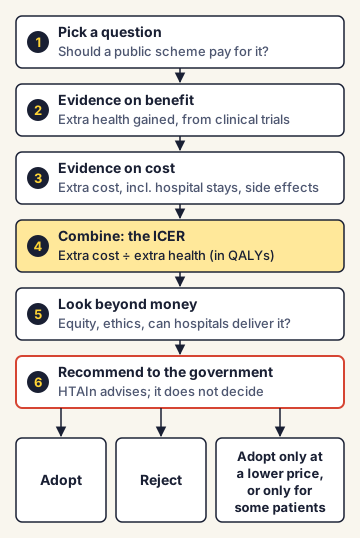
- Pick a question: a ministry or state asks, for example, "Should the public scheme pay for this new cancer drug?"
- Collect evidence on benefit: how much longer or better do patients live with the new option? This comes from clinical trials and studies.
- Collect evidence on cost: what does the new option cost, including hospital stays and side effects, compared with the current one?
- Combine the two: experts calculate the extra cost for each extra unit of health gained.
- Look beyond money: HTA also considers equity (does it help the poor?), ethics and practical issues like whether hospitals can deliver it.
- Recommend: the HTA body advises the government to adopt it, reject it, or adopt it only at a lower price or for certain patients.
The key measures, explained simply
- QALY (Quality-Adjusted Life Year): one year of life in perfect health. A year lived in poor health counts as less than one. For example, two years at half health = one QALY. This lets very different treatments be compared on one scale.
- ICER (Incremental Cost-Effectiveness Ratio): the extra cost divided by the extra health gained. If a new drug costs ₹2 lakh more than the old one and gives 0.5 extra QALY, the ICER is ₹4 lakh per QALY.
- Cost-effectiveness threshold: the maximum amount a health system is willing to pay for one extra QALY. If the ICER is below the threshold, the option is usually considered good value. India has not yet officially fixed its threshold; research to estimate it is ongoing.
HTAIn's structure and work in India
- HTAIn works under the Department of Health Research (DHR), Ministry of Health and Family Welfare.
- It has an HTA Board (chaired by a Member of NITI Aayog, according to DHR) and a Technical Appraisal Committee that reviews studies.
- It works with a network of regional resource hubs and centres, often in medical colleges and research institutes, that carry out studies.
- It studies medicines, devices, diagnostics, vaccines and health programmes for cost-effectiveness, clinical effectiveness and equity.
- Its studies have informed Ayushman Bharat-Pradhan Mantri Jan Arogya Yojana (AB-PMJAY), for example studies on intraocular lenses for cataract surgery and safe syringes that helped define and cost health benefit packages.
- HTAIn is a member of INAHTA, the international network of HTA agencies.
Commonly confused concepts
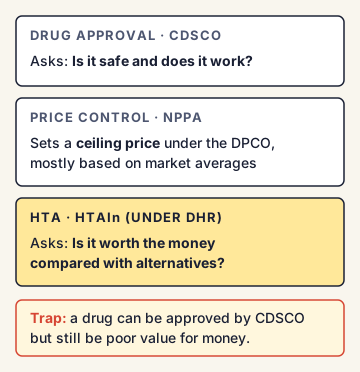
- HTA vs drug approval: Drug approval (by CDSCO) asks "Is it safe and does it work?" HTA asks "Is it worth the money compared with alternatives?" A drug can be approved but still be poor value.
- HTA vs price control: Price control (by NPPA under the DPCO) sets a ceiling price, mostly based on market averages. HTA judges value based on health benefit. In some countries, HTA results are used to negotiate prices; in India this link is still weak.
- HTA vs EIA: Environmental Impact Assessment checks a project's effect on the environment. HTA checks a health technology's value. The word "assessment" is common, but the subjects are different.
- Cost-effective vs cheap: A costly treatment can be cost-effective if its health gain is large. A cheap one can be poor value if it barely works.
Issues, criticism and the way forward
- No legal backing: HTAIn's advice is not binding, and it has no law of its own. Its recommendations are used mainly for public schemes, not for the wider market.
- Not linked to pricing: NPPA does not routinely use HTA findings when fixing prices, and CDSCO does not consider value. The analysis behind this news argues that a link is needed.
- Data gaps: Good Indian data on costs and patient outcomes is often missing, so studies may have to rely on foreign data.
- Skills shortage: India has too few trained health economists and HTA experts.
- Ethical worries: Some patient groups fear HTA may be used to deny costly treatments for rare diseases. Experts respond that HTA should weigh equity and special needs, not just cost.
- Way forward: Give HTA a legal basis, fix an Indian cost-effectiveness threshold, use HTA results in price negotiation and in public procurement, and build a joint platform where CDSCO, NPPA and HTAIn share evidence.
Concepts to Know
- Health technology: Any tool used to improve health: medicines, vaccines, devices, tests, surgical procedures and even health programmes.
- Health economics: The study of how money and resources are used in health care, and how to get the most health from a limited budget.
- Equity (in health): Fairness, making sure poor and disadvantaged people also get needed care.
- Attached office: A government office that works under a department of a ministry and helps carry out its policies.
- HTAIn: pilot started April 2017 under the Department of Health Research; approved as an attached office of DHR on 9 May 2023
- Medical Technology Assessment Board: recommended by the 12th Plan working group on health research
- UK's NICE: set up in 1999; Thailand's HITAP: 2007
- QALY = one year in perfect health; ICER = extra cost / extra health gained
- India has not officially fixed a cost-effectiveness threshold
- HTAIn studies (intraocular lenses, safe syringes) informed AB-PMJAY health benefit packages
● Tracked since November 02, 2026 · last seen November 02, 2026 · updates as the daily brief publishes