Harmonized System (HS) Code
How Traded Goods Are Classified
The Harmonized System, or HS, is a common international list that gives every traded product a number. Almost every country uses it, so a bag of coffee or a bottle of whisky has the same first six digits of code in India, the UK or Brazil. Customs officers use this code to decide how much duty to charge, and governments use it to count trade. You can think of the HS as the world's shared "address book" for goods.
Why does it exist?
Imagine every country used its own names and numbers for goods. One country might call a product "spirit concentrate" and another "whisky base". Traders would never know which rate applies, and trade deals would be almost impossible to write. Trade statistics from different countries could not be compared either. The HS fixes this by giving the whole world one language for goods. A tariff cut promised in a trade deal is written against HS codes, so both sides know exactly which goods it covers.
Where did it come from?
- Customs officers in Europe first tried common lists in the early 20th century. After the Second World War, the Customs Co-operation Council (CCC) was set up in Brussels and began work in 1952. It later became the World Customs Organization (WCO) in 1994.
- The WCO's member countries drafted the HS in the 1970s. The International Convention on the Harmonized Commodity Description and Coding System (the "HS Convention") was concluded in Brussels on 14 June 1983.
- The HS came into force on 1 January 1988, with 37 contracting parties at the start. Today well over 150 countries are parties, and more than 200 economies use the HS in practice.
- The HS is updated about every five years to keep up with new products and new concerns (for example, e-waste or drones). The seventh edition, HS 2022, came into force on 1 January 2022. The eighth edition, HS 2028, has been accepted and will come into force on 1 January 2028.
How is the code built?
The HS is like a tree. It starts with broad groups and becomes more exact with each pair of digits.
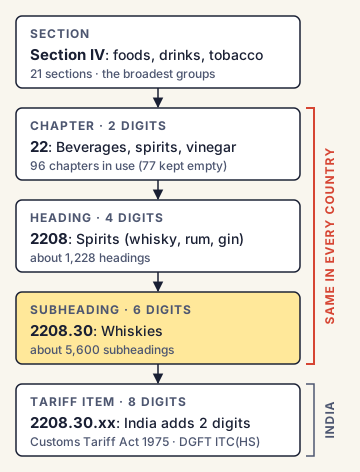
- Sections (21): very broad groups, such as "Prepared foodstuffs; beverages, spirits and vinegar; tobacco".
- Chapters (2 digits): there are 97 chapter numbers, but chapter 77 is kept empty for future use, so 96 chapters are in use. For example, Chapter 22 is "Beverages, spirits and vinegar".
- Headings (4 digits): HS 2022 has about 1,228 headings. For example, 2208 covers spirits such as whisky, rum and gin.
- Subheadings (6 digits): HS 2022 has about 5,600 subheadings. For example, 2208.30 is "Whiskies".
The first six digits are the same in every country. After that, each country can add its own digits for more detail.
How does India use it?
India adds two digits of its own, so its codes have 8 digits.
- The First Schedule of the Customs Tariff Act, 1975 lists import duty rates at the 8-digit level. Customs officers call the 4-digit level a "heading", the 6-digit level a "subheading" and the 8-digit level a "tariff item".
- The Directorate General of Foreign Trade (DGFT) under the Ministry of Commerce publishes the ITC(HS) list, also at 8 digits. Schedule 1 of ITC(HS) sets the import policy (free, restricted or prohibited), and Schedule 2 sets the export policy.
- Under GST, businesses print the HSN code (the same HS system) on their invoices. Since April 2021, businesses with yearly turnover up to ₹5 crore give 4 digits, and larger ones give 6 digits.
How do officers decide the right code?
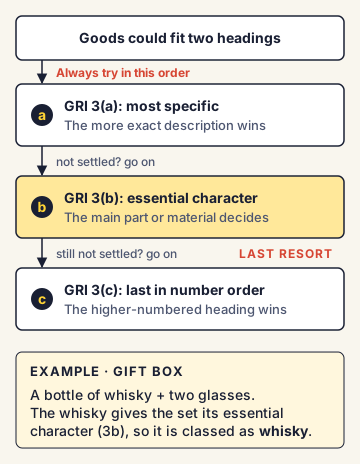
Many goods could fit more than one heading. So the HS comes with six General Rules for the Interpretation (GRI), which must be used in order.
- GRI 1: Classification depends on the words of the headings and the section and chapter notes. The section titles are only for easy reference.
- GRI 2: Unfinished or unassembled goods go where the finished good goes, if they already have its essential character. Mixtures are also dealt with here.
- GRI 3: If goods could fit two headings, (a) the most specific description wins; if that does not settle it, (b) the material that gives the good its "essential character" decides; and if still unclear, (c) the heading that comes last in number order is chosen.
- GRI 4: Goods that fit nowhere go to the heading of the goods they are most like.
- GRI 5: Rules for cases and packing materials.
- GRI 6: The same logic is used to pick among subheadings.
A simple example: a gift box with a bottle of whisky and two glasses. Under GRI 3(b), the whisky gives the set its essential character, so the whole set may be classified as whisky.
What happens when the importer and customs disagree?
In India, an importer can ask for a binding answer before importing. The Customs Authority for Advance Rulings (CAAR), with benches in Delhi and Mumbai, gives such rulings under Sections 28E to 28M of the Customs Act, 1962. Disputes after import go through the usual appeal path: the Commissioner (Appeals), then the tribunal (CESTAT), then the High Court and the Supreme Court. Internationally, the WCO's Harmonized System Committee gives classification opinions, but these guide countries and do not bind them.
Why classification matters so much in trade deals
A trade agreement does not cut duty on "whisky" in words. It cuts duty on certain tariff lines (codes). So the code decides whether a product gets the concession or pays the full rate. Rules of origin in trade deals also use HS codes. For example, a "change in tariff heading" rule says a product is local if processing changed its 4-digit heading.
Commonly confused concepts
- HS vs HSN vs ITC(HS): HS is the WCO's 6-digit world system. HSN (Harmonized System of Nomenclature) is the name commonly used in India, especially for GST; it is the same system. ITC(HS) is India's 8-digit version published by DGFT for import and export policy.
- Classification vs valuation vs origin: Classification decides what a good is (its code). Valuation decides how much it is worth for duty. Origin decides where it comes from (which affects trade-pact rates). These are three separate customs questions.
- WCO vs WTO: The WCO (Brussels) looks after customs procedures and the HS. The WTO (Geneva) makes trade rules, such as tariff bindings and the Most-Favoured-Nation principle. WTO members write their tariff promises using HS codes, so the two are linked but different.
- Tariff item vs tariff rate: The tariff item is the code; the tariff rate is the duty attached to that code. A trade deal changes the rate for certain items, not the codes themselves.
Issues, criticism and the way forward
- Disputes and delays: Unclear classification leads to goods being held at ports, extra costs and long cases in tribunals and courts. Investors see this as a sign of uncertainty.
- New products: New technology (for example, smart devices that do many things) often fits more than one heading. The five-year update cycle can lag behind innovation.
- Gaming the code: Some importers may describe goods wrongly to pay less duty. Customs agencies like the DRI exist to stop this, but heavy-handed action can also hurt honest traders.
- Way forward: Experts suggest wider use of advance rulings, clear public circulars from the CBIC on doubtful items, closer coordination between the Commerce and Finance Ministries when writing trade schedules, and using the GRI and WCO opinions consistently.
Concepts to Know
- Tariff line: One code in a customs tariff with its own duty rate. A trade deal lists concessions line by line.
- World Customs Organization (WCO): The international body for customs administrations, based in Brussels. It looks after the HS and helps countries simplify customs procedures.
- Contracting party: A country that has formally joined a treaty and must follow it.
- Advance ruling: A written, binding decision given to an importer before the goods arrive, so the importer knows in advance how they will be treated.
- CESTAT (Customs, Excise and Service Tax Appellate Tribunal): A special tribunal that hears appeals in customs and indirect-tax disputes.
- Concentrate / compound preparation: A product that is not ready to drink or use and needs mixing or processing before it becomes the final product. Customs often puts these under a different heading from the finished good.
- HS Convention concluded in Brussels on 14 June 1983; in force from 1 January 1988 (37 contracting parties at start)
- Administered by the World Customs Organization (Customs Co-operation Council, began 1952; renamed WCO in 1994), headquarters Brussels
- Structure: 21 sections, 96 chapters in use (97 numbered; chapter 77 reserved), about 1,228 headings and about 5,600 subheadings (HS 2022)
- First 6 digits are common worldwide; India uses 8 digits (Customs Tariff Act, 1975, First Schedule; DGFT's ITC(HS))
- Reviewed about every 5 years; HS 2022 in force from 1 January 2022; HS 2028 to come into force on 1 January 2028
- Six General Rules for Interpretation (GRI), applied in order; GRI 3(a) = most specific description wins
- Whisky: Chapter 22, heading 2208, subheading 2208.30
- India's advance rulings on classification: CAAR (Delhi and Mumbai), Sections 28E to 28M, Customs Act, 1962
- GST invoices: 4-digit HSN for turnover up to ₹5 crore, 6-digit above (since April 2021)
● Tracked since November 13, 2026 · last seen November 13, 2026 · updates as the daily brief publishes