Golden Crescent and Golden Triangle
India's Drug Trafficking Neighbourhood
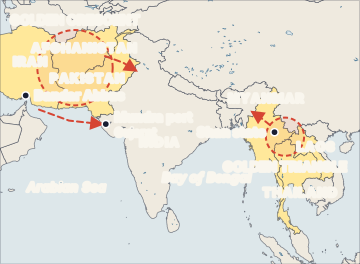
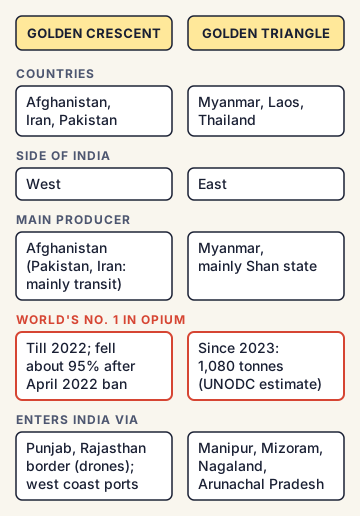
The Golden Crescent and the Golden Triangle are the two biggest illegal opium-producing regions of Asia. The Golden Crescent lies to India's west, where Afghanistan, Iran and Pakistan meet. The Golden Triangle lies to India's east, where Myanmar, Laos and Thailand meet. Because India sits between them, drugs from both regions are smuggled into India, either to be used here or to be passed on to other countries.
Why are they called "golden"?
Opium poppy farming and the drug trade bring huge illegal profits to farmers, smugglers and armed groups. The name reflects this wealth. "Crescent" comes from the curved, moon-like shape of the region on the map, and "triangle" from the three countries whose borders meet.
Why do these regions grow so much opium?
Several factors come together:
- Weak government control: Remote mountain areas with long-running conflicts, where the state has little presence.
- Poverty: Poppy earns farmers far more than food crops.
- Armed groups: Insurgents and militias tax or run the drug trade to fund their fighting.
- Suitable geography: Hilly land and climate suitable for poppy, and porous borders for smuggling.
The Golden Crescent (west of India)
For decades, Afghanistan was the world's largest producer of opium and heroin. Pakistan and Iran mainly act as transit countries. Drugs from here reach India by:
- Land: across the India-Pakistan border in Punjab and Rajasthan, increasingly using drones to drop packets.
- Sea: through ports on India's west coast. In September 2021, the Directorate of Revenue Intelligence seized about 2,988 kg of heroin at Mundra port (Gujarat). It came from Afghanistan via Bandar Abbas port in Iran, falsely declared as talc stones. It is among India's largest-ever heroin seizures.
The big change after 2022
The Taliban, who took control of Afghanistan in 2021, banned poppy cultivation in April 2022. According to the United Nations Office on Drugs and Crime (UNODC), Afghanistan's opium production fell by about 95%, from about 6,200 tonnes in 2022 to about 333 tonnes in 2023. But UNODC has also warned that methamphetamine (a synthetic drug) trafficking from and around Afghanistan has grown. So the threat from the west is shifting from heroin to synthetic drugs.
The Golden Triangle (east of India)
This region lies along the Mekong river area where Myanmar, Laos and Thailand meet. Myanmar is the main producer, especially in its Shan state. After the 2021 military takeover in Myanmar, conflict and poverty increased, and opium farming expanded. In 2023, UNODC reported that Myanmar overtook Afghanistan as the world's largest opium producer, with an estimated 1,080 tonnes. The region is also a major hub for methamphetamine tablets and crystal meth.
Drugs from here enter India through its northeastern states that border Myanmar: Manipur, Mizoram, Nagaland and Arunachal Pradesh. The India-Myanmar border is about 1,643 km long, mostly hilly and forested, and only a small part is fenced.
What is the Free Movement Regime (FMR)?
Tribes living on both sides of the India-Myanmar border have family and cultural ties. The FMR allowed border residents to cross a short distance into the other country without a visa. The free movement zone was 16 km for many years. Because of concerns about drugs, arms and illegal migration, the MHA in 2024 announced plans to end the FMR and fence the full border. Revised rules in December 2024 cut the zone to 10 km and require border passes issued by the Assam Rifles.
How does this affect India?
- Punjab has a long-standing drug abuse problem linked to heroin from across the western border.
- Manipur and Mizoram face heroin and methamphetamine coming from Myanmar. Drug money is linked to ethnic armed groups in the region.
- Narco-terrorism: Money from drug sales can fund terror and insurgent groups. Security agencies have linked drug smuggling in Punjab and Jammu and Kashmir to cross-border groups.
- Transit risk: India is also used as a route to send drugs onward to other countries.
What has India done?
- Strong law: the NDPS Act, 1985 and the PIT-NDPS Act, 1988.
- Border security: BSF on the Pakistan and Bangladesh borders, Assam Rifles on the Myanmar border, anti-drone systems in Punjab, and border fencing.
- Coordination: the NCORD four-tier system and Anti-Narcotics Task Forces in every state.
- International cooperation: drug-control agreements and MoUs with neighbours, information sharing through the UNODC, and work in BIMSTEC and the Colombo Plan.
Commonly confused concepts
- Golden Crescent vs Golden Triangle: Crescent = Afghanistan, Iran, Pakistan (west of India). Triangle = Myanmar, Laos, Thailand (east of India).
- Golden Triangle (drugs) vs Golden Triangle (tourism): India's tourist "Golden Triangle" is the Delhi-Agra-Jaipur circuit. It has nothing to do with drugs.
- Golden Quadrilateral: India's highway network linking Delhi, Mumbai, Chennai and Kolkata. Again, not related to drugs.
- Top opium producer: Afghanistan was number one for many years; after its 2022 poppy ban, Myanmar became number one in 2023 (UNODC).
- Free Movement Regime vs open border: India's border with Nepal and Bhutan is open by treaty. The FMR on the Myanmar border only allowed limited movement within a short zone.
Issues, criticism and the way forward
- Hard terrain: Long, hilly, forested borders are difficult to fence and guard fully.
- Local ties: Ending the FMR is opposed by some border communities, who say it divides families and harms traditional trade. The government's position is that security needs come first.
- Shift to synthetic drugs: Methamphetamine is easier to make and hide than heroin, so traditional crop-based controls are less effective.
- Political instability next door: Conflict in Myanmar and changes in Afghanistan make cooperation with these governments difficult.
- Way forward: Smart fencing and technology-based surveillance, closer work with neighbours and UNODC, alternative livelihoods for poppy-growing communities in neighbouring countries, cutting the money trail behind trafficking, and reducing demand at home through treatment and awareness.
Concepts to Know
- UNODC (United Nations Office on Drugs and Crime): The UN agency that tracks drug production and trafficking and helps countries fight drugs and organised crime. It is based in Vienna.
- Transit country: A country through which drugs pass on their way to another market.
- Narco-terrorism: When terrorist or insurgent groups use money from the drug trade to fund their activities, or when drug gangs use violence like terrorists.
- Methamphetamine: A powerful, addictive synthetic stimulant drug, sold as tablets (often called "yaba") or crystals.
- Porous border: A border that is easy to cross without being checked, because it is unfenced or hard to guard.
- Golden Crescent: Afghanistan, Iran, Pakistan; Golden Triangle: Myanmar, Laos, Thailand
- Taliban poppy ban: April 2022; Afghan opium fell about 95% (about 6,200 t in 2022 to about 333 t in 2023, UNODC)
- Myanmar became the world's largest opium producer in 2023 (about 1,080 t, UNODC)
- Mundra port heroin seizure: about 2,988 kg, September 2021, via Bandar Abbas (Iran)
- India-Myanmar border: about 1,643 km; states: Arunachal Pradesh, Nagaland, Manipur, Mizoram
- Free Movement Regime zone: 16 km, cut to 10 km under revised rules of December 2024; passes issued by Assam Rifles
● Tracked since October 21, 2026 · last seen October 21, 2026 · updates as the daily brief publishes