Genetically Modified (GM) Crops
Regulation in India and the GEAC
A genetically modified (GM) crop is a plant whose DNA (the set of instructions inside every cell) has been changed in a laboratory, usually by adding a gene taken from another living thing. This new gene gives the plant a new quality, such as killing a pest or surviving a weedkiller. In India, GM crops are tightly controlled.
Only one GM crop, Bt cotton, is approved for commercial farming, and every GM seed, food or import needs approval from government committees, mainly the Genetic Engineering Appraisal Committee (GEAC).
How is a GM crop made?
Every living thing carries genes, which are small pieces of DNA that tell the cell what to make. Scientists find a gene that does something useful in one organism. They then insert that gene into the DNA of a crop plant. The new plant now has a trait (a quality) it could never get through normal breeding.
A simple way to picture it: normal breeding is like mixing two recipes from the same cookbook. Genetic modification is like copying one useful line from a completely different cookbook into yours.
Why do scientists make GM crops?
Farmers face pests, weeds, drought and poor soils. GM technology tries to solve these problems inside the seed itself.
- Insect resistance: The best-known example is Bt cotton. It carries a gene from a soil bacterium called Bacillus thuringiensis (Bt). The gene makes a protein (a Cry protein) that kills certain caterpillars, like the bollworm, when they eat the plant.
- Herbicide tolerance (HT): The crop survives a weedkiller (herbicide) that kills the weeds around it. This saves farmers the cost of removing weeds by hand.
- Higher yield or better hybrids: For example, GM mustard uses a genetic system that makes it easier to produce high-yielding hybrid seeds.
- Better nutrition: For example, "Golden Rice" was modified to produce beta-carotene, which the body turns into vitamin A.
Why are GM crops controversial?
Supporters say GM crops raise yields, cut pesticide use and help farmers earn more. Opponents worry about three things: possible harm to health over the long term, harm to the environment (for example, genes spreading to wild plants, or harm to bees), and control of seeds by a few big companies. Because the risks are debated, most countries regulate GM crops strictly.
India follows a precautionary approach: be careful first, and allow a GM crop only after it has been tested for safety step by step.
Where did India's GM rules come from?
India's GM rules are older than the GM crops grown in the country.
- 1986: Parliament passed the Environment (Protection) Act, 1986, after the Bhopal gas tragedy. It gives the Centre wide powers to protect the environment.
- 1989: Under this Act, the Environment Ministry notified the Rules for the Manufacture, Use, Import, Export and Storage of Hazardous Microorganisms, Genetically Engineered Organisms or Cells, 1989. These are simply called the "Rules, 1989". They are still the main legal basis for GM regulation in India.
- 2002: The GEAC approved Bt cotton (Bollgard I, with one gene, Cry1Ac) for commercial farming in March 2002. Bollgard II, with two Bt genes, came in 2006.
- 2003: India became a Party to the Cartagena Protocol on Biosafety on 11 September 2003, the day it came into force. This international agreement sets rules for moving living GM organisms safely between countries.
- 2009-2010: The GEAC recommended the release of Bt brinjal in October 2009. After nationwide public consultations, the Environment Ministry put it under an indefinite moratorium (a temporary stop) on 9 February 2010, until independent studies prove it safe.
- 2010: The GEAC's name was changed from Genetic Engineering Approval Committee to Genetic Engineering Appraisal Committee. "Appraisal" means careful assessment, showing its wider role in checking risks.
- 2012-2013: A Parliamentary Standing Committee on Agriculture (2012) and a Technical Expert Committee set up by the Supreme Court (final report, July 2013) both called for a halt on open field trials of GM food crops until regulation became stronger.
- 2022: The GEAC recommended the environmental release of GM mustard (DMH-11) at its meeting on 18 October 2022. The same year, the government exempted certain genome-edited plants from the strict GM rules (see below).
- 2024: The Supreme Court gave a split verdict on GM mustard on 23 July 2024 in Gene Campaign v. Union of India. The two judges disagreed on the approval, so the case went to a larger bench. But both agreed that the Centre must frame a national policy on GM crops after consulting states, farmers and experts.
Who regulates GM crops in India?
The Rules, 1989 set up six committees. Think of them as a ladder that a GM crop must climb, one step at a time.
- Recombinant DNA Advisory Committee (RDAC): under the Department of Biotechnology (DBT). It watches developments in biotechnology in India and abroad and suggests safety rules.
- Institutional Biosafety Committee (IBSC): set up inside every institution (a university, lab or company) that does GM research. It is the first check at the lab level.
- Review Committee on Genetic Manipulation (RCGM): under the DBT. It approves research-stage work and early, small trials, and checks safety data.
- Genetic Engineering Appraisal Committee (GEAC): under the Ministry of Environment, Forest and Climate Change (MoEFCC). It is the top body. It decides on large-scale field trials, environmental release (letting a GM crop be grown in open fields) and the import of living GM organisms.
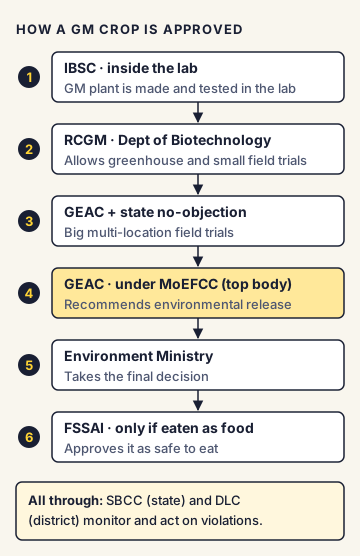
- State Biotechnology Coordination Committee (SBCC) and District Level Committee (DLC): these monitor GM activities in states and districts and can act against violations.
How does a GM crop get approved, step by step?
- A scientist or company develops the GM plant in a lab, under the eye of the IBSC.
- The RCGM reviews the lab data and allows small, controlled trials in greenhouses and limited fields.
- The developer then runs bigger, multi-location field trials, which need GEAC approval and a no-objection from the state government (agriculture is a State subject).
- Data on food safety, effect on other insects, effect on soil and yield is studied.
- The GEAC decides whether to recommend environmental release. The Environment Ministry then takes the final decision.
- If the crop is also eaten as food, the Food Safety and Standards Authority of India (FSSAI) must approve it as food.
What does the food law say?
Section 22 of the Food Safety and Standards Act, 2006 says no one can make, sell, distribute or import any GM food except as allowed under the Act and its regulations. FSSAI has published draft GM food regulations, but final standards had not been notified as of late 2025. In October 2025, the Rajasthan High Court directed the Centre and FSSAI to frame these regulations within six months, and restrained approvals for the sale or import of GM food until then.
For imports of 24 food crops (like rice, wheat, maize, soybean, potato and tomato), FSSAI has required a non-GM certificate from the exporting country since 1 March 2021, with a tolerance of 1% for accidental GM presence.
India's position and Indian examples
- Bt cotton is India's only approved GM crop for commercial cultivation. It now covers nearly all of India's cotton area and helped India become one of the world's largest cotton producers.
- Bt brinjal remains under the 2010 moratorium. (Neighbouring Bangladesh approved Bt brinjal for farming in 2013.)
- GM mustard (DMH-11) was developed at the Centre for Genetic Manipulation of Crop Plants, University of Delhi. It uses a barnase-barstar system (two genes that switch male fertility off and back on) to make hybrid seed production easier. It also carries the bar gene, which makes the plant tolerant to the herbicide glufosinate. Its release is held up in the Supreme Court.
- Herbicide-tolerant Bt cotton (HTBt) is not approved, though illegal planting has been reported in some states.
- Imports: India has allowed the import of refined oil from GM soybean and canola, because highly refined oil has no detectable DNA or protein. In 2021, the government also allowed the one-time import of de-oiled GM soymeal (crushed soybean left after oil extraction) for poultry feed, since it contains no living GM organism. India does not allow the import or growing of GM grains or seeds as food crops.
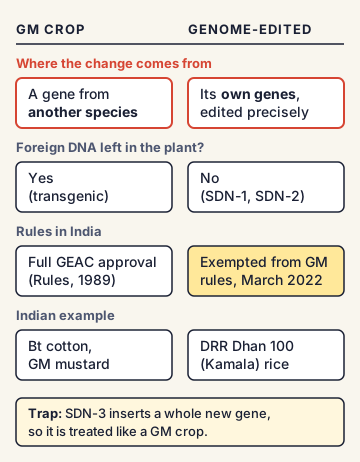
- Genome editing: In March 2022, the Environment Ministry exempted plants made by SDN-1 and SDN-2 genome editing (with no foreign DNA left in them) from the strict GM approval rules. In May 2025, India released its first two genome-edited rice varieties: DRR Dhan 100 (Kamala) and Pusa DST Rice 1, developed by ICAR (Indian Council of Agricultural Research).
- Worldwide: GM crops are grown in about 30 countries. The United States has the largest area, followed by Brazil, Argentina, India and Canada (ISAAA data for 2024). India's place in this list comes entirely from Bt cotton.
Commonly confused concepts
- GM crop vs genome-edited crop: A GM (transgenic) crop carries a gene from another species. A genome-edited crop has its own genes changed precisely, like correcting a spelling inside the same book, usually with tools like CRISPR. SDN-1 and SDN-2 edits leave no foreign DNA, which is why India treats them more lightly.
- SDN-1 vs SDN-2 vs SDN-3: SDN means Site-Directed Nuclease, a "molecular scissors" that cuts DNA at a chosen spot. SDN-1 makes a small change with no template. SDN-2 uses a small template to make a planned change. SDN-3 inserts a whole new gene, so it is treated like a GM crop.
- GEAC vs RCGM: GEAC (Environment Ministry) approves large trials, environmental release and imports. RCGM (Department of Biotechnology) handles research-stage approvals.
- GEAC vs FSSAI: GEAC checks the environmental safety of a GM organism. FSSAI checks whether a GM product is safe to eat.
- Living GM organism (LMO) vs GM product: A GM seed can grow, so it is a "living modified organism" and falls under the Cartagena Protocol. Refined oil or de-oiled meal made from GM crops cannot grow, so it is a processed product, not an LMO.
- Bt crop vs HT crop: A Bt crop kills certain insects. An HT crop survives a weedkiller. Some crops, like HTBt cotton, carry both traits.
Issues, criticism and the way forward
- Food security and yields: Supporters, including many agricultural scientists, argue that India needs GM and gene-edited crops to raise yields and to cut its large edible oil imports. They say GM mustard could help in this.
- Health and environment concerns: Critics, including farmer groups and civil society networks, point to the lack of long-term health studies, possible harm to bees and other pollinators, and the risk of genes spreading to related plants.
- Pest resistance: The pink bollworm became resistant to Bt cotton over the years. This shows that GM traits can lose their power if farmers do not follow practices like planting refuge rows (a strip of non-Bt plants that slows resistance).
- Weak enforcement: Illegal HTBt cotton shows that seeds can spread without approval, which weakens trust in the system.
- Regulation by office orders: Critics say important decisions, like the 2022 genome-editing exemption, were made through office memorandums rather than through Parliament or the full rules.
- Trade pressure: Big exporting countries, especially the US, grow mostly GM soybean and maize and want market access. India's strict rules protect its farmers and its "non-GM" export image, but they can become a sticking point in trade talks.
- Way forward: The Supreme Court has asked for a national GM crop policy built through wide consultation. Experts also suggest a single, independent and transparent biotechnology regulator, final GM food rules from FSSAI, and better seed-supply checks to stop illegal GM seeds.
Concepts to Know
- Gene / DNA: DNA is a long chemical code inside every cell. A gene is a small part of it that tells the cell to make one particular thing, like a protein.
- Transgenic: A plant or animal that carries a gene from a different species.
- Herbicide: A chemical used to kill weeds.
- Moratorium: A temporary stop on an activity until certain conditions are met.
- Environmental release: Permission to grow a GM crop in open fields, outside a lab or controlled trial.
- Precautionary approach: The idea that when a new technology may cause serious harm and science is not yet certain, the government should be careful and act to prevent harm first.
- Hybrid seed: A seed produced by crossing two different parent lines, which often gives a stronger, higher-yielding plant for one season.
- CRISPR: A gene-editing tool that works like very precise scissors, letting scientists cut and change DNA at an exact spot.
- Legal basis: Rules, 1989 under the Environment (Protection) Act, 1986
- Six committees: RDAC, IBSC, RCGM, GEAC, SBCC, DLC; GEAC is under MoEFCC, RCGM under DBT
- GEAC renamed "Approval" to "Appraisal" in 2010
- Bt cotton approved March 2002; Bollgard II in 2006; India's only commercial GM crop
- Bt brinjal moratorium: 9 February 2010
- GM mustard DMH-11: GEAC recommendation on 18 October 2022; Supreme Court split verdict on 23 July 2024 (Gene Campaign v. Union of India), national GM policy directed
- Cartagena Protocol: India a Party from 11 September 2003
- FSS Act, 2006, Section 22: GM food needs approval; FSSAI non-GM certificate for 24 imported food crops from 1 March 2021, 1% tolerance
- Genome-edited SDN-1 and SDN-2 plants exempted: March 2022; first genome-edited rice varieties released May 2025 (DRR Dhan 100 Kamala, Pusa DST Rice 1)
● Tracked since November 03, 2026 · last seen November 03, 2026 · updates as the daily brief publishes