FTA Utilisation Rate
Why Signed Trade Deals Often Go Unused
The FTA utilisation rate tells us what share of eligible trade actually uses the lower tariffs promised in a free trade agreement (FTA). Signing a trade deal does not cut anyone's taxes automatically. An exporter must prove that the goods really come from the partner country and then claim the lower rate. If an exporter skips this step, the goods pay the normal, higher tariff, and the benefit of the deal is lost.
Why does this number matter?
Countries spend years negotiating trade deals. They give up tariff income and open their own markets in return for better access abroad. If their own exporters then do not use that access, the country bears the cost of the deal without getting its full benefit. So the utilisation rate is like a report card for a trade deal: it shows whether the promises on paper turned into real savings for real businesses.
Think of it like a discount coupon. A shop may give you a 10% coupon. But if the shop asks you to fill a long form, bring three documents and wait in a queue, you might just pay full price for a small item. Low FTA use works the same way.
How is it calculated?
The simple formula is:
- Utilisation rate = value of trade that actually got the lower FTA tariff ÷ value of trade that was eligible for the lower tariff × 100
For example, say Indian firms sent ₹100 crore of goods to a partner country that could have entered at the lower FTA rate. If only ₹25 crore of those goods were actually declared under the FTA, the utilisation rate is 25%. The other ₹75 crore paid the normal tariff even though a cheaper rate was available.
A related idea is the preference margin. This is the gap between the normal tariff and the FTA tariff. If a partner charges 10% normally and 0% under the FTA, the margin is 10 percentage points. The bigger the margin, the more reason a firm has to claim it.
How does a firm claim the FTA rate?
The steps are roughly these:
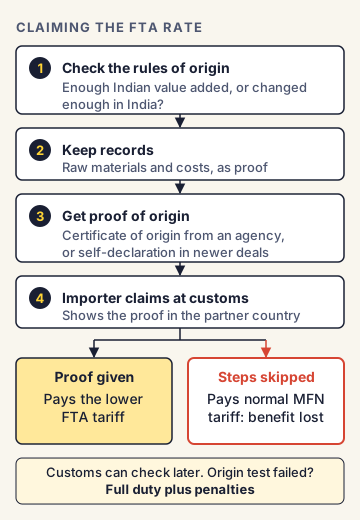
- The exporter checks the rules of origin for its product. These are the tests that decide whether a product truly "comes from" India, for example by having enough Indian value added or by being changed enough in India.
- The exporter keeps records of its raw materials and costs to prove it meets these tests.
- The exporter gets a certificate of origin from an authorised agency, or in some newer deals writes its own origin declaration (self-certification).
- The importer in the partner country shows this proof to customs and claims the lower tariff.
- Customs can later check the claim. If the goods fail the origin test, the importer may have to pay the full duty plus penalties.
Where does the idea come from?
Under World Trade Organization (WTO) rules, the basic principle is Most-Favoured-Nation (MFN) treatment, in GATT (General Agreement on Tariffs and Trade) Article I. It means a country must charge the same tariff to all WTO members. FTAs are an allowed exception under GATT Article XXIV. Because FTA tariffs are lower only for partners, every FTA needs rules of origin to stop goods from outside countries sneaking in through a partner. These rules create paperwork, and paperwork is the main reason utilisation is often low across the world.
Why is India's utilisation low?
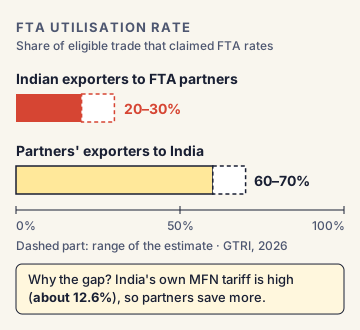
A 2026 study by the think tank Global Trade Research Initiative (GTRI) estimated that Indian exporters use FTA benefits on only about 20–30% of eligible exports. In contrast, partner countries' exporters selling to India use them on about 60–70%. The main reasons given:
- Compliance cost: Gathering origin proof takes time, staff and money. Small firms often find this not worth it for a small tariff saving.
- Low partner tariffs: Many of India's partners (for example in Southeast Asia) already have low normal tariffs, so the preference margin is small.
- Complex rules of origin: Each FTA has its own rules, so a firm exporting to several partners must learn several systems.
- Low awareness: Many micro, small and medium enterprises (MSMEs) do not know which FTA covers their product or what rate applies.
The same study noted that India's own trade-weighted MFN tariff is about 12.6%. This is much higher than in many partners, so foreign exporters gain more by using India's FTAs than Indian exporters gain from theirs.
What has India done about it?
- Common Digital Platform for Certificates of Origin (2019): The Directorate General of Foreign Trade (DGFT) and the Department of Commerce launched an online system in September 2019 for issuing preferential certificates of origin. It was later widened to non-preferential certificates from 2021. It cuts paperwork and in-person visits.
- CAROTAR 2020: The Customs (Administration of Rules of Origin under Trade Agreements) Rules came into effect on 21 September 2020, under Section 28DA of the Customs Act, 1962 (added by the Finance Act, 2020). These rules make importers into India take "reasonable care" that origin claims are true. This targets misuse of India's FTAs by goods from non-partner countries.
- Self-certification in newer deals: Under the India-UK CETA, exporters can make their own origin declaration instead of always getting a government certificate. In July 2026, the Central Board of Indirect Taxes and Customs (CBIC) issued Circular No. 33/2026-Customs setting out how such self-certified declarations work for UK goods.
- Data sharing with partners: Agreeing to exchange data on how much trade claims the FTA rate, as India and the UK have done, lets both sides see where use is low and fix the problems.
Commonly confused concepts
- FTA utilisation rate vs FTA coverage: Coverage is how many tariff lines or how much trade the deal makes eligible for lower tariffs (for example "99% of tariff lines"). Utilisation is how much of that eligible trade actually used the lower tariff. A deal can have very high coverage and still low utilisation.
- Preferential vs non-preferential certificate of origin: A preferential certificate is used to claim a lower FTA tariff. A non-preferential certificate only states where goods come from (for example, for anti-dumping checks or the buyer's records). It gives no tariff benefit.
- Utilisation rate vs trade deficit with FTA partners: A rising trade deficit with a partner after an FTA is a different problem. It is about imports growing faster than exports, not about whether firms claim tariff cuts. Both are often discussed together, but they measure different things.
Issues, criticism and the way forward
- Benefits go mostly to big firms: Large exporters have staff to handle paperwork; MSMEs often do not. This means the gains of a trade deal may not reach the small firms that employ most workers.
- Weak data: For a long time India did not publish regular, product-level utilisation data for every FTA, making it hard to judge if a deal is working.
- "Spaghetti bowl" problem: Many overlapping FTAs, each with different rules, confuse traders. Experts suggest common, simpler origin rules across deals where possible.
- Suggested fixes: Experts and trade bodies recommend helpdesks and awareness drives for MSMEs, more self-certification, fully digital origin processes, regular publication of utilisation data, and FTA review clauses that use this data to fix problem areas.
Concepts to Know
- Free Trade Agreement (FTA): A deal between countries to remove or cut tariffs on most goods traded between them, while each keeps its own tariffs for outside countries.
- Tariff line: One product category in a country's customs tariff list, such as "cotton shirts for men". Each line has its own tariff rate.
- Most-Favoured-Nation (MFN) tariff: The normal tariff a WTO member charges all other members equally. FTA partners get rates lower than this.
- Trade-weighted tariff: An average tariff where each product's tariff counts according to how much of it is actually imported. Heavily traded items affect the average more.
- MSME (Micro, Small and Medium Enterprises): Small businesses, defined in India by limits on investment and turnover. They make up a large share of India's exporters and jobs.
- Utilisation rate = FTA-claimed trade ÷ FTA-eligible trade × 100
- GTRI (2026) estimate: Indian exporters use FTA benefits on about 20–30% of eligible exports; partners' exporters to India, about 60–70%
- India's trade-weighted MFN tariff: about 12.6% (GTRI estimate)
- Common Digital Platform for preferential certificates of origin: launched September 2019 (DGFT); non-preferential certificates added in 2021
- CAROTAR 2020: in force from 21 September 2020, under Section 28DA of the Customs Act, 1962 (inserted by the Finance Act, 2020)
- MFN principle: GATT Article I; FTA exception: GATT Article XXIV
● Tracked since October 12, 2026 · last seen October 12, 2026 · updates as the daily brief publishes