Foreign Exchange Reserves
Components, Adequacy and Use
Updated 11 Oct 2026: Added how the RBI's special dollar window for oil companies uses reserves (2013 and October 2026), plus the October 2026 reserve breakdown.
Foreign exchange reserves (forex reserves) are the foreign money and other safe international assets that a country's central bank keeps aside. In India, the Reserve Bank of India holds them. They are mostly US dollars and other major currencies, plus gold. They work like a family's emergency savings: the country can use them to pay for imports, repay foreign loans and calm the rupee when it falls too fast.
Why does a country need them?
India buys much more from the world than it sells, especially crude oil, gold and electronics. It pays for these imports in dollars. If foreign money suddenly stops coming in, or investors rush out, the country could run short of dollars. Then the rupee would crash, imports would become very costly and the country might not repay its debts. Reserves are the cushion that prevents this. A large cushion also gives foreign investors confidence that India can always pay its bills.
Where did India learn this lesson?
In the 1991 balance of payments crisis, India's reserves fell to about USD 1.2 billion in January 1991, enough for only about three weeks of imports. To borrow emergency money, India had to pledge its gold: about 47 tonnes was shipped to the Bank of England, and about 20 tonnes was used in a deal through UBS (a Swiss bank).
This painful episode pushed India into the 1991 economic reforms and made building strong reserves a national priority. Since then, reserves have grown many times over.
What are India's reserves made of?
There are four parts:
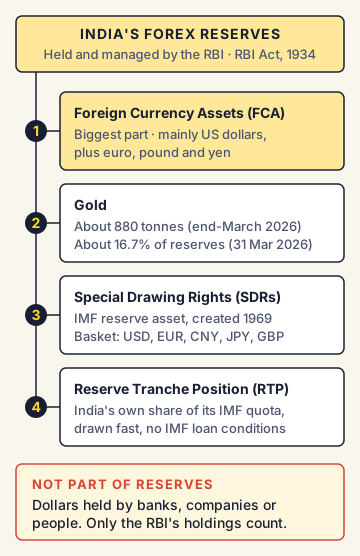
- Foreign Currency Assets (FCA): the biggest part. These are mainly US dollars, plus euros, pounds and yen, kept as deposits with other central banks and as safe foreign government bonds. Their value in dollars also changes when other currencies rise or fall against the dollar.
- Gold: gold held by the RBI. At end-March 2026, the RBI held about 880 tonnes, and most of it is now kept in vaults inside India. Gold made up about 16.7% of reserves on 31 March 2026.
- Special Drawing Rights (SDRs): a reserve asset created by the International Monetary Fund (IMF) in 1969. Its value is based on a basket of five currencies: the US dollar, euro, Chinese yuan, Japanese yen and British pound. The yuan joined the basket in 2016.
- Reserve Tranche Position (RTP) in the IMF: part of India's quota (membership money) with the IMF that India can withdraw quickly, without the usual conditions of an IMF loan.
Who manages them and how?
The RBI manages the reserves under the Reserve Bank of India Act, 1934, mainly sub-sections of Section 17 and Section 33, which list where the money can be invested. The RBI follows three goals in this order: safety, liquidity and return. Safety means the money must not be lost. Liquidity means it must be available quickly when needed.
Only after these comes earning some income. The RBI publishes reserve data every week (in its Weekly Statistical Supplement, every Friday) and a detailed report on reserve management twice a year.
How do reserves rise and fall?
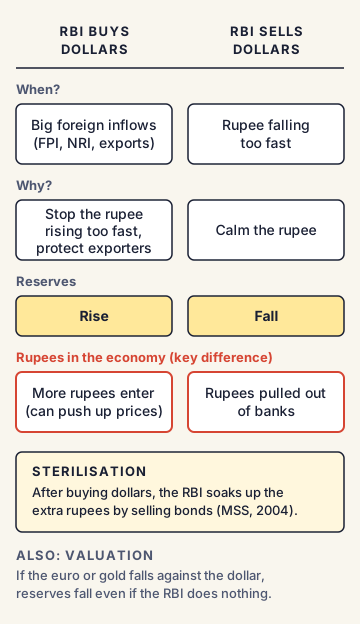
- They rise when the RBI buys dollars. This happens when lots of foreign money flows in (from foreign investors, NRI deposits or exports). The RBI buys the extra dollars so the rupee does not rise too fast and hurt exporters.
- They fall when the RBI sells dollars to stop the rupee from falling too fast, as in September and October 2026.
- They also fall when the RBI gives dollars straight to big importers. Oil companies need huge amounts of dollars every day. When they all buy in the market, the rupee falls further. So in a crisis, the RBI can open a special dollar window: it supplies the dollars itself, through chosen banks. It did this for Indian Oil, BPCL and HPCL from 28 August 2013 (as a forex swap, where the companies returned the dollars later), and closed it in December 2013 once the rupee was stable. It opened a similar window for the same three companies from 12 October 2026, covering their full daily dollar needs.
- They also change with valuation. If the euro or gold price falls against the dollar, the dollar value of reserves falls, even if the RBI did nothing.
What is sterilisation?
When the RBI buys dollars, it pays in rupees, so more rupees enter the economy. Too much extra money can push up prices. So the RBI often "sterilises" these purchases by soaking up the extra rupees, for example by selling government bonds. The Market Stabilisation Scheme (MSS), started in 2004 under an agreement between the government and the RBI, allows special bonds to be issued only for this purpose. When the RBI sells dollars, the opposite happens: rupees are pulled out of the banking system.
How much is enough? (Reserve adequacy)
There is no single right number. Experts use several measures:
- Import cover: how many months of imports the reserves can pay for. A common rule of thumb says at least 3 months.
- Guidotti-Greenspan rule: reserves should at least cover all foreign debt that falls due within the next one year (short-term external debt).
- IMF's Assessing Reserve Adequacy (ARA) measure: a broader formula that also counts exports, money supply and other foreign liabilities.
India's position
India built one of the world's largest reserve stocks. As per the Economic Survey, India was the fourth-largest holder at end-2024, after China, Japan and Switzerland. Reserves crossed USD 700 billion for the first time in 2024, and touched a record of about USD 785.7 billion in the week ended 4 September 2026, helped by a special FCNR(B) deposit swap window that drew dollar deposits from Non-Resident Indians.
They then fell sharply as the RBI sold dollars: in the week ended 25 September 2026 they dropped by about USD 18.3 billion, the biggest weekly fall on record, and stood at about USD 734.6 billion in the week ended 2 October 2026. Of this, foreign currency assets were about USD 604.7 billion and gold about USD 106.4 billion.
Commonly confused concepts
- Forex reserves vs foreign exchange (in general): Reserves are only the foreign assets held by the RBI. Dollars held by banks, companies or people are not part of reserves.
- Forex reserves vs Sovereign Wealth Fund: A sovereign wealth fund (like Norway's) invests a country's surplus wealth to earn high returns, often in shares. Reserves are kept mainly for safety and quick use, not for high returns. India does not have a sovereign wealth fund built from its reserves.
- SDR vs Reserve Tranche: SDRs are a special IMF reserve asset given to members in proportion to their quotas. The reserve tranche is a part of India's own quota payment that it can draw back from the IMF at short notice.
- Gross reserves vs net position: The headline number is gross. The RBI also has a "forward book": dollars it has promised to sell or buy in future through forward contracts. A large promise to sell dollars later means the real cushion is smaller than the headline number.
- Forex reserves vs Strategic Petroleum Reserves: Forex reserves are money. Strategic Petroleum Reserves are stores of crude oil kept for supply emergencies.
Issues, criticism and the way forward
- Cost of holding reserves: Reserves are kept in very safe assets that earn low interest. Meanwhile, India pays higher interest on its own borrowing. Critics say this gap is a cost to the country.
- Using reserves vs saving them: Selling dollars to defend the rupee can drain reserves fast, as seen in 2026. Some experts argue the RBI should let the rupee adjust more and save reserves for a real crisis. Others say sharp rupee falls cause panic and costly imports, so smoothing is needed.
- "Hot money" reserves: A part of the reserves was built from foreign portfolio investment and NRI deposits, which can leave quickly. Reserves built on such flows are less solid than those built on exports.
- Way forward: Experts suggest raising exports, attracting steady foreign direct investment, keeping a balance between gold and currencies, and using rules (like curbs on speculation) along with reserves to protect the rupee.
Concepts to Know
- Balance of payments (BoP): A record of all money flowing between India and the rest of the world, through trade, investment, loans and remittances.
- Spot market: The market where currencies are bought and sold for immediate delivery (usually within two days).
- Depreciation: When the rupee loses value against another currency. If one dollar costs ₹97 instead of ₹90, the rupee has depreciated.
- IMF quota: The amount each country contributes to the IMF. It decides the country's voting power and how much it can borrow.
- Foreign portfolio investment (FPI): Money foreign investors put into Indian shares and bonds. It can come in and go out quickly.
- FCNR(B) deposits: Foreign Currency Non-Resident (Bank) deposits: fixed deposits that NRIs keep in Indian banks in foreign currency, such as dollars.
- Forex swap: A deal where one side gives dollars now and agrees to take them back (or give them back) on a fixed later date at a fixed rate.
- Four components: Foreign Currency Assets, Gold, SDRs, Reserve Tranche Position in the IMF
- Managed by the RBI under the RBI Act, 1934 (sub-sections of Sections 17 and 33); priority: safety, liquidity, return
- Weekly data every Friday (Weekly Statistical Supplement); half-yearly report on reserve management
- 1991 crisis: reserves about USD 1.2 billion (January 1991); about 47 tonnes of gold pledged with the Bank of England, about 20 tonnes via UBS
- SDR created by the IMF in 1969; basket of five currencies (USD, EUR, CNY, JPY, GBP); yuan added 2016
- Market Stabilisation Scheme (sterilisation): 2004
- RBI gold: about 880 tonnes (end-March 2026); gold share about 16.7% of reserves (31 March 2026)
- Record reserves: about USD 785.7 billion (week ended 4 September 2026); about USD 734.6 billion (week ended 2 October 2026)
- India: fourth-largest reserve holder at end-2024 (after China, Japan, Switzerland)
- Special dollar window for public sector oil companies (IOC, BPCL, HPCL): August to December 2013; again from 12 October 2026
- 11 Oct 2026Added how the RBI's special dollar window for oil companies uses reserves (2013 and October 2026), plus the October 2026 reserve breakdown.
● Tracked since March 02, 2026 · last seen October 11, 2026 · updates as the daily brief publishes