Food Fortification
Rationale, Science and FSSAI Standards
Food fortification means adding extra vitamins and minerals to commonly eaten foods while they are being processed. For example, iodine is added to salt, and iron, folic acid and vitamin B12 are added to rice. The food looks, tastes and costs almost the same, but it gives more nutrition. It is one of the cheapest ways to reduce micronutrient deficiency across a whole population.
Why does it exist?
Most people do not eat a balanced diet every day. But almost everyone eats salt, rice or wheat flour, cooking oil and milk. If small amounts of missing nutrients are added to these daily foods, everyone gets them without having to change their habits or remember to take tablets. It works like a silent safety net.
Where did it come from?
The most famous early example is iodised salt. Lack of iodine causes goitre (a swelling in the neck) and can harm brain development in children. India began the National Goitre Control Programme in 1962. In 1992 it was renamed the National Iodine Deficiency Disorders Control Programme (NIDDCP), with the aim of making all edible salt iodised. The rule is that iodised salt should have at least 30 ppm of iodine at the production level and at least 15 ppm at the consumer level.
The legal framework in India
Fortification is regulated by the Food Safety and Standards Authority of India (FSSAI), set up under the Food Safety and Standards Act, 2006.
- FSSAI notified the Food Safety and Standards (Fortification of Foods) Regulations, 2018. These set the levels of nutrients that must be added to fortified foods.
- Five staple foods are the focus: rice, wheat flour (atta and maida), edible oil, milk and salt.
- Fortified foods carry the "+F" logo, so buyers can recognise them.
- FSSAI runs a Food Fortification Resource Centre (FFRC) to support industry and states.
What goes into each food?
- Salt: iodine; and in double fortified salt, both iodine and iron. Double fortified salt was developed by the National Institute of Nutrition (NIN), Hyderabad.
- Rice: iron, folic acid and vitamin B12.
- Wheat flour: iron, folic acid and vitamin B12.
- Edible oil and milk: vitamins A and D.
How is rice fortified?
Rice grains cannot simply be sprayed with nutrients, because washing would remove them. So a special method is used:
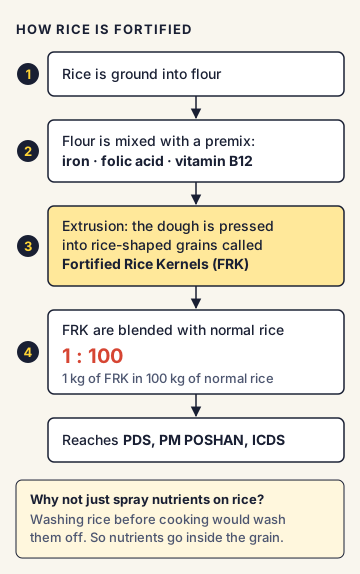
- Rice is ground into flour.
- The flour is mixed with a premix of iron, folic acid and vitamin B12.
- This dough is pressed through a machine (extrusion) into small grains that look like rice. These are called Fortified Rice Kernels (FRK).
- The FRK are mixed with normal rice, usually in a ratio of 1:100 (1 kg of FRK with 100 kg of normal rice).
India's rice fortification programme
On 15 August 2021, the Prime Minister announced that rice given through government schemes would be fortified. The Cabinet approved a three-phase plan:
- Phase I: ICDS and PM POSHAN across India, by March 2022.
- Phase II: the Targeted Public Distribution System (TPDS) and other welfare schemes in 291 aspirational and high-burden districts, by March 2023.
- Phase III: the rest of the country, by March 2024.
In October 2024, the Cabinet approved continuing the supply of free fortified rice under the PM Garib Kalyan Anna Yojana (PMGKAY) and other schemes from July 2024 to December 2028, with an outlay of ₹17,082 crore, fully funded by the Centre as part of food subsidy.
India's nutrition challenge
The need is clear from the National Family Health Survey-5 (NFHS-5, 2019–21):
- 67.1% of children aged 6–59 months were anaemic (up from 58.6% in NFHS-4).
- 57% of women aged 15–49 were anaemic (up from 53%).
- 35.5% of children under five were stunted (too short for their age), 19.3% were wasted (too thin for their height) and 32.1% were underweight.
Commonly confused concepts
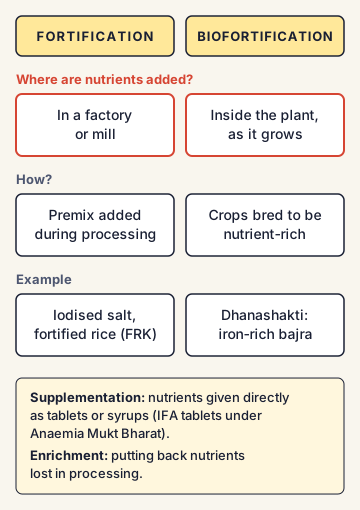
- Food fortification vs biofortification: Fortification adds nutrients during processing in a factory or mill. Biofortification breeds plants that grow with more nutrients inside.
- Fortification vs enrichment: Enrichment usually means putting back nutrients that were lost during processing (for example, nutrients lost when wheat is refined). Fortification adds nutrients, whether or not they were there originally.
- Fortification vs supplementation: Supplementation means giving nutrients directly as tablets, syrups or injections, like iron-folic acid tablets under the Anaemia Mukt Bharat programme.
- Mandatory vs voluntary fortification: Salt iodisation is compulsory for edible salt in most cases. For many other foods, fortification by private companies is voluntary, while rice in government schemes is fortified by policy.
Issues, criticism and the way forward
- Health concerns for some groups: People with thalassaemia or sickle cell disease may already have too much iron in their bodies. Earlier, FSSAI rules required a warning on iron-fortified food for such people. In July 2024, FSSAI dropped this warning, citing an expert review that found no evidence of risk. Some doctors and citizen groups objected to the removal.
- One-size-fits-all approach: Critics argue that iron deficiency is not the only cause of anaemia. Lack of other nutrients, infections and poor sanitation also matter, so fortification alone cannot solve it.
- Quality control: Ensuring the right amount of nutrients in every batch, especially among many small rice mills, is hard.
- Diet diversity: Some experts say money would be better spent giving pulses, eggs, millets and vegetables in public schemes.
- Supporters' view: The government and many nutrition bodies point out that fortification is cheap, proven worldwide and reaches the poorest through the PDS.
- Way forward: stronger testing labs, clear labelling, awareness among beneficiaries, regular evaluation of health outcomes, and combining fortification with biofortification, supplementation and diet diversity.
Concepts to Know
- Premix: A carefully measured mix of vitamins and minerals that is added to food during fortification.
- Extrusion: A process where dough is pushed through a shaped opening to form pieces of a fixed shape, like making noodles or rice-shaped kernels.
- Thalassaemia and sickle cell disease: Inherited blood disorders. Patients often receive blood transfusions, which can lead to iron build-up in the body.
- Stunting, wasting, underweight: Stunting is low height for age (long-term undernutrition). Wasting is low weight for height (recent, acute undernutrition). Underweight is low weight for age (a mix of both).
- PMGKAY: The Pradhan Mantri Garib Kalyan Anna Yojana, under which the government gives free foodgrains to people covered under the National Food Security Act, 2013.
- FSSAI: statutory body under the Food Safety and Standards Act, 2006
- Food Safety and Standards (Fortification of Foods) Regulations, 2018; "+F" logo
- Five staples: rice, wheat flour, edible oil, milk, salt
- National Goitre Control Programme 1962; renamed NIDDCP 1992; iodine at least 30 ppm (production) and 15 ppm (consumer level)
- Rice fortification announced 15 August 2021; three phases ending March 2024
- FRK blended with normal rice usually at 1:100
- Cabinet (October 2024): fortified rice supply July 2024 to December 2028, ₹17,082 crore, 100% central funding
- NFHS-5: anaemia 67.1% (children 6–59 months), 57% (women 15–49)
- July 2024: FSSAI removed the thalassaemia/sickle cell warning on iron-fortified food
● Tracked since March 06, 2026 · last seen October 11, 2026 · updates as the daily brief publishes