Fly Ash Utilisation Notification, 2021
Fly ash is the fine, powder-like ash left behind when coal or lignite is burnt in a thermal power plant. India produces hundreds of millions of tonnes of it every year. The Ash Utilisation Notification of 31 December 2021, issued by the Union Ministry of Environment, Forest and Climate Change (MoEFCC), is the main rule that tells power plants how to deal with this ash.
Its core demand is simple: every plant must use 100% of the ash it produces, in approved ways like making cement, bricks and roads, and must also clear the old ash piled up over the years.
What is fly ash, exactly?
When coal burns in a boiler, the part that cannot burn (minerals like silica, alumina and iron oxide) is left as ash.
- Fly ash: The very fine ash that rises with the hot gases and is caught by filters called electrostatic precipitators. It makes up about 75 to 85% of total ash.
- Bottom ash: The heavier, coarser ash that falls to the bottom of the boiler.
- Pond ash: A mix of fly ash and bottom ash mixed with water and pumped into large storage ponds (ash ponds).
Indian coal has a very high ash content, about 30 to 45%, compared with roughly 10 to 15% in many imported coals. So India produces far more ash per unit of electricity than many other countries.
Why does this rule exist?
Unused fly ash is a big problem.
- Land: Ash ponds take up huge areas of land near power plants.
- Air: Dry ash blows into nearby villages and gets into people's lungs, causing breathing problems.
- Water and soil: Ash contains small amounts of heavy metals such as arsenic, lead, mercury and chromium. These can leak into rivers, groundwater and crops.
- Accidents: Ash pond walls (dykes) can break. In April 2020, an ash dyke breach at the Sasan power project in Singrauli (Madhya Pradesh) killed six people.
But fly ash is also useful. It is pozzolanic, which means that when mixed with lime and water it hardens like cement. So it can replace part of the cement, clay and soil used in construction. The rule turns a waste into a resource.
Where did it come from?
India has regulated fly ash for over 25 years.
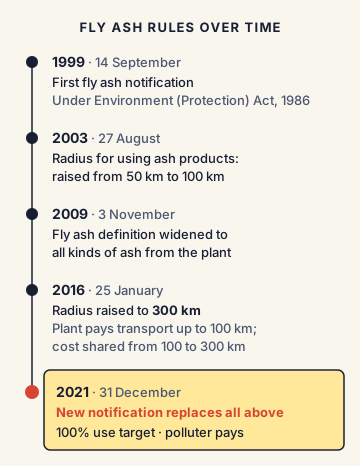
- 14 September 1999: MoEFCC issued the first fly ash notification under the Environment (Protection) Act, 1986. It aimed at gradual use of ash and asked brick kilns near power plants to mix fly ash into bricks.
- 27 August 2003: First amendment. The radius within which construction work had to use fly ash products was raised from 50 km to 100 km.
- 3 November 2009: Second amendment. Widened the definition of fly ash to include all kinds of ash from the plant.
- 25 January 2016: Third amendment. Radius raised to 300 km. Plants had to bear the full transport cost within 100 km, and share it equally with the user between 100 and 300 km. For government road and building projects within 300 km, plants had to bear the full cost.
- 31 December 2021: The present notification. It replaced the 1999 notification and all its amendments and brought in the polluter pays principle with penalties. It has since been amended, including on 30 December 2022 and 1 January 2024.
How does the 2021 notification work, step by step?
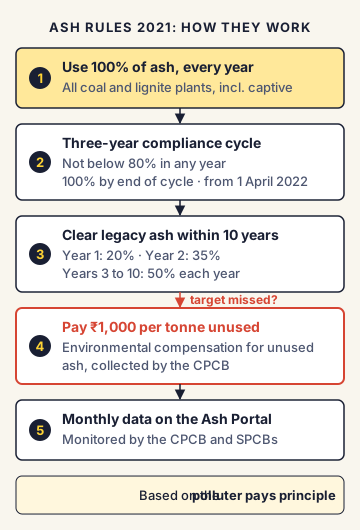
- 100% use target: Every coal or lignite plant, including captive power plants of industries, must use 100% of the ash it produces each year.
- Three-year cycle: Plants get a compliance cycle of three years to meet the target. In this cycle, use must not fall below 80% in any year, and must reach 100% by the end of the cycle. The obligation started from 1 April 2022.
- Legacy ash: Ash already lying in ponds before the notification ("legacy ash") must be used up within 10 years. The yearly targets are at least 20% in the first year, 35% in the second year, and 50% from the third to the tenth year (counting legacy ash use over and above current ash use).
- Penalty (environmental compensation): A plant that misses the target must pay ₹1,000 per tonne of unused ash as environmental compensation, collected by the CPCB. This money is used for safe disposal of unused ash and research on ash products.
- Monitoring: Plants must upload monthly data on ash generation and use on an online Ash Portal. The CPCB and State Pollution Control Boards (SPCBs) monitor compliance. The notification also provides for compliance audits of plants by authorised auditors, and for annual certification of ash dykes.
Approved ways to use fly ash
- Making cement (fly ash can replace part of the clinker in Portland Pozzolana Cement)
- Making bricks, blocks and tiles
- Building roads, embankments and flyovers
- Filling mines (backfilling) and low-lying areas, under rules
- Use in agriculture in a controlled way, based on soil testing
- Export of ash
India's position and numbers
According to the Central Electricity Authority (CEA), ash use has grown sharply, from about 10% in 1996-97 to 96.34% in 2024-25 across 189 coal and lignite plants, with about 307 million tonnes used that year. In 2020-21, coal plants generated about 232.56 million tonnes of fly ash. But decades of under-use have left a huge stock of legacy ash: around 1,670 million tonnes had piled up by 2020-21, as per an NGT joint committee summary.
In January 2022, the NGT ordered the setting up of a Fly Ash Management and Utilisation Mission, jointly headed by the Secretaries of the Union Ministries of Environment, Coal and Power and the Chief Secretaries of Uttar Pradesh and Madhya Pradesh, to make roadmaps for using legacy ash, especially in the Singrauli and Sonbhadra power hub.
As of early 2026, MoEFCC had proposed draft amendments (23 January 2026) that would shift key monitoring work from the CPCB to the CEA, reduce the penalty for unused ash, and allow limited carry-forward of unused ash across cycles. These drafts were opened for public comment; whether they have been made final was not confirmed as of October 2026 [Unverified].
Commonly confused concepts
- Fly ash vs bottom ash vs pond ash: Fly ash is fine and caught from flue gases; bottom ash is coarse and collected from the boiler floor; pond ash is a wet mix of both, stored in ponds. Wet storage reduces fly ash's cement-like quality.
- Fly ash vs fly ash bricks vs red clay bricks: Red clay bricks are made by burning topsoil in kilns, which destroys fertile land and pollutes the air. Fly ash bricks are made by mixing fly ash with lime or cement and sand, and need no burning.
- Environmental compensation vs fine: A fine is a punishment given by a court after a trial. Environmental compensation is money a polluter must pay to repair the damage, under the polluter pays principle. The ₹1,000 per tonne charge is environmental compensation.
- 1999 notification vs 2021 notification: The older rules set targets and distances but had weak penalties. The 2021 rule sets a firm 100% target, a three-year cycle, a legacy ash deadline and money penalties.
Issues, criticism and the way forward
- "Utilisation" can hide dumping: Experts say that "filling low-lying areas" is often used as a cover for simply dumping ash on land, wetlands and riverbanks.
- Legacy ash exemption: Ash in ponds that are "stabilised" or covered with plants and certified by the CPCB can be exempted from the 10-year deadline. Critics say this may let plants avoid clearing old ash.
- Weak enforcement: In the past, very few plants actually paid environmental compensation; many sought exemptions.
- Supply problems for brick makers: Small fly ash brick makers often complain that plants sell ash to large cement companies or charge high prices, which hurts small businesses.
- Health not addressed: Some experts suggested treating fly ash as a public health hazard, but the final rule did not do this.
- Way forward: Experts recommend independent third-party audits, real-time public data on the Ash Portal, strict collection of compensation, better support for small ash-based industries, and safe design and regular checking of ash dykes.
Concepts to Know
- Thermal power plant: A power station that burns coal, lignite or gas to boil water; the steam turns a turbine to make electricity.
- Lignite: A soft, brown, low-quality type of coal. India's main lignite reserves are in Tamil Nadu (Neyveli), Gujarat and Rajasthan.
- Electrostatic precipitator (ESP): A filter that uses electric charge to catch fine ash particles from smoke before it leaves the chimney.
- Pozzolanic: A material that does not harden alone, but hardens like cement when mixed with lime and water.
- Polluter pays principle: The idea that whoever causes pollution must pay for the damage and the clean-up.
- Captive power plant: A power plant built by an industry (like a steel or aluminium factory) mainly to supply its own electricity.
- Notification: A rule issued by the government under the power given by a law (here, the Environment (Protection) Act, 1986). It has legal force without a separate Act of Parliament.
- Ash Utilisation Notification issued by MoEFCC on 31 December 2021 under the Environment (Protection) Act, 1986
- Replaced the 14 September 1999 notification and its amendments of 2003, 2009 and 2016
- 100% ash use; three-year compliance cycle; not less than 80% in any year; obligations from 1 April 2022
- Legacy ash: to be used within 10 years (20% in year 1, 35% in year 2, 50% in years 3 to 10)
- Environmental compensation: ₹1,000 per tonne of unused ash, collected by CPCB
- 2016 amendment: 300 km radius for compulsory use of ash products
- Fly ash utilisation: 96.34% in 2024-25 (CEA, 189 plants)
- Indian coal ash content: about 30 to 45%
● Tracked since October 20, 2026 · last seen October 20, 2026 · updates as the daily brief publishes