Farmer Producer Organisations (FPOs)
Updated 13 Oct 2026: Added the ₹25 lakh per FPO paid to CBBOs for handholding, and the number of FPOs on e-NAM as of June 2025.
A Farmer Producer Organisation, or FPO, is a group of farmers who come together and form their own registered business. The farmers are its members and owners. Together they buy seeds and fertilisers in bulk at lower prices, store and process their crops, and sell them in larger quantities to big buyers and markets. In short, an FPO lets many small farmers act like one big farmer.
Why does India need FPOs?
Most Indian farmers own very little land. As per the Agriculture Census 2015-16, small and marginal holdings (less than 2 hectares) made up 86.08% of all holdings, and the average holding was only 1.08 hectares. A single small farmer has little bargaining power. He buys inputs at retail prices, sells his crop to a local trader at whatever price is offered, and cannot afford a cold store, a grading machine or a truck.
When hundreds of such farmers pool their produce, they can get better prices, cut out middlemen, get bank loans more easily and use modern technology. This is called economies of scale: the cost per unit falls when you buy or sell in large volumes.
What legal forms can an FPO take?
"FPO" is a general name, not a single legal form. An FPO can be registered as:
- a Producer Company under the Companies Act (the most common form for new FPOs);
- a cooperative society under a state Cooperative Societies Act or the Multi-State Cooperative Societies Act, 2002;
- or, less commonly, a society or trust.
Where did the producer company idea come from?
Traditional cooperatives in India often suffered from heavy government interference, political control and weak management. A committee led by economist Y.K. Alagh recommended a new form that would combine the member-ownership of a cooperative with the professional management of a company. Based on this, the Companies (Amendment) Act, 2002 added Part IXA (Sections 581A to 581ZT) to the Companies Act, 1956.
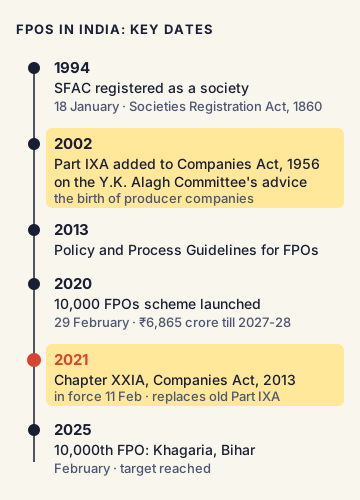
When the Companies Act, 2013 came, producer companies continued under the old Part IXA for some years. The Companies (Amendment) Act, 2020 then added a new Chapter XXIA (Sections 378A to 378ZU) to the 2013 Act; these provisions came into force on 11 February 2021.
How does a producer company work?
- Who can be members: only "primary producers" (people engaged in farming, animal husbandry, fisheries, handicrafts and similar activities) or producer institutions.
- Minimum to start: 10 individual producers, or 2 producer institutions, or a mix of both.
- Board: at least 5 and at most 15 directors.
- Voting: one member, one vote, no matter how many shares a member holds. This stops a rich member from taking control.
- Shares: members' shares cannot be traded on the stock market, so outsiders cannot buy up the company.
- Profits: surplus can be shared with members in proportion to the business they did with the company (the produce they supplied), not just their shares.
A simple example: 500 pea growers in a village cluster form an FPO. The FPO buys seed in bulk at a discount, collects all their peas, freezes them in its own unit and sells frozen peas to an exporter or directly abroad. Each farmer earns from the crop and also gets a share of the profit from processing and selling.
Which government bodies support FPOs?
- Small Farmers' Agribusiness Consortium (SFAC): registered as a society on 18 January 1994 under the Societies Registration Act, 1860; an autonomous body under the Ministry of Agriculture and Farmers Welfare. It runs the Equity Grant and Credit Guarantee Fund for FPOs.
- NABARD (National Bank for Agriculture and Rural Development): funds and promotes FPOs and gives them loans.
- NCDC (National Cooperative Development Corporation): promotes FPOs registered as cooperatives.
- In 2013, the Department of Agriculture and Cooperation issued the Policy and Process Guidelines for Farmer Producer Organisations to encourage states to support FPOs.
The 10,000 FPOs scheme
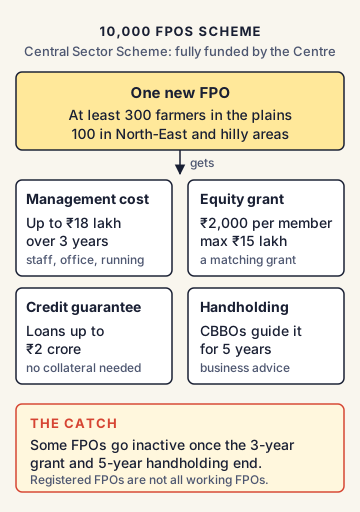
The Central Sector Scheme for "Formation and Promotion of 10,000 Farmer Producer Organizations" was launched on 29 February 2020. Its main features:
- Budget: ₹6,865 crore, running until 2027-28.
- Funding pattern: a Central Sector Scheme, so it is fully funded by the Union government.
- Management cost: up to ₹18 lakh per FPO over 3 years, to pay for staff, office and running costs in the early years.
- Equity grant: a matching grant of up to ₹2,000 per farmer-member, with a limit of ₹15 lakh per FPO. "Matching" means the government adds an amount equal to what members put in, up to the limit.
- Credit guarantee: cover for project loans of up to ₹2 crore per FPO, so banks lend without asking for collateral (security such as land).
- Handholding: professional agencies called Cluster-Based Business Organisations (CBBOs) guide each new FPO for 5 years. The CBBO is paid up to ₹25 lakh per FPO for this 5-year support. This money goes to the CBBO, not to the FPO.
- Minimum membership: 300 farmers in plains; 100 in North-Eastern and hilly areas.
- Implementing agencies: mainly SFAC, NABARD and NCDC, along with others such as NAFED.
- Approach: a "produce cluster" approach, with FPOs built around one main crop or product in an area, linked to the One District One Product idea.
- Milestone: the target of 10,000 FPOs was reached in February 2025, when the 10,000th FPO, registered in Khagaria district of Bihar (dealing in maize, banana and paddy), was launched.
Tax support
Section 80PA of the Income Tax Act, 1961 gave eligible producer companies with turnover below ₹100 crore a 100% deduction on profits from farm-related activities of members. This benefit was time-limited, covering assessment years 2019-20 to 2024-25.
Commonly confused concepts
- FPO vs Producer Company: FPO is the broad idea of a farmers' collective. A producer company is one specific legal form an FPO can take.
- Producer company vs cooperative: both are member-owned with one member, one vote. A cooperative is registered under cooperative laws, often with more government control. A producer company is registered under the Companies Act and is run more like a professional business.
- FPO vs Self-Help Group (SHG): an SHG is a small informal group (usually 10 to 20 members, often women) mainly for saving and small loans. An FPO is a registered business focused on farm production and marketing.
- FPO vs Farmer Interest Group (FIG): a FIG is a small, informal group of farmers with a common interest, often the first step before forming an FPO.
- Central Sector Scheme vs Centrally Sponsored Scheme: a Central Sector Scheme (like the 10,000 FPOs scheme) is fully funded and run by the Centre. A Centrally Sponsored Scheme is shared between the Centre and states.
Issues, criticism and the way forward
- Weak finances: many FPOs have very little share capital and struggle to get working capital (money to buy produce from members before it is sold).
- Lack of professional management: farmers may not have business, accounting or marketing skills, and hiring a good CEO is costly.
- Survival after support ends: some FPOs become inactive once the 3-year management grant and 5-year handholding end. Critics say the focus on reaching a number (10,000) can come at the cost of quality.
- Market access: FPOs often find it hard to get regular buyers, quality certification and storage.
- Compliance burden: producer companies must follow Companies Act filings, which small farmer groups find costly and complex.
- Way forward: experts suggest easier access to working capital, digital platforms like e-NAM and ONDC for selling, linking FPOs with processors and exporters, training in business skills, simpler compliance, and tracking how many FPOs are actually doing business, not just how many are registered.
Concepts to Know
- Marginal and small farmers: a marginal farmer works on less than 1 hectare of land; a small farmer on 1 to 2 hectares. One hectare is about 2.5 acres.
- Economies of scale: the saving that comes from doing things in bulk. Buying 1,000 bags of fertiliser together costs less per bag than buying one bag.
- Value addition: increasing the worth of a raw product by processing it. Fresh peas sold in a mandi earn less than frozen, packed peas sold abroad.
- Equity: money put into a business by its owners in return for shares. It is not a loan and does not have to be repaid.
- Collateral: something valuable, like land or gold, that a borrower pledges to the bank as security for a loan.
- Working capital: the money a business needs for day-to-day operations, such as paying farmers for their crop before the processed product is sold.
- e-NAM (National Agriculture Market): an online trading platform that links agricultural markets (mandis) across India so farmers can sell to buyers in other places. As of 30 June 2025, 4,518 FPOs were registered on e-NAM.
- Producer companies: Part IXA of the Companies Act, 1956 (added in 2002, on the Y.K. Alagh Committee's recommendation); now Chapter XXIA (Sections 378A to 378ZU) of the Companies Act, 2013, in force from 11 February 2021
- Producer company: minimum 10 individual producers or 2 producer institutions; 5 to 15 directors; one member, one vote
- SFAC: registered 18 January 1994 under the Societies Registration Act, 1860
- 10,000 FPOs scheme: launched 29 February 2020; ₹6,865 crore till 2027-28; Central Sector Scheme
- Support per FPO: management cost up to ₹18 lakh over 3 years; equity grant up to ₹2,000 per member (max ₹15 lakh); credit guarantee up to ₹2 crore; CBBO handholding for 5 years (up to ₹25 lakh per FPO, paid to the CBBO)
- Minimum members under the scheme: 300 (plains), 100 (North-East and hilly areas)
- 10,000th FPO: Khagaria, Bihar (February 2025)
- Agriculture Census 2015-16: small and marginal holdings 86.08%; average holding 1.08 hectares
- 13 Oct 2026Added the ₹25 lakh per FPO paid to CBBOs for handholding, and the number of FPOs on e-NAM as of June 2025.
● Tracked since February 10, 2026 · last seen October 12, 2026 · updates as the daily brief publishes