Export Promotion Councils (EPCs)
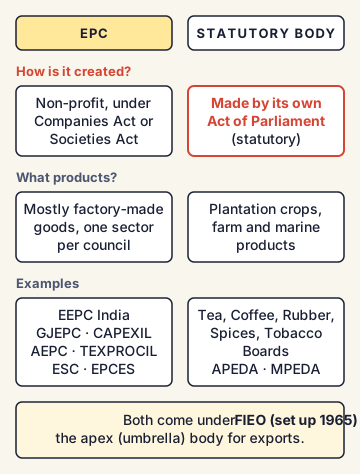
Export Promotion Councils, or EPCs, are associations of exporters set up to help Indian businesses sell more goods and services abroad. Each council usually looks after one group of products, such as engineering goods, gems and jewellery, chemicals or leather. They are non-profit bodies, registered under the Companies Act or the Societies Registration Act, and they work closely with the Government of India. You can think of an EPC as a "help desk plus trade union" for exporters of one sector.
Why do we need EPCs?
Exporting is harder than selling at home. A small exporter in Moradabad or Tiruppur has to find foreign buyers, understand foreign rules, fill many forms and claim government benefits. Most small firms do not have the staff to do this. An EPC pools this knowledge for the whole sector. It also gives the government one place to talk to an entire industry, both to explain new policies and to hear industry problems.
Where did they come from?
After independence, India exported mostly a few traditional goods like tea, jute and cotton textiles. From the 1950s, the government began setting up councils for specific product groups to push exports and earn foreign exchange. In 1965, the Federation of Indian Export Organisations (FIEO) was set up by the Ministry of Commerce as the apex body (top umbrella body) of EPCs, commodity boards and export development authorities. Over time, the number of councils grew as India started exporting new products like software, chemicals and engineering goods.
What do EPCs do?
Their main jobs are:
- Registration of exporters: They issue the Registration-cum-Membership Certificate (RCMC). An exporter needs a valid RCMC to claim many benefits under the Foreign Trade Policy (FTP). An RCMC is generally valid for five financial years.
- Market promotion: They organise trade fairs, buyer-seller meets, and trade delegations abroad.
- Information and guidance: They tell exporters about foreign markets, tariffs, standards and FTA benefits, including rules of origin and how to get a certificate of origin.
- Policy feedback: They collect data and complaints from their members and give suggestions to the government on export policy.
- Help with problems: They help exporters with trade disputes, delayed payments and quality issues.
How are they organised?
- As per a 2020 government list, 14 EPCs are attached to the Department of Commerce (Ministry of Commerce and Industry). Examples include EEPC India (engineering), the Gem and Jewellery Export Promotion Council (GJEPC), the Chemical and Allied Export Promotion Council (CAPEXIL), the Council for Leather Exports, the Electronics and Computer Software EPC (ESC), and the Export Promotion Council for EOUs and SEZs (EPCES).
- Other EPCs work under other ministries. For example, the Ministry of Textiles oversees councils such as the Apparel Export Promotion Council (AEPC) and the Cotton Textiles Export Promotion Council (TEXPROCIL).
- FIEO issues RCMCs to multi-product exporters not covered by any single council.
- The government gives EPCs financial help for promotion activities. Earlier this came mainly through the Market Access Initiative (MAI) scheme. Since the Export Promotion Mission was approved in November 2025 (outlay ₹25,060 crore for 2025-26 to 2030-31), MAI-type support is given through its Market Access Support component, which EPCs help implement.
How does it work for an exporter? An example
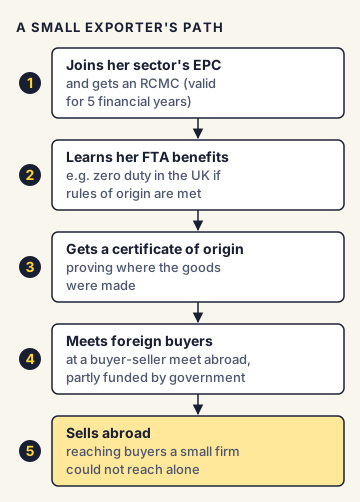
Suppose a small brass-ware maker in Moradabad wants to sell to the UK. She joins the relevant EPC and gets an RCMC. The council tells her that under the India-UK trade deal, her product may enter the UK at zero duty if it meets the rules of origin. It helps her get a certificate of origin. It then invites her to a buyer-seller meet abroad, partly funded by the government. Without the EPC, she would have to figure all of this out alone.
India's position and Indian examples
India's combined exports of goods and services in April to September 2026-27 were estimated at about $476 billion, nearly 14% higher than a year earlier. EPCs are a key link in the government's push to raise exports, along with the DGFT (which runs the Foreign Trade Policy), state export cells and district committees under the Districts as Export Hubs initiative. In FTA outreach programmes, EPCs explain sector-specific benefits to exporters, for example GJEPC for gems and jewellery in Jaipur.
Commonly confused concepts
- EPC vs Commodity Board: An EPC is a non-profit exporters' association, usually for manufactured goods. A Commodity Board is a statutory body (made by a law) for a plantation or agricultural product. There are five: Tea Board, Coffee Board, Rubber Board, Spices Board and Tobacco Board. They look after production as well as export.
- EPC vs Export Development Authority: Bodies like APEDA (agricultural and processed foods) and MPEDA (marine products) are statutory authorities created by Acts of Parliament. EPCs are not created by a special Act.
- EPC vs FIEO: EPCs are sector-specific. FIEO is the umbrella body covering all of them, and it serves multi-product exporters.
- EPC vs DGFT: The DGFT is a government office that makes and enforces trade rules and issues licences. EPCs are industry bodies that help exporters use those rules.
Issues, criticism and the way forward
- Reach to small firms: Many tiny exporters, artisans and farmer groups in small towns never join an EPC. Councils are often seen as serving bigger, established exporters.
- Dependence on government funds: Many councils rely on government grants for fairs and missions. Delays or cuts in schemes (such as the gap after MAI ended in December 2024) hurt their work.
- Overlap and fragmentation: Some products fall under more than one council or ministry, which confuses exporters.
- Low FTA use: Exporters often do not claim FTA benefits because of paperwork, which shows that guidance on rules of origin still does not reach enough firms.
- Way forward: Experts suggest a stronger district-level presence, digital single-window services, joint work with state governments, special help desks for FTA rules, and performance-linked funding for councils.
Concepts to Know
- MSME (Micro, Small and Medium Enterprises): Small businesses classified by how much they invest in machinery and how much they sell in a year. They provide a large share of India's jobs and exports.
- RCMC (Registration-cum-Membership Certificate): A certificate an exporter gets from an EPC or similar body. It proves the exporter is registered and lets them claim export benefits.
- Statutory body: An organisation created by a law passed by Parliament.
- Certificate of origin: A document that proves in which country a product was made. It is needed to claim lower tariffs under an FTA.
- Foreign exchange: Money in foreign currencies, such as US dollars, that a country earns mainly through exports.
- EPCs: non-profit, registered under the Companies Act or the Societies Registration Act
- 14 EPCs under the Department of Commerce (as per a 2020 government list); others under the Ministry of Textiles and other ministries
- FIEO: set up in 1965; apex body for EPCs, commodity boards and export development authorities
- RCMC: issued by EPCs; generally valid for five financial years
- Five statutory Commodity Boards: Tea, Coffee, Rubber, Spices, Tobacco
- Export Promotion Mission: approved November 2025; outlay ₹25,060 crore (2025-26 to 2030-31); includes Market Access Support (successor to MAI)
● Tracked since October 21, 2026 · last seen October 21, 2026 · updates as the daily brief publishes