Exempt, Nil-Rated and Non-GST Supplies under GST
Under GST, not every sale is taxed. Some goods and services carry no GST at all, but they reach that "zero" in different ways. Some are exempt by a government notification. Some are put in the schedule at a nil rate (0%). Some are kept outside GST altogether, like petrol and liquor. And exports are zero-rated, which looks similar but works very differently.
For a buyer, all of these may look like "no tax", but for the seller they lead to very different results, mainly on whether the seller can get back the tax it paid on its own purchases.
Why does GST have tax-free items at all?
GST is a tax on consumption, and everyone pays it, rich or poor. If basic items like fresh vegetables, milk or farm services were taxed, poor families and small farmers would feel it most. So the GST law lets the government keep essential goods and services free of tax. Other items are kept outside GST for a different reason: states did not want to give up their own big sources of income, such as taxes on petrol and alcohol.
What does the law say?
The main definitions are in the Central Goods and Services Tax (CGST) Act, 2017:
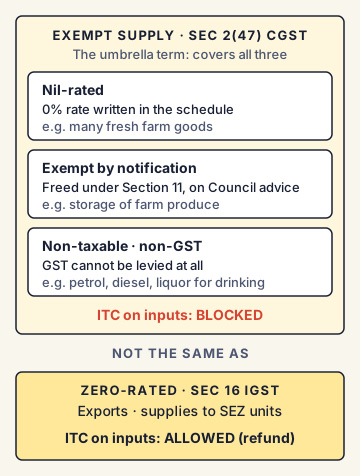
- Section 2(47), "exempt supply": a supply that carries a nil rate of tax, or is wholly exempt under Section 11 of the CGST Act (or Section 6 of the IGST Act), and it includes non-taxable supply. So "exempt supply" is the umbrella term.
- Section 2(78), "non-taxable supply": a supply that is not leviable (cannot be taxed) under the CGST Act or IGST Act.
- Section 11: the power to exempt. The government, on the recommendation of the GST Council, can issue a notification exempting goods or services from the whole or part of the tax. It can do this absolutely (no conditions) or subject to conditions. Under Section 11(2), it can also exempt a particular case by a special order in exceptional situations. When an exemption is absolute, the seller is not allowed to charge GST on that supply.
The four kinds of "no tax" supplies, explained simply
- Nil-rated supply: The item is listed in the rate schedule with a 0% rate. Example: many fresh farm goods. The item is inside GST, but its rate is zero.
- Exempt supply (by notification): The item would normally be taxable, but a notification under Section 11 frees it from tax. Example: the main notification for services, Notification No. 12/2017-Central Tax (Rate) dated 28 June 2017, exempts many farm-related services. Its Entry 54 covers services relating to growing crops and rearing animals, including the loading, unloading, packing, storage or warehousing of agricultural produce. Since 22 September 2025, premiums on individual life and health insurance policies have also been exempt.
- Non-GST supply: Goods that are kept outside GST by the Constitution or by law. Two key groups:
- Alcoholic liquor for human consumption: Article 366(12A) of the Constitution defines GST as a tax on all supplies except this item. States continue to tax it through state excise.
- Five petroleum products: petroleum crude, high speed diesel, motor spirit (petrol), natural gas and aviation turbine fuel. Article 279A(5) says the GST Council will recommend the date from which GST will apply to them. That date has not yet been set, so they still pay the old central excise duty and state VAT.
- Zero-rated supply: Exports and supplies to Special Economic Zone (SEZ) units or developers, under Section 16 of the IGST Act, 2017. These are taxable in principle, but the rate is effectively zero, and the seller can claim back the tax it paid on inputs.
Separately, Schedule III of the CGST Act lists activities that are treated as neither a supply of goods nor a supply of services, such as services by an employee to an employer, and the sale of land. These are simply outside the meaning of "supply".
The real difference: input tax credit
To understand why the type of "zero" matters, you need input tax credit (ITC). A business pays GST when it buys raw materials and services (its "inputs"). Normally, it can deduct this tax from the GST it collects on its own sales. This prevents a tax-on-tax.
Now see what happens in each case:
- Zero-rated (exports): the seller charges no tax but gets ITC back (as a refund or set-off). So the product leaves India completely free of Indian tax.
- Exempt and nil-rated: the seller charges no tax, and cannot claim ITC on the inputs used for these supplies. Under Section 17(2) of the CGST Act, if inputs are used for both taxable and exempt supplies, ITC is allowed only for the taxable part. Rules 42 and 43 of the CGST Rules give the method for this split.
A simple example
A cold-storage owner buys refrigeration equipment and electricity-related services and pays ₹1,000 as GST on them. If his storage service is taxable at 18%, he collects tax from customers and deducts the ₹1,000. If his service is exempt, he charges no tax, but he also loses the ₹1,000, and he may add it to his price. So an exemption does not always make the final price fully tax-free. Some "hidden tax" from inputs can stay inside the price.
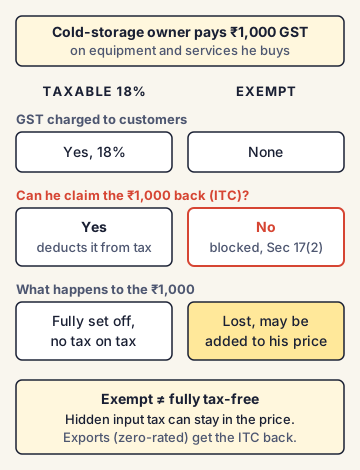
Why does exemption sometimes hurt?
This hidden tax is the reason some businesses prefer a low rate (like 5% with ITC) over a full exemption. When individual insurance was exempted in September 2025, the tax department clarified that insurers could no longer claim ITC on inputs such as agent commissions, and insurers warned this could reduce how much of the benefit reaches customers.
Where does the "agricultural produce" question come from?
The farm exemptions apply to "agricultural produce": produce from growing plants and rearing animals (except horses) on which either no further processing is done, or only the kind of processing a farmer usually does, which does not change its basic nature but makes it ready for the primary market. Seeds that are graded, chemically treated and packed, or coffee that is cured at a separate facility, created doubt about whether they still fit this meaning. That is why specific, separate exemptions are often needed.
Indian examples
- Fresh vegetables, fresh milk and many farm goods are nil-rated or exempt.
- Under the GST rate reform effective 22 September 2025 (often called "GST 2.0"), most items were moved into two main slabs of 5% and 18%, with a special 40% rate for a few luxury and "sin" goods. Tractor tyres and tubes were cut from 18% to 5% in this reform.
- Petrol, diesel and aviation turbine fuel remain non-GST items, which is why their prices differ from state to state.
Commonly confused concepts
- Exempt vs zero-rated: Both charge no tax to the buyer. But zero-rated (exports, SEZ) allows ITC, while exempt blocks ITC. This is the single most tested difference.
- Nil-rated vs exempt: Nil-rated items have a 0% rate written in the schedule. Exempt items are freed by a separate notification. In practice both block ITC, and both fall within "exempt supply" under Section 2(47).
- Non-GST vs non-taxable: Non-GST items (petrol, alcohol for drinking) are kept outside GST and taxed by other laws such as excise and VAT. "Non-taxable supply" is the legal term in Section 2(78) for any supply on which GST cannot be levied.
- Exempt supply vs Schedule III activity: An exempt supply is still a "supply" under GST, just freed from tax. A Schedule III activity is not treated as a supply at all.
Issues, criticism and the way forward
- Breaking the ITC chain: Exemptions in the middle of a supply chain cause "tax cascading", where hidden tax on inputs adds up, which GST was meant to end. Experts often suggest a low positive rate with ITC instead of an exemption for business-to-business items.
- Classification disputes: Whether something is "agricultural produce", or whether a service is "related to cultivation", has led to many advance rulings and court cases. Clear, specific entries, like those for seed storage and coffee curing, reduce such disputes.
- Petroleum outside GST: Keeping fuel outside GST means businesses cannot claim ITC on the tax paid on diesel and petrol, which raises costs for transport and farming. States worry about losing a large share of their own revenue if fuel comes under GST.
- Benefit may not reach the user: An exemption helps only if sellers pass it on through lower prices. For farmers, the real gain depends on whether service providers lower their charges.
Concepts to Know
- Goods and Services Tax (GST): A single tax on the sale of goods and services across India, which replaced many central and state taxes on 1 July 2017.
- Input tax credit (ITC): The tax a business has already paid on its purchases, which it can subtract from the tax it owes on its own sales.
- Notification: A formal order published by the government in the official Gazette that puts a rule into force, such as an exemption.
- Tax cascading: When tax is charged on a price that already includes tax, so the total tax keeps growing at each step. Also called "tax on tax".
- CGST and IGST: Central GST is the Centre's share of tax on sales within a state. Integrated GST is charged on sales from one state to another and on imports.
- Special Economic Zone (SEZ): A marked area with special business and tax rules, set up mainly to boost exports.
- Section 2(47) CGST Act: "exempt supply" = nil-rated + wholly exempt (Section 11 CGST / Section 6 IGST) + non-taxable supply
- Section 2(78) CGST Act: "non-taxable supply" = supply not leviable to tax under CGST or IGST Acts
- Section 11 CGST Act: exemption by notification on GST Council recommendation; absolute or conditional; 11(2) for special orders
- Section 17(2) CGST Act: ITC only for the share of inputs used for taxable supplies; method in Rules 42 and 43
- Section 16 IGST Act: zero-rated supply = exports and supplies to SEZ units/developers; ITC allowed
- Article 366(12A): GST excludes alcoholic liquor for human consumption
- Article 279A(5): GST Council to recommend the date for GST on petroleum crude, high speed diesel, petrol, natural gas and aviation turbine fuel
- Notification No. 12/2017-Central Tax (Rate), 28 June 2017: main services exemption list; Entry 54 covers farm services including storage of agricultural produce
- GST rate reform effective 22 September 2025: main slabs 5% and 18%, plus 40% for select goods
● Tracked since October 15, 2026 · last seen October 15, 2026 · updates as the daily brief publishes