Euro 7 Emission Standards
The European Union's Next Vehicle Pollution Rules
Euro 7 is the European Union's (EU's) newest law on how much pollution road vehicles may release. It covers cars, vans, buses and trucks in one single law. It is the first standard in the world to put limits on particles from brakes and to cover tyre wear, and it is the first to set rules on how long the batteries of electric cars must last. India's draft BS-VII norms closely follow its design.
Why does Euro 7 matter to India?
India's vehicle pollution rules have always followed the European series. BS-I was based on Euro I, and BS-VI is broadly equal to Euro 6. Vehicle makers sell the same models in many countries, so similar rules make testing and design easier. When Europe changes what it measures, India usually follows a few years later. So to understand where BS-VII comes from, a student needs to understand Euro 7.
Where did the Euro standards come from?
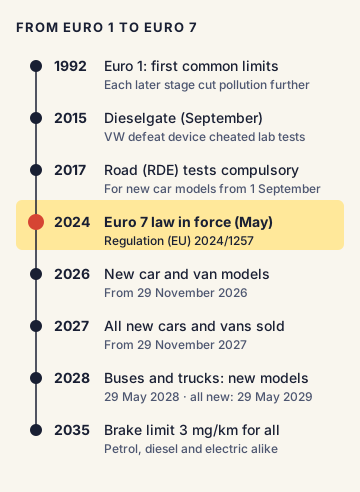
Europe started common limits for vehicle pollution with Euro 1 in 1992. Each new stage cut the allowed pollution further. For diesel cars, the limit on nitrogen oxides (NOx) fell from 500 mg/km at an earlier stage to 80 mg/km under Euro 6. Euro 6 came in for new car models in 2014 and for all new cars from September 2015.
What went wrong with lab tests?
For many years, cars were tested only in laboratories, on a fixed pattern of driving. In September 2015, the "Dieselgate" scandal broke. Volkswagen was found to have used illegal software (a "defeat device") that made its diesel cars pollute less only when they were being tested. On the road, the cars released far more NOx.
After this, Europe made Real Driving Emissions (RDE) tests compulsory for new car models from 1 September 2017. In an RDE test, the car is driven on normal roads with a portable machine fitted to the exhaust.
How did Euro 7 become law?
The EU's executive body, the European Commission, proposed Euro 7 in 2022. The European Parliament and the member states reached a deal in December 2023. The final law is Regulation (EU) 2024/1257, which entered into force in May 2024. It replaced the separate Euro 6 rules (for cars and vans) and Euro VI rules (for buses and trucks).
What are the main parts of Euro 7?
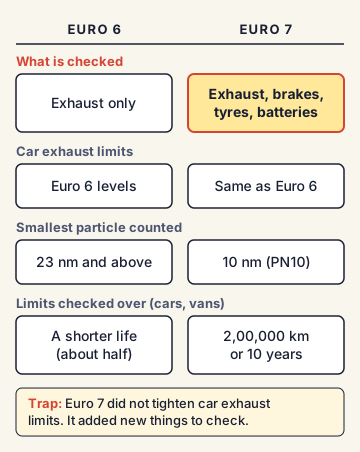
- Exhaust limits for cars and vans stay at Euro 6 levels. But the particle limits now apply to all petrol engines, not only some types.
- Smaller particles are counted. Euro 6 counted solid particles of 23 nanometres and above. Euro 7 counts particles from 10 nanometres (called PN10).
- Brake particle limits (PM10): 3 mg/km for pure electric cars and 7 mg/km for most petrol, diesel, hybrid and fuel-cell cars, with a higher limit (11 mg/km) for large petrol or diesel vans. From 2035, a single limit of 3 mg/km applies to all types.
- Tyre wear: Euro 7 brings tyre abrasion (rubber worn off on the road) under the rules for the first time. The limits and test method are being worked out separately, with dates starting from 2028 for car tyres.
- Battery durability for cars: A battery must keep at least 80% of its capacity up to 5 years or 1,00,000 km, and 72% up to 8 years or 1,60,000 km. For vans, the figures are 75% and 67%.
- Longer life checks: Cars and vans must meet the limits for up to 2,00,000 km or 10 years, about double the earlier period. Heavy trucks and buses must do so for up to 8,75,000 km or 15 years.
- Heavy vehicles: New limits are added for gases like nitrous oxide (N2O), which Euro VI did not cover. The NOx limit for trucks is 200 mg/kWh in the lab and 260 mg/kWh in real driving.
- On-board monitoring: The vehicle must check its own emissions while it runs.
- Environmental Vehicle Passport (EVP): Each vehicle must carry digital data on its environmental performance, such as pollutant limits, fuel or energy use and battery health, which the owner can see.
When does Euro 7 apply?
- Cars and vans: new models from 29 November 2026; all new vehicles sold from 29 November 2027.
- Buses and trucks: new models from 29 May 2028; all new vehicles from 29 May 2029.
- Small manufacturers get later dates (2030 for cars and vans, 2031 for heavy vehicles).
How does India's draft BS-VII compare?
- Like Euro 7, BS-VII keeps the current exhaust limits for cars, counts particles down to 10 nanometres, adds brake and tyre rules, adds battery rules and has an Environmental Vehicle Passport.
- India's brake limits for cars (3 mg/km for pure electric, 7 mg/km for others, 3 mg/km for all from 2035) match the Euro 7 figures.
- India's battery figures for cars (75% after 5 years or 1,00,000 km, 67% after 8 years or 1,60,000 km) are the same as Euro 7's figures for vans, which are lower than Euro 7's figures for cars (80% and 72%).
- India's dates come about two to three years after Europe's: cars from April 2029 in India, against November 2026 to 2027 in the EU.
Commonly confused concepts
- Euro 7 vs Euro 6: Euro 6 controlled only exhaust and was checked over a shorter life. Euro 7 keeps the car exhaust numbers but adds brakes, tyres, batteries, smaller particles and longer life checks.
- "Euro 7" vs "Euro VII": Europe writes car standards in Arabic numbers (Euro 6) and older heavy-vehicle standards in Roman numbers (Euro VI). Euro 7 now covers both in one law.
- Emission norms vs fuel-efficiency (CO2) norms: Euro 7 and BS norms limit harmful pollutants like NOx, CO and particles, which damage health. Carbon dioxide (CO2) rules, like India's CAFE norms, limit fuel use and greenhouse gases, which cause climate change. They are separate rules.
- PM10 brake limit vs PM10 in air: The brake limit is in mg per km driven. Air quality standards are in micrograms per cubic metre of air. They measure different things.
Issues, criticism and the way forward
- Weaker than first planned: Environmental groups said the final Euro 7 was "watered down". The original proposal had tighter exhaust limits for cars, but the final law kept Euro 6 levels.
- Industry cost: Car makers argued that spending on petrol and diesel engines takes money away from electric vehicles. The same worry has been raised in India for BS-VII.
- Measuring brake and tyre dust is hard: There was no standard test for these particles until recently. The UN's vehicle rules forum had to develop new test methods.
- Battery rules help buyers: Supporters say battery durability limits protect people who buy used electric cars, because they can trust the battery's health.
- Way forward: Experts suggest clear test methods, enough lead time for makers, and linking pollution rules with clean-air plans for cities.
Concepts to Know
- Type approval: Official approval of a new vehicle model before sale, after tests show it meets all rules.
- Defeat device: Hidden software or hardware that makes a vehicle pollute less only during tests, and more on the road. It is illegal.
- Conformity factor: How much more a car may emit on the road than the lab limit. A factor of 1.0 means no extra margin.
- Battery capacity (state of health): How much energy a battery can still store compared with when it was new. 80% means it holds 80% of its original charge.
- mg/kWh: Milligrams of pollutant per unit of energy the engine produces. Used for trucks because they carry very different loads.
- Regulation (EU law): A type of EU law that applies directly in all member countries, without each country passing its own law.
- Euro 7 law: Regulation (EU) 2024/1257; entered into force May 2024; replaces Euro 6 and Euro VI
- First standard to limit brake particles and cover tyre wear; first to set battery durability rules
- Brake PM10: 3 mg/km (pure electric), 7 mg/km (most others), 11 mg/km (large combustion vans); 3 mg/km for all from 2035
- Battery: cars 80% (5 years or 1,00,000 km) and 72% (8 years or 1,60,000 km); vans 75% and 67%
- Durability: cars and vans 2,00,000 km or 10 years; heaviest vehicles 8,75,000 km or 15 years
- Particles counted from 10 nm (PN10), down from 23 nm
- Applies to new car and van models from 29 November 2026; all new cars and vans from 29 November 2027; buses and trucks from May 2028 and May 2029
- RDE tests compulsory in the EU for new models since 1 September 2017, after the 2015 Dieselgate scandal
● Tracked since October 16, 2026 · last seen October 16, 2026 · updates as the daily brief publishes