Duty Drawback Scheme
Duty drawback is a refund that the government gives to an exporter for the customs duty paid on imported goods that end up being exported. For example, a bicycle maker imports steel parts, pays customs duty on them, uses them to make bicycles, and then exports the bicycles. Under duty drawback, the government pays back that customs duty. The idea is simple: India should export goods, not its taxes.
Why does it exist?
When an Indian product goes abroad, it competes with products from China, Vietnam, Bangladesh and many other countries. If the price of the Indian product includes Indian taxes, it becomes costlier and loses orders. The buyer's country will also put its own import tax on it. So the product gets taxed twice. To avoid this, almost every trading country refunds the taxes paid on inputs of exported goods.
World trade rules allow this, as long as the refund is not more than the tax actually paid. Duty drawback is India's oldest and most basic tool for this.
Where does the law come from?
The power comes from Chapter X of the Customs Act, 1962 (Sections 74 to 76):
- Section 74: drawback when imported goods are re-exported as they are (for example, a machine imported for an exhibition and sent back).
- Section 75: drawback on imported materials used to make goods that are exported. Most manufacturing exporters claim drawback under this section.
- Section 75A: interest for the exporter if drawback is not paid within one month of filing the claim; and recovery with interest if drawback was paid wrongly (to be repaid within two months of the demand).
- Section 76: cases where drawback is not allowed.
The detailed procedure is in the Customs and Central Excise Duties Drawback Rules, 2017. These replaced the older 1995 Rules and took effect from 1 October 2017, soon after GST began on 1 July 2017.
How did GST change drawback?
Before GST, drawback also refunded central excise duty and service tax paid on inputs. GST replaced those taxes, and GST paid on inputs is now returned to exporters through the GST system itself (input tax credit and GST refunds). So the 2017 Rules exclude Integrated GST and GST Compensation Cess from drawback. Today, drawback mainly refunds customs duty, and the rates became much lower than before.
How does it work, step by step? (Section 75)
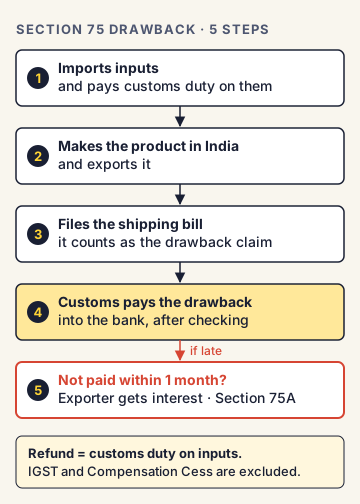
- The exporter imports inputs and pays customs duty on them.
- The exporter makes the final product in India and exports it.
- While filing the shipping bill (the main customs document for exports), the exporter declares the drawback claim. Under the rules, the shipping bill itself is treated as the drawback claim, so no separate form is usually needed.
- Customs checks the export and pays the drawback amount, usually electronically into the exporter's bank account.
- If customs delays payment beyond one month, the exporter gets interest under Section 75A.
The two ways the amount is fixed
- All Industry Rate (AIR): The Central Government studies average input costs and duty paid across an industry. It then notifies a standard rate for each export product, usually as a percentage of the export price (FOB value), often with a maximum amount per unit (a "value cap"). Any exporter of that product gets the same rate, whether its own duty paid was a bit higher or lower. This keeps the system fast and simple. The current AIR schedule was notified by Notification No. 77/2023-Customs (N.T.) dated 20 October 2023 and is amended from time to time. For example, rates for gold and silver jewellery are reviewed often because metal prices change.
- Brand Rate: A rate fixed for one particular exporter's product, based on its actual duty paid. An exporter can ask for it when no AIR exists for the product, or when the AIR covers less than four-fifths (80%) of the duty actually paid. It needs more paperwork, so it is used less often.
Re-export drawback (Section 74)
When imported goods are sent out again without being used, the exporter gets back 98% of the import duty paid. The goods must be identified by customs as the same goods, and they must be exported within two years of paying the import duty (this can be extended on good reason). If the goods were used in India before re-export, a lower drawback applies, depending on how long they were used.
India's position and Indian examples
Duty drawback is run by the Central Board of Indirect Taxes and Customs (CBIC) under the Department of Revenue, Ministry of Finance. It sits alongside other export support tools:
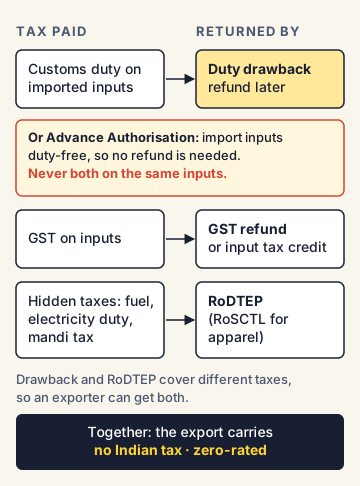
- RoDTEP refunds hidden taxes that drawback and GST do not cover (such as tax on fuel used in transport, electricity duty, mandi tax).
- RoSCTL does the same for apparel, garments and made-ups.
- Advance Authorisation lets an exporter import inputs without paying duty in the first place, so no refund is needed.
- GST refunds return the GST on inputs or on the export itself. Together, these tools try to make Indian exports fully "zero-rated".
Commonly confused concepts
- Duty drawback vs RoDTEP: Drawback refunds customs duty on imported inputs. RoDTEP refunds other hidden central, state and local taxes that are not refunded anywhere else. An exporter can get both, because they cover different taxes.
- Duty drawback vs Advance Authorisation: Drawback is a refund after paying duty. Advance Authorisation is an exemption before paying duty. An exporter cannot get both on the same inputs.
- Section 74 vs Section 75: Section 74 is for re-exporting the same imported goods. Section 75 is for exporting new goods made using imported materials.
- AIR vs Brand Rate: AIR is a standard rate for the whole industry. Brand Rate is a special rate for one exporter's product, based on its own costs.
- Drawback vs export subsidy: A subsidy gives the exporter extra money. Drawback only returns tax already paid. That is why WTO rules allow drawback but ban export subsidies, as long as the refund is not larger than the tax paid.
WTO angle
The WTO Agreement on Subsidies and Countervailing Measures (SCM Agreement) bans export subsidies. But its Annex I, item (i) accepts drawback of import charges as long as the refund is not more than the duty actually paid on inputs used up in making the exported product. Annex II and III give the rules for checking this. So a well-designed drawback system is WTO-safe. An AIR that is set too high could be challenged as a hidden subsidy.
Issues, criticism and the way forward
- Averages are rough: Because AIR is an average, some exporters get more than the duty they paid and some get less.
- Misuse: Some exporters have overstated the value of their exports, or exported poor-quality goods, to claim more drawback. Customs must keep checking for such fraud.
- Delays and disputes: Delays in payment, rejected claims and disputes over Brand Rates block working capital, especially for small exporters.
- Frequent rate changes: Exporters need stable rates to price their orders.
- Way forward: Experts suggest updating AIRs regularly with fresh cost data, using data analytics to spot fraud, paying faster through automated systems, and keeping all export refund schemes (drawback, RoDTEP, RoSCTL, GST refunds) well coordinated so that no tax is refunded twice and no tax is left out.
Concepts to Know
- Customs duty: A tax charged on goods when they enter (or sometimes leave) the country. It is collected at ports, airports and land borders.
- Input: Any raw material, part or service used to make a final product, like cotton for a shirt.
- FOB (Free on Board) value: The price of export goods once they are loaded on the ship at the Indian port. It does not include sea freight or insurance to the foreign buyer.
- Shipping bill: The main form an exporter files with customs, giving details of the goods being exported.
- Zero-rating: Making sure an exported product carries no domestic tax at all, by refunding all taxes paid on its inputs.
- Working capital: The day-to-day money a business needs to buy materials and pay wages. Refunds that come late lock up this money.
- Legal base: Chapter X, Sections 74–76 of the Customs Act, 1962
- Section 74: re-export of imported goods; 98% of duty if exported within 2 years and identified
- Section 75: drawback on imported materials used in exported goods
- Section 75A: interest if drawback not paid within 1 month of claim
- Customs and Central Excise Duties Drawback Rules, 2017, effective 1 October 2017; Integrated GST and Compensation Cess excluded
- Two types: All Industry Rate and Brand Rate (Brand Rate if AIR is less than 4/5 of actual duty)
- Current AIR schedule: Notification No. 77/2023-Customs (N.T.), 20 October 2023 (amended from time to time)
- Administered by CBIC, Department of Revenue, Ministry of Finance
- WTO: allowed under SCM Agreement Annex I, item (i), if not more than the duty actually paid
● Tracked since November 15, 2026 · last seen November 15, 2026 · updates as the daily brief publishes