Demonetisation in India
Demonetisation means the government declares that certain currency notes are no longer legal money. After this, nobody is bound to accept those notes for payment, and people must deposit or exchange them at banks within a fixed time. India has done this three times: in 1946, 1978 and 2016. The 2016 move was by far the biggest, because it covered the two highest-value notes then in use.
Why would a country do this?
Governments usually give these reasons:
- Black money: This is income hidden from tax. Some of it may be stored as piles of high-value cash. If those notes suddenly become worthless, the hoarder must either bring them to a bank (and explain the source) or lose them.
- Fake notes: Counterfeit notes, mostly of high value, spread through the system. Cancelling a whole series of notes wipes out the fakes of that series in one stroke.
- Terror financing: Fake and hidden cash can fund terrorism and crime.
- Push to digital payments: When cash is short, people are pushed to try bank accounts, cards and mobile payments.
Where did it come from? India's three demonetisations
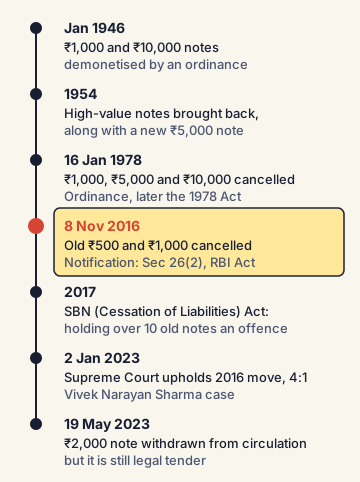
- January 1946: Before Independence, the government demonetised high-value notes, including the ₹1,000 and ₹10,000 notes, through the High Denomination Bank Notes (Demonetisation) Ordinance, 1946. These notes were brought back in 1954 along with a ₹5,000 note.
- 16 January 1978: The government cancelled the ₹1,000, ₹5,000 and ₹10,000 notes through an ordinance, later made the High Denomination Bank Notes (Demonetisation) Act, 1978. Very few ordinary people held such large notes then, so the impact on daily life was small.
- 8 November 2016: The Government of India issued a notification under Section 26(2) of the RBI Act, 1934, ending the legal tender status of the old ₹500 and ₹1,000 notes from midnight. Unlike 1978, these notes were used daily by ordinary people.
How did the 2016 demonetisation work?
The cancelled notes were called Specified Bank Notes (SBNs).
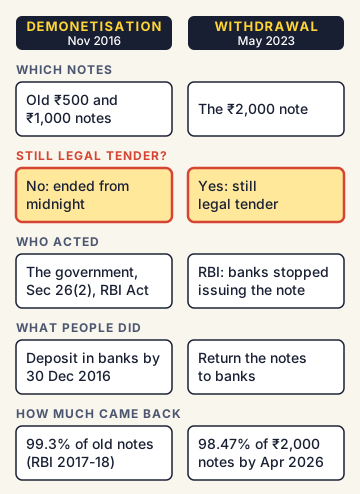
- People could deposit SBNs in bank accounts until 30 December 2016. There were limits on how much old cash could be exchanged over the counter for new notes.
- New notes were introduced: a new ₹2,000 note (from November 2016) and a new design ₹500 note. A new ₹200 note followed in 2017.
- Parliament then passed the Specified Bank Notes (Cessation of Liabilities) Act, 2017. It ended the RBI's duty to pay for these notes and made it an offence to hold more than ten such notes after the grace period, with a fine of at least ₹10,000 or five times the value held, whichever is higher.
What happened to the money?
The RBI Annual Report 2017-18 gave the final count:
- SBNs in circulation on 8 November 2016: about ₹15.41 lakh crore.
- SBNs returned to the RBI: about ₹15.31 lakh crore, or 99.3%.
- Only about ₹10,720 crore did not come back.
So almost all the cancelled cash returned to banks. Critics say this means most black money was not held as cash, or was converted into new notes. The government's view is that bringing the cash into bank accounts made it traceable, and that tax filing and the formal economy grew afterwards.
What did the courts say?
In Vivek Narayan Sharma v. Union of India (2 January 2023), a five-judge Constitution Bench of the Supreme Court upheld the 2016 decision by a 4:1 majority. The majority held that Section 26(2) allows the central government to demonetise "any series" of notes, including all notes of a denomination, after consulting the RBI's Central Board, and that the decision passed the test of proportionality.
Justice B.V. Nagarathna dissented. She held that when the central government starts such a move, it must be done through a law passed by Parliament (or an ordinance), not through a notification, because Section 26(2) contemplates the RBI starting the process.
Ten years on: what does the data show?
- Cash came back: Currency with the public was about ₹17.97 lakh crore on 4 November 2016. By October 2025 it had more than doubled to about ₹37.29 lakh crore.
- Currency-to-GDP ratio: about 12.1% in March 2016, a peak of about 14.5% in 2020-21, and about 11.1% in 2024-25. India's ratio is still higher than that of many major economies.
- High-value notes still dominate: The ₹500 note now makes up roughly 86% of the value of all notes in circulation, almost the same share the old ₹500 and ₹1,000 notes had together in 2016.
- Fake notes: After falling for a few years, detection of fake ₹500 notes is rising again (up about 20.5% in 2025-26).
- Digital payments: UPI, launched in 2016, has grown into the world's largest real-time payment system by number of transactions.
Commonly confused concepts
- Demonetisation vs withdrawal from circulation: In 2016, the old notes stopped being legal tender. In May 2023, the RBI only withdrew the ₹2,000 note from circulation: banks stopped issuing it, but it is still legal tender. As of April 2026, about 98.47% of the ₹2,000 notes in circulation on 19 May 2023 had come back.
- Demonetisation vs remonetisation: Remonetisation is the process of putting new notes back into the system after demonetisation.
- Black money as a stock vs a flow: The stock is hidden wealth already built up (in cash, gold, property or abroad). The flow is new hidden income being earned every year. Demonetisation hit only the cash part of the stock, once.
- Cashless vs less-cash economy: A cashless economy has almost no cash use. A less-cash economy still uses cash but relies more and more on digital modes. India is moving towards the second.
Issues, criticism and the way forward
- Short-term pain: Because 86% of cash vanished overnight, there were long queues at banks and a cash shortage for weeks. Sectors that run on cash, like small traders, farm markets, construction and informal workers, were hit hardest.
- Growth debate: Some economists linked the slowdown in growth in 2016-17 and 2017-18 to demonetisation and the GST rollout. The government's position is that the effect was short-lived and that formalisation brought long-term gains.
- Black money and fakes: With 99.3% of notes returned, critics say the black money goal was not met. Fake note detections are now rising again in the new ₹500 note.
- Gains claimed: More people filed income tax returns, bank deposits rose, and digital payments took off.
- Way forward: Experts suggest steady measures instead of shocks: better tax data use, strong anti-counterfeit features with regular note design upgrades, and expanding digital payments while keeping cash available for those who need it.
Concepts to Know
- Legal tender: Money that, by law, everyone must accept for paying a debt. A ₹100 note is legal tender; a cancelled note is not.
- Black money: Income or wealth on which tax has not been paid, or which comes from illegal activity.
- Counterfeit note: A fake note made to look like a real one.
- Currency in circulation (CIC): All notes and coins issued by the RBI that are out in the economy. When the cash held by banks is removed, the rest is "currency with the public".
- Currency-to-GDP ratio: The value of cash in the economy divided by the country's GDP (total value of goods and services produced in a year). It shows how much an economy depends on cash.
- Proportionality test: A court's check on whether a government action has a proper aim, a rational link to that aim, and does not hurt people's rights more than necessary.
- Ordinance: A temporary law made by the President (or a Governor) when the legislature is not in session. It must later be approved by the legislature.
- 1946: ₹1,000 and ₹10,000 notes demonetised (January 1946)
- 1978: ₹1,000, ₹5,000 and ₹10,000 notes demonetised from 16 January 1978; High Denomination Bank Notes (Demonetisation) Act, 1978
- 2016: old ₹500 and ₹1,000 notes; notification of 8 November 2016 under Section 26(2), RBI Act, 1934; about 86% of currency value
- SBNs: ₹15.41 lakh crore out; ₹15.31 lakh crore (99.3%) returned (RBI Annual Report 2017-18)
- Specified Bank Notes (Cessation of Liabilities) Act, 2017: holding more than 10 SBNs is an offence; fine of at least ₹10,000 or five times the value
- Vivek Narayan Sharma v. Union of India (2 January 2023): upheld 4:1; Justice B.V. Nagarathna dissented
- ₹2,000 note: introduced November 2016; withdrawal from circulation announced 19 May 2023; still legal tender
● Tracked since November 07, 2026 · last seen November 07, 2026 · updates as the daily brief publishes