Defence Public Sector Undertakings (DPSUs)
Defence Public Sector Undertakings, or DPSUs, are companies owned mainly by the central government that make weapons and military equipment. They build fighter jets, helicopters, warships, submarines, missiles, radars, tanks, ammunition and much more for the Army, Navy and Air Force. India has 16 DPSUs. All of them work under the Department of Defence Production (DDP) of the Ministry of Defence.
Why does India have them?
Weapons are not like normal products. A country at war cannot depend on another country to send spare parts or ammunition, because that country may stop supplies. So, after Independence, India decided to make key defence items itself. For many years, private companies were not allowed into defence manufacturing at all. The government had to build and own these factories and companies itself.
Where did they come from?
Some DPSUs grew out of older factories, while others were set up new.
- India's ordnance factories date back to British times. They were managed by the Ordnance Factory Board (OFB), which was about 246 years old when it was dissolved in 2021.
- Hindustan Aeronautics Limited (HAL) began in 1940 as Hindustan Aircraft in Bengaluru. Bharat Electronics Limited (BEL) was set up in 1954.
- The government took over Mazagon Dock in Mumbai in April 1960. The yard traces its history to a small dry dock built in 1774.
- After the 1962 war with China showed India's weak defence industry, the Department of Defence Production was set up in November 1962.
- Later came BEML (1964), Bharat Dynamics Limited (BDL, 1970) and Mishra Dhatu Nigam (MIDHANI, 1973). Goa Shipyard began in 1957 at Vasco da Gama, under Portuguese rule. Hindustan Shipyard, Visakhapatnam, moved from the shipping ministry to the Ministry of Defence in 2010.
The 2021 reform: OFB becomes seven companies
For a long time, the 41 ordnance factories were run like a government department, not like companies. Critics said this made them slow, costly and hard to hold to account. So on 1 October 2021, the government dissolved the OFB. It moved the factories, staff and assets into seven new DPSUs:
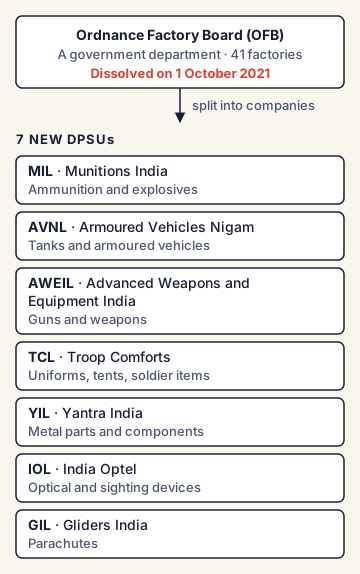
- Munitions India Limited (MIL): ammunition and explosives
- Armoured Vehicles Nigam Limited (AVNL): tanks and armoured vehicles
- Advanced Weapons and Equipment India Limited (AWEIL): guns and weapons
- Troop Comforts Limited (TCL): uniforms, tents and other soldier items
- Yantra India Limited (YIL): metal parts and components
- India Optel Limited (IOL): optical and sighting devices
- Gliders India Limited (GIL): parachutes
Ordnance workers' unions had planned a strike against this change. To prevent strikes in defence production, Parliament passed the Essential Defence Services Act, 2021 in August 2021.
The full list of 16 DPSUs
The 16 DPSUs are the 9 older companies plus the 7 new ones.
- Aerospace and electronics: HAL, BEL
- Missiles: BDL
- Earth-movers and heavy vehicles: BEML
- Special metals and alloys: MIDHANI
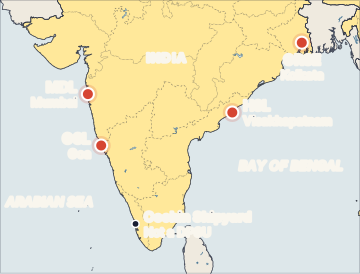
- Shipyards: Mazagon Dock Shipbuilders (MDL, Mumbai), Garden Reach Shipbuilders & Engineers (GRSE, Kolkata), Goa Shipyard (GSL), Hindustan Shipyard (HSL, Visakhapatnam)
- The seven former OFB companies listed above
How does a DPSU work?
A DPSU is a company registered under the Companies Act, 2013, with its own board of directors. The government owns most of its shares, and some DPSUs (such as HAL, BEL, BDL, MDL and GRSE) are also listed on the stock market. The Ministry of Defence is both the owner and the main customer. The armed forces place orders through the Defence Acquisition Procedure (DAP) 2020.
In the past, many orders went to DPSUs directly on "nomination", without competition. Now, more projects use competitive bidding, as in the corvette contracts, where GRSE and GSL won their shares through bids.
The "Ratna" ladder: more freedom for better performers
The government grades its strongest companies as Maharatna, Navratna or Miniratna. A higher grade gives the company's board more power to invest money without asking the government first.
- Maharatna: HAL became India's 14th Maharatna company in October 2024.
- Navratna: BEL; Mazagon Dock (June 2024); GRSE (June 2026).
- Miniratna Category-I: Munitions India, AVNL and India Optel were given this status in May 2025, and Yantra India in early 2026.
India's defence production today
India's defence production reached a record ₹1,50,590 crore in 2024-25, up about 18% from the year before. DPSUs made about 77% of this and private companies about 23%. The private share is growing faster. Defence exports were about ₹23,622 crore in 2024-25.
Commonly confused concepts
- DPSU vs DRDO: The Defence Research and Development Organisation (DRDO) is a group of government laboratories that designs and develops weapons. It does not mass-produce them. DPSUs (and private firms) manufacture them. For example, DRDO developed the Akash missile; BDL and BEL produce it.
- DPSU vs OFB: OFB was a government department that ran ordnance factories. It no longer exists. Its factories now belong to seven DPSUs, which are companies.
- Defence shipyards vs other public shipyards: Cochin Shipyard Limited, which built the aircraft carrier INS Vikrant, is a public sector company but it is not a DPSU. It works under the Ministry of Ports, Shipping and Waterways. The four DPSU shipyards are MDL, GRSE, GSL and HSL.
- Department of Defence Production vs Department of Military Affairs: The DDP looks after the defence industry (DPSUs, production, exports). The Department of Military Affairs, headed by the Chief of Defence Staff, deals with the armed forces themselves.
Issues, criticism and the way forward
- Delays and cost overruns: Several DPSU projects, from aircraft to ships, have run late or cost more than planned. Late delivery hurts the armed forces' readiness.
- Import dependence: Many DPSU products still use imported engines, electronics or special materials. So "made in India" does not always mean "fully Indian".
- Less competition in the past: Orders given on nomination reduced the pressure to cut costs and deliver on time. Competitive bidding, as in the corvette deal, is meant to fix this.
- Low research spending: Critics say DPSUs spend too little on their own research and depend heavily on DRDO or foreign partners for designs.
- Private sector balance: The private sector has been allowed into defence manufacturing since 2001. Experts argue for a level playing field, where DPSUs and private firms compete and also work together.
- Way forward: The government's approach is to give DPSUs more freedom (the Ratna grades), push them toward exports, shift orders toward competition, and draw private firms and MSMEs into their supply chains.
Concepts to Know
- Public Sector Undertaking (PSU): A company in which the government owns more than half the shares. A central PSU is owned by the central government.
- Ordnance: Military weapons, ammunition and related equipment.
- Corporatisation: Turning a government department into a company with its own board and accounts, while the government still owns it.
- Nomination: Giving a government order directly to one company without inviting bids from others.
- Listed company: A company whose shares are bought and sold on a stock exchange, so the public can own part of it.
- Person-days: A way to count work. One person working for one day equals one person-day. 100 people working for 10 days equals 1,000 person-days.
- 16 DPSUs under the Department of Defence Production (set up November 1962), Ministry of Defence
- OFB dissolved on 1 October 2021; its 41 factories went to 7 new DPSUs (MIL, AVNL, AWEIL, TCL, YIL, IOL, GIL)
- Essential Defence Services Act, 2021: lets the Centre ban strikes in essential defence units
- 4 DPSU shipyards: MDL (Mumbai), GRSE (Kolkata), GSL (Goa), HSL (Visakhapatnam); Cochin Shipyard is not a DPSU
- HAL: 14th Maharatna (October 2024); MDL Navratna (June 2024); GRSE Navratna (June 2026)
- Defence production 2024-25: ₹1,50,590 crore; DPSUs about 77%, private sector about 23%
- Defence exports 2024-25: about ₹23,622 crore
● Tracked since August 14, 2026 · last seen November 02, 2026 · updates as the daily brief publishes