Credit Information Companies (CICs)
How Credit Bureaus Work in India
A Credit Information Company (CIC), also called a credit bureau, is a company that collects information about how people and businesses borrow and repay loans. Banks and other lenders send it details of every loan and credit card: how much was borrowed and whether repayments were on time. The CIC stores this as each borrower's credit history and turns it into a credit report and a credit score.
When you apply for a new loan, the lender checks this report to decide whether to lend to you, and at what interest rate.
Why do we need credit bureaus?
Imagine a shopkeeper who gives goods on credit. He knows which customers pay back because he has known them for years. A big bank, lending to millions of strangers, cannot know this. Without shared records, a person who never repaid one bank could simply go to another bank and borrow again. Economists call this problem information asymmetry: the borrower knows more about himself than the lender does. Credit bureaus fix this by sharing repayment records across all lenders. This helps in three ways:
- Lenders make better decisions, so fewer loans turn bad.
- Good borrowers get loans faster and at lower interest rates.
- People are encouraged to repay on time, because a bad record follows them everywhere.
Where did it come from?
In 1999, an RBI working group chaired by N.H. Siddiqui recommended setting up a credit bureau in India. Following this, Credit Information Bureau (India) Limited (CIBIL) was incorporated in August 2000. It started its consumer bureau in April 2004 and its commercial (business) bureau in May 2006. CIBIL is now known as TransUnion CIBIL.
To give the sector a proper legal base, Parliament passed the Credit Information Companies (Regulation) Act, 2005 (CICRA). The RBI and the central government then issued the CIC Rules and Regulations in 2006. After the Act, three more CICs were set up.
Who are the CICs in India?
Four companies hold a Certificate of Registration from the RBI:
- TransUnion CIBIL
- Equifax Credit Information Services
- Experian Credit Information Company of India
- CRIF High Mark Credit Information Services
How does it work, step by step?
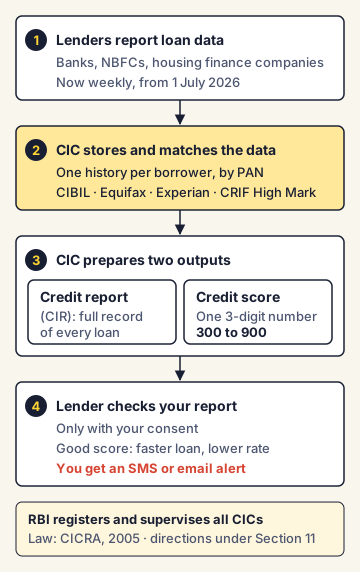
- Reporting: Every bank, NBFC (non-banking finance company), housing finance company and other "credit institution" sends its borrowers' loan data to the CICs at regular intervals.
- Storing and matching: The CIC matches records using identifiers like PAN and builds one history per borrower.
- Report and score: The CIC prepares a Credit Information Report (CIR) listing all loans, repayments and defaults. From this it calculates a credit score, a three-digit number. For individuals, scores usually range from 300 to 900; a higher score means a better repayment record.
- Use by lenders: When you apply for a loan, the lender, with your consent, pulls your report. A good score can mean quick approval and a lower rate.
What does the law say?
CICRA, 2005 is the main law:
- No company can work as a CIC without a Certificate of Registration from the RBI.
- The RBI regulates and supervises CICs. It issues directions under Section 11 of the Act.
- Credit information can be shared only with specified users (like banks) and only for permitted purposes.
- Borrowers have a right to get their credit information corrected if it is wrong.
Key customer rights (RBI rules)
- Free annual report: Since 1 January 2017, every individual can get one free full credit report, with credit score, once every calendar year from each CIC (RBI circular of September 2016).
- Compensation for delays: Under an RBI circular of October 2023, if a complaint about wrong credit information is not resolved within 30 calendar days, the customer gets ₹100 per day of delay. The lender must send the correction within 21 days; if it does and the CIC still delays, the CIC pays.
- Alerts: CICs must send an SMS or email alert to a customer when a lender accesses their credit report.
- Reasons for rejection: If a request to correct data is rejected, the customer must be told why.
- Faster updates: From 1 January 2025, lenders had to report credit data every 15 days (fortnightly), instead of monthly. Under amended directions issued in December 2025, this moves to weekly incremental reporting from 1 July 2026. Faster updates mean that when you repay a loan, your score improves sooner.
India's position and examples
Credit bureaus have helped the huge growth of retail credit in India, such as personal loans, credit cards and small business loans, including loans by fintech companies. Bureau data is also used beyond lending: the RBI has worked on a Public Credit Registry, recommended in 2018 by a task force headed by Y.M. Deosthalee, to hold more complete credit data.
The same "bureau" idea is now being applied to other areas. For example, the proposed National Infrastructure Data Platform of NaBFID aims to do for infrastructure projects what credit bureaus do for borrowers.
Commonly confused concepts
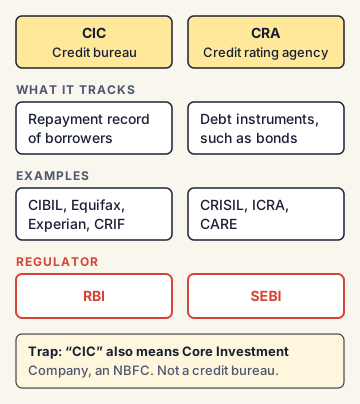
- Credit Information Company vs Credit Rating Agency (CRA): A CIC tracks the repayment record of individual borrowers and businesses for lenders, and is regulated by the RBI under CICRA, 2005. A CRA (like CRISIL, ICRA, CARE) rates debt instruments such as bonds issued by companies or governments, and is regulated by SEBI.
- Credit score vs credit report: The report is the full record of every loan. The score is a single number summarising it.
- CIC vs Account Aggregator: A CIC collects loan data from lenders by law. An Account Aggregator only moves a customer's financial data from one institution to another with the customer's consent; it does not store or score it.
- Credit bureau vs Public Credit Registry: Credit bureaus are private companies. A public credit registry is run by the central bank itself.
- CIC vs Core Investment Company: Both are shortened to "CIC". A Core Investment Company is an NBFC that mainly holds shares of its group companies. It has nothing to do with credit bureaus.
Issues, criticism and the way forward
- Errors in reports: Wrong entries (such as a closed loan shown as unpaid) can unfairly block someone's loan. The compensation framework and faster reporting are meant to fix this.
- Thin-file borrowers: People with no loan history (many farmers, informal workers, young people) have no score, so they struggle to get formal credit. Experts suggest using other data, like utility bill payments, carefully.
- Data privacy: Credit data is very sensitive. It must be protected from leaks and misuse, especially under the Digital Personal Data Protection Act, 2023.
- Customer awareness: Many borrowers do not know they can get a free report or dispute errors.
- Way forward: More frequent and accurate reporting, stronger grievance redressal, careful use of alternative data for the unbanked, and stronger data protection.
Concepts to Know
- Information asymmetry: When one side of a deal knows much more than the other. Here, the borrower knows his own repayment habits but the lender does not.
- NBFC (Non-Banking Financial Company): A company that lends money like a bank but does not have a full banking licence; for example, many vehicle and gold loan companies.
- Default: Failing to repay a loan or instalment on time.
- Specified user: An entity, like a bank, that the law allows to access credit reports.
- Time-series data: Data collected over many years in order, so that trends can be seen.
- First credit bureau: CIBIL, incorporated August 2000, after the N.H. Siddiqui working group (1999)
- Law: Credit Information Companies (Regulation) Act, 2005; Rules and Regulations: 2006; RBI directions under Section 11
- Four CICs: TransUnion CIBIL, Equifax, Experian, CRIF High Mark
- Regulator: RBI (CRAs are regulated by SEBI)
- One free full credit report with score per calendar year: from 1 January 2017
- Complaint resolution: lender 21 days, CIC 30 days; compensation ₹100/day after that (RBI, October 2023)
- Fortnightly reporting from 1 January 2025; weekly reporting from 1 July 2026
- Public Credit Registry task force: Y.M. Deosthalee, report 2018
● Tracked since October 21, 2026 · last seen October 21, 2026 · updates as the daily brief publishes