Cotton Cultivation in India
Cotton is a plant grown for the soft white fibre around its seeds. This fibre is spun into yarn and woven into cloth. Cotton is India's most important fibre crop and a kharif crop (sown with the monsoon). India has the largest area under cotton in the world and is the second-largest producer and consumer of cotton, after China. Millions of farmers, many of them small farmers in dry areas, depend on it for their income.
Why does cotton matter so much?
Cotton is called "white gold" because it links farms to factories. The raw cotton (called kapas, before the seeds are removed) goes to ginning mills, which separate the fibre (called lint) from the seed. The lint goes to spinning mills, then to weaving and garment units, and finally to shops and export markets. The seed gives cottonseed oil and cattle feed (oilcake).
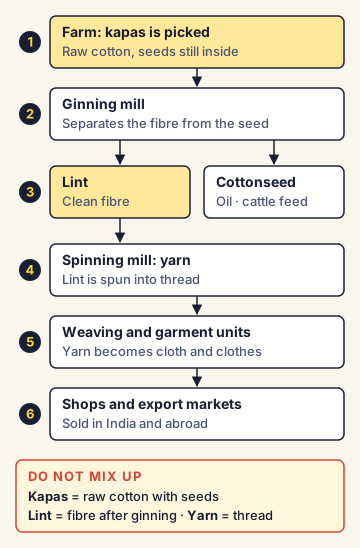
So a good or bad cotton crop affects farmers, mill workers, garment exporters and even edible oil supply. The government calls this chain "Farm to Fibre to Factory to Fashion to Foreign".
What does the crop need?
Cotton is a tropical and subtropical crop:
- Temperature: It needs high temperature, roughly 21°C to 30°C, and plenty of bright sunshine.
- Rainfall: Light to moderate rainfall of about 50 to 100 cm. Too much rain at picking time spoils the fibre.
- Frost-free days: It needs about 210 frost-free days, because it is a long-duration crop.
- Soil: It grows best in the black soil (regur soil) of the Deccan plateau, which holds moisture well. It also grows in alluvial soils in the north and red and black soils in the south. It cannot stand waterlogging.
- Water source: More than 65% of India's cotton is rainfed (it depends on rain, not canals or wells). This makes yields swing with the monsoon.
Where is it grown?
India's cotton belt has three zones:
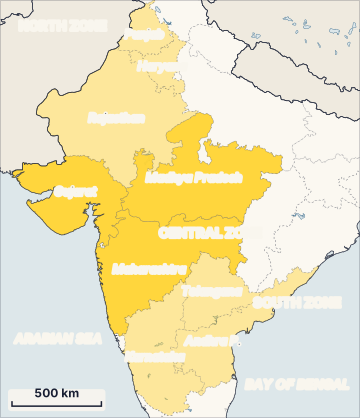
- North zone: Punjab, Haryana and Rajasthan. Here cotton is mostly irrigated, and sowing starts in April-May.
- Central zone: Gujarat, Maharashtra and Madhya Pradesh. This is the largest zone, mostly rainfed, on black soil.
- South zone: Telangana, Andhra Pradesh and Karnataka (Tamil Nadu and Odisha also grow some cotton).
Maharashtra has the largest area under cotton, while Gujarat and Maharashtra are usually the top producers, followed by Telangana and Karnataka. Production is counted in bales of 170 kg each. The cotton season runs from 1 October to 30 September.
What are the types of cotton?
Cotton is graded by staple length (the length of the fibre). Longer fibre makes finer, stronger and costlier cloth.
- Short staple: below about 24 mm, used for coarse cloth.
- Medium staple: about 24 to 28 mm.
- Long staple: 28 mm and above.
- Extra Long Staple (ELS): 30 mm and above in the definition used in Indian schemes, mainly from the species Gossypium barbadense (Egyptian and Pima cotton). India grows little ELS cotton and imports it mainly from Egypt and the USA.
India grows four cultivated cotton species: two "Old World" (Asian) species, Gossypium arboreum and Gossypium herbaceum, and two "New World" species, Gossypium hirsutum (American upland cotton, the most widely grown) and Gossypium barbadense.
How did Bt cotton change the crop?
Bollworms are caterpillars that eat into the cotton boll (the fruit that holds the fibre). In March 2002, the Genetic Engineering Appraisal Committee (GEAC) under the Ministry of Environment approved Bt cotton for commercial farming. Bt cotton carries a gene from a soil bacterium, Bacillus thuringiensis, which makes a protein that kills bollworms. It is India's only genetically modified (GM) crop approved for commercial cultivation.
The first version (Bollgard I) had one Bt gene (Cry1Ac); Bollgard II, with two genes, came in 2006. Bt cotton now covers almost all of India's cotton area, and production rose sharply in the 2000s.
But the pink bollworm became resistant. Field resistance to Bollgard I was first confirmed in Gujarat (Amreli and nearby districts) around 2009-2010, and later to Bollgard II as well. Herbicide-tolerant (HT) Bt cotton, a newer GM variety, is not approved in India, though illegal planting has been reported.
How does the government support cotton farmers?
- Minimum Support Price (MSP): The Centre announces an MSP for cotton every kharif season, on the advice of the Commission for Agricultural Costs and Prices (CACP), approved by the Cabinet Committee on Economic Affairs (CCEA). For 2026-27, the MSP is ₹8,267 per quintal for medium staple and ₹8,667 per quintal for long staple cotton.
- Cotton Corporation of India (CCI): A public sector company set up in 1970 under the Ministry of Textiles (under the Companies Act, 1956). When market prices fall below the MSP, CCI buys kapas from farmers at the MSP. This is called MSP operations. Farmers register through CCI's "Kapas Kisan" app. In the 2025-26 season, CCI bought about 104 lakh bales at MSP.
- Mission for Cotton Productivity: Announced in the Union Budget 2025-26 as a five-year mission. The Union Cabinet approved an outlay of ₹5,659 crore for 2026-27 to 2030-31. It aims to raise lint yield from about 440 kg per hectare to about 755 kg per hectare and production to about 498 lakh bales by 2031, with better seeds (including ELS cotton), mechanisation and value-chain reforms. It is run jointly by the Ministry of Agriculture and Farmers Welfare and the Ministry of Textiles.
- Kasturi Cotton Bharat: A branding programme to sell Indian cotton as a premium, traceable product, with very low "trash" (dirt and leaf bits) content.
How productive is India?
Even with the world's largest cotton area (about 11-12 million hectares), India's yield is only about 440-500 kg of lint per hectare. The world average is about 770 kg per hectare. This is because most cotton is rainfed, seed quality has slipped, pest attacks are common, and holdings are small.
Commonly confused concepts
- Kapas vs lint vs yarn: Kapas is raw cotton with seeds. Lint is the cleaned fibre after ginning. Yarn is the thread made by spinning lint.
- Bt cotton vs HT Bt cotton: Bt cotton (approved since 2002) kills bollworms. HT Bt cotton also survives weed-killer sprays (glyphosate) and is not approved in India.
- Cotton season vs financial year: The cotton season runs October to September, not April to March.
- CACP vs CCEA vs CCI: CACP recommends the MSP; the CCEA approves it; CCI actually buys cotton at that price.
- Long staple vs ELS: All ELS cotton is long staple, but not all long staple cotton is ELS. ELS is the top grade (30 mm and above).
Issues, criticism and the way forward
- Falling production and stagnant yields: Pink bollworm, erratic rain and old seed technology have hurt yields. The way forward suggested is new pest-resistant seeds, high-density planting and better extension (farm advice) services.
- Farmer vs industry conflict: The textile industry wants cheap cotton and asks for duty-free imports. Farmers' groups fear that cheap imports pull down local prices, especially at harvest time. The government tries to balance both, for example by timing import relief and running MSP operations.
- Heavy dependence on MSP buying: When CCI buys a very large share of the crop, the government has to store and later sell huge stocks, which costs money.
- Quality issues: Contamination with dirt and plastic lowers the price of Indian cotton abroad. Kasturi Cotton Bharat and better ginning standards aim to fix this.
- Distress in rainfed areas: Cotton growers in dry areas such as Vidarbha (Maharashtra) face high input costs and crop failure risks. Crop insurance and assured irrigation are long-standing suggestions.
Concepts to Know
- Kharif crop: A crop sown at the start of the south-west monsoon (June-July) and harvested in autumn (September-November). Rice, cotton and soybean are kharif crops.
- Genetically modified (GM) crop: A crop whose genes have been changed in a laboratory, often by adding a gene from another living thing, to give it a new feature like pest resistance.
- Ginning: The process of separating cotton fibre from the seeds.
- Quintal: 100 kg.
- Yield: How much crop is produced from one hectare of land.
- Black soil (regur): A dark, clay-rich soil formed from volcanic rock in the Deccan plateau. It holds water well and is ideal for cotton.
- India: largest cotton area in the world (about 11.4 million ha); second-largest producer and consumer after China
- Growing conditions: about 21-30°C, 50-100 cm rainfall, about 210 frost-free days, black (regur) soil; over 65% rainfed
- Top states: Maharashtra (largest area), Gujarat, Telangana, Karnataka
- 1 bale = 170 kg; cotton season = October to September
- Bt cotton approved by GEAC in March 2002; India's only commercially approved GM crop; Bollgard II from 2006
- MSP 2026-27: medium staple ₹8,267/quintal; long staple ₹8,667/quintal
- CCI: set up 1970, under the Ministry of Textiles; buys cotton at MSP
- Mission for Cotton Productivity: ₹5,659 crore, 2026-27 to 2030-31; target yield about 755 kg/ha and about 498 lakh bales by 2031
- ELS cotton: staple length 30 mm or more; mostly Gossypium barbadense
● Tracked since October 31, 2026 · last seen October 31, 2026 · updates as the daily brief publishes