Cost of Cultivation Concepts
A2, A2+FL and C2
When the government fixes a crop's MSP, it first works out how much it costs a farmer to grow that crop. But "cost" can be measured in different ways. India uses a ladder of cost concepts (named A1, A2, B1, B2, C1, C2 and so on). Each step up the ladder adds more items. The three that matter most in the MSP debate are A2, A2+FL and C2. The lower the cost used, the bigger the "profit margin" looks on paper.
Why do we need different cost concepts?
Think of a family that runs a small tea stall in its own house. To know if the stall is profitable, it could count only cash spent on milk, sugar and gas. Or it could also count the value of the family's own hours of work. Or it could go further and count the rent the family could have earned by renting out that room, plus interest it lost by putting its savings into the stall.
Each answer is "correct", but each tells a different story. Farming is the same. Many costs are not paid in cash: the farmer's own land, own tractor and family's labour still have value.
The cost ladder, step by step
- A1: All actual costs paid in cash or kind by a farmer who owns the land: hired labour, bullock and machine labour, seeds, fertilisers, manure, pesticides, irrigation, depreciation (wear and tear) of tools and buildings, land revenue (a tax on land), and interest on working capital (money borrowed for the season).
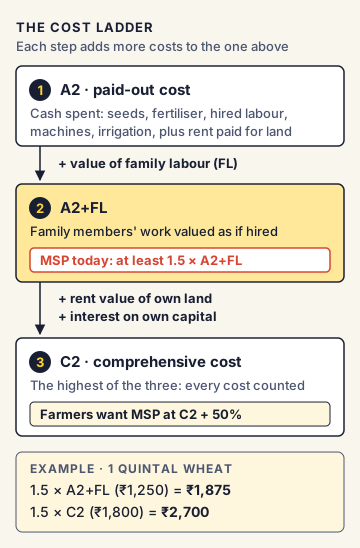
- A2: A1 plus rent paid for leased-in land (land the farmer has taken on rent from someone else). A2 is often called the paid-out cost.
- A2+FL: A2 plus the imputed value of family labour (FL). "Imputed" means a value is assigned even though no cash is paid. If the farmer's wife and son work on the farm, their work is valued as if it had been hired.
- B1: A1 plus interest on the value of owned fixed capital (own tractor, pump set, cattle shed and so on, but not land).
- B2: B1 plus rental value of owned land (the rent the farmer could have earned by leasing it out, minus land revenue) and rent paid for leased-in land.
- C1: B1 plus imputed value of family labour.
- C2: B2 plus imputed value of family labour. This is the comprehensive cost: everything in A2+FL, plus rent on owned land and interest on owned capital.
- C2* and C3: In C2*, labour is valued at the statutory minimum wage or the actual market wage, whichever is higher. C3 adds 10% to C2* as a reward for the farmer's management skills.
Who calculates these costs?
Data come from the Comprehensive Scheme for the Study of Cost of Cultivation of Principal Crops, run by the Directorate of Economics and Statistics in the Ministry of Agriculture. Field surveys record costs on sample farms across states. The CACP uses these costs (projected for the coming season) along with demand and supply, prices in India and abroad, and the effect on consumers, to recommend MSP.
Where did the "cost plus 50%" idea come from?
- National Commission on Farmers (2004-2006): Set up on 18 November 2004 and chaired by agricultural scientist M.S. Swaminathan, it gave five reports. Its fifth and final report (October 2006) recommended that MSP should be at least 50% more than the weighted average cost of production. Farmers' groups and many experts read this cost as C2.
- National Policy for Farmers, 2007: did not adopt the 50%-over-cost rule.
- Union Budget 2018-19: The government announced that MSPs would be fixed at at least 1.5 times the cost of production, starting with the kharif season of 2018-19. The cost used is A2+FL, not C2.
How big is the gap in practice?
A simple example: suppose for one quintal of wheat, A2+FL = ₹1,250 and C2 = ₹1,800.
- 1.5 × A2+FL = ₹1,875
- 1.5 × C2 = ₹2,700
The same "50% margin" gives very different prices. That is why the choice of cost matters so much to farmers and to the government's budget. (These numbers are only for illustration.)
Commonly confused concepts
- A2 vs A2+FL vs C2: A2 = cash costs (including rent paid). A2+FL = A2 plus value of family labour. C2 = A2+FL plus rent of own land and interest on own capital. C2 is always the highest of the three.
- Cost of production vs MSP: Cost is what it takes to grow the crop. MSP is the price the government offers, usually set above cost.
- MSP vs FRP: MSP is fixed by the Centre on CACP advice for 22 crops. Sugarcane gets a Fair and Remunerative Price (FRP), fixed under the Sugarcane (Control) Order, 1966, which sugar mills must legally pay.
- MSP vs procurement: Announcing MSP does not mean the government buys all the crop. Actual buying (procurement) is big for wheat and rice in some states and small for most other crops.
- Swaminathan formula vs current formula: "C2+50%" is what farmers' groups link with the Swaminathan Commission. The present policy is "A2+FL+50%".
Issues, criticism and the way forward
- The C2 demand: Farmers' groups argue that land and capital are real costs, and leaving them out understates the farmer's true cost. They want a legal guarantee of MSP at C2+50%.
- The fiscal and market concern: The government's side and many economists point out that a much higher MSP could raise food prices, make Indian crops costlier than imports and world prices, and increase the government's food subsidy bill.
- Measuring costs correctly: Critics say cost surveys lag behind real prices (for example, sudden rises in diesel and wages) and value family labour too low.
- State inputs: Agriculture is a State subject (Entry 14, State List), and states send their own MSP suggestions to the CACP. Some states suggest much higher prices than the Centre finally fixes.
- Limited reach of procurement: Benefits go mostly to farmers in a few states with strong procurement systems. Many farmers sell below MSP.
- Way forward: Experts suggest better and more frequent cost surveys, wider procurement or price-deficiency payments (paying farmers the gap between MSP and market price), crop diversification, and stronger state roles in price setting.
Concepts to Know
- Imputed value: A value given to something that is used but not paid for in cash, such as the work of family members or the use of one's own land.
- Leased-in land: Land a farmer takes on rent from another owner to farm.
- Working capital: Money needed during the season for seeds, fertiliser and wages, often borrowed and repaid after harvest.
- Depreciation: The loss in value of a machine or building because of use and age.
- Marketing season: The period when a harvested crop is sold. The rabi marketing season 2027-28 covers wheat sown in late 2026 and sold in 2027.
- Quintal: 100 kilograms.
- A2 = paid-out costs (cash and kind, including rent paid for leased-in land)
- A2+FL = A2 + imputed value of family labour (basis of current MSP: at least 1.5 × A2+FL since 2018-19)
- C2 = A2+FL + rental value of owned land + interest on owned fixed capital
- C3 = C2* + 10% for management
- National Commission on Farmers: set up 18 November 2004, chaired by M.S. Swaminathan; fifth report October 2006 recommended MSP at least 50% over weighted average cost of production
- Cost data from the Comprehensive Scheme for the Study of Cost of Cultivation of Principal Crops (Directorate of Economics and Statistics)
● Tracked since October 04, 2026 · last seen October 04, 2026 · updates as the daily brief publishes