Cloud Seeding
How Artificial Rain Is Made
Cloud seeding is a way of trying to get more rain or snow out of a cloud by adding tiny particles to it. These particles, usually silver iodide or common salts, act as "seeds" around which water collects into drops or ice crystals big enough to fall. Cloud seeding cannot create clouds from clear sky. It can only help a suitable cloud that already has enough moisture to give a little more rain than it would on its own.
Why does it exist?
Many clouds float across the sky without giving any rain. This is because their water droplets are too small to fall. Millions of tiny droplets must join together to make one raindrop. Cloud seeding tries to speed up this step. Countries use it for three main goals: to get more water during droughts, to add snow to mountains that feed rivers, and to reduce hail that damages crops. In recent years, Indian cities have also tried it to wash pollution out of the air.
How does rain form naturally?
You need to understand this first. Water vapour in the air cannot turn into a droplet on its own. It needs a tiny surface to collect on, such as a speck of dust, salt or smoke. These specks are called condensation nuclei. Once droplets form, they must grow much bigger before they fall. This happens in two main ways:
- In warm clouds (above 0°C), droplets bump into each other and merge, a process called collision and coalescence. Bigger droplets fall faster and collect more droplets on the way down.
- In cold clouds, many droplets stay liquid even below 0°C. These are called supercooled droplets. If a few ice crystals form among them, the ice crystals grow quickly by taking water from the droplets around them. This is the Bergeron-Findeisen process. The ice crystals become heavy, fall, and melt into rain on the way down.
How does cloud seeding work?
Seeding copies these natural steps in two ways:
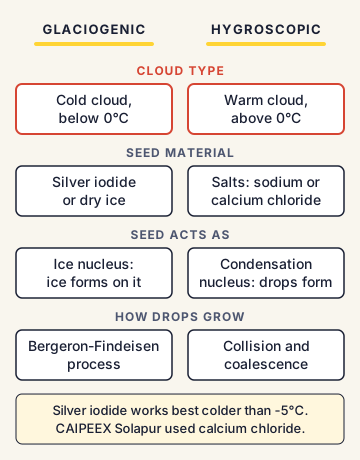
- Glaciogenic (ice-forming) seeding is used on cold clouds. Silver iodide is released into the cloud. Its crystal shape is very similar to ice, so supercooled water freezes on it. Silver iodide starts working well at temperatures colder than about -5°C. Dry ice (frozen carbon dioxide) can also be used, because it is so cold that it freezes droplets around it.
- Hygroscopic (water-attracting) seeding is used on warm clouds. Salts such as sodium chloride or calcium chloride are released near the cloud base. These salts pull water towards them and form bigger droplets early, which then grow by collision and coalescence.
How is the seeding done?
The most common method is an aircraft. It flies into or under the cloud and burns flares (sticks that release a fine smoke of seeding particles when lit) or sprays the material. Seeding can also be done with ground generators that send smoke up into passing clouds, or with rockets. The cloud must be the right type, at the right height, with enough moisture.
A simple comparison: seeding is like adding a pinch of sugar crystals to a nearly saturated sugar syrup. The crystals help it set, but if there is no syrup, nothing happens.
Where did it come from?
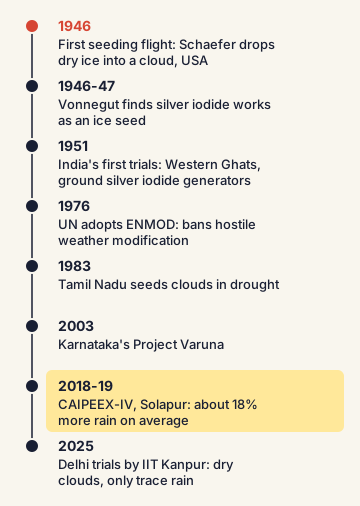
- 13 November 1946: Vincent Schaefer, a scientist at General Electric in the United States, dropped dry ice from an aircraft into a supercooled cloud near Schenectady, New York, and snow fell. This was the first cloud seeding flight.
- 1946-1947: his colleague Bernard Vonnegut found that silver iodide works as an ice "seed" because its crystals look like ice crystals. Silver iodide is still the most used seeding material.
- India: experiments began in 1951, when a Tata company used ground-based silver iodide generators over the Western Ghats. Tamil Nadu ran seeding operations in 1983 and again in later years during droughts. Karnataka ran Project Varuna (2003) and Varshadhare (2017). Maharashtra has also tried seeding in drought years.
The CAIPEEX experiment: India's main scientific test
The Indian Institute of Tropical Meteorology (IITM), Pune, under the Ministry of Earth Sciences (MoES), runs the Cloud Aerosol Interaction and Precipitation Enhancement Experiment (CAIPEEX). Its fourth phase, held over Solapur in Maharashtra (a rain-shadow area) during the 2018 and 2019 monsoons, used hygroscopic seeding with calcium chloride flares. The report, released on 27 July 2023, found:
- an average rainfall increase of about 18% over a 100 sq km area downwind of seeding;
- increases of up to about 46% at some locations;
- only some clouds responded: seeding works only for suitable, moisture-rich cumulus (heap-shaped, tall) clouds.
India's position and Indian examples
There is no single national law in India that controls cloud seeding. Operations are usually approved case by case, with permissions for aircraft and airspace from aviation authorities. Delhi's trials are a good example of the challenges:
- In October 2025, IIT Kanpur carried out trials over Delhi using a Cessna aircraft. Flares containing about 20% silver iodide, with the rest salts, were burned. The moisture in the clouds was only about 10-15%, far too little. Only traces of rain (0.1 mm in Noida and 0.2 mm in Greater Noida) were recorded.
- Studies, including one from IIT Delhi, point out that Delhi's winter air is usually too dry for cloud seeding to work reliably. Winter clouds over Delhi are often thin and few.
- Globally, more than 25 countries use cloud seeding. The United Arab Emirates (UAE) and China run some of the largest programmes.
International law
The Environmental Modification Convention (ENMOD) bans the military or hostile use of weather-changing techniques that have widespread, long-lasting or severe effects. The UN General Assembly adopted it on 10 December 1976 (Resolution 31/72). It opened for signature in Geneva on 18 May 1977 and came into force on 5 October 1978. It does not ban peaceful cloud seeding for rain or snow. India is a party to it.
Commonly confused concepts
- Cloud seeding vs creating rain from nothing: Seeding only boosts rain from clouds that already exist and are nearly ready to rain. It cannot make rain in a clear sky.
- Glaciogenic vs hygroscopic seeding: Glaciogenic seeding uses silver iodide or dry ice on cold clouds to form ice. Hygroscopic seeding uses salts on warm clouds to make bigger droplets.
- Condensation nuclei vs ice nuclei: Condensation nuclei help water vapour form liquid droplets. Ice nuclei help water freeze into ice crystals. Silver iodide is an ice nucleus; salt is a condensation nucleus.
- Cloud seeding vs geoengineering: Cloud seeding is local and short-term (one cloud, one day). Geoengineering means large-scale ideas to change the whole Earth's climate, such as reflecting sunlight back to space.
- Cloudburst vs cloud seeding: A cloudburst is a natural, sudden, very heavy downpour over a small area. It has nothing to do with seeding.
Issues, criticism and the way forward
- Uncertain results: It is very hard to prove how much rain came from seeding and how much would have fallen anyway. Scientists need randomised trials, where some clouds are seeded and some are not, to measure the effect. Several studies abroad found small or no gains.
- Needs the right weather: Seeding fails without moist, suitable clouds. This is exactly the problem in Delhi's dry winter, when pollution is worst.
- Short-lived relief for pollution: Even when rain falls, it washes out particles only for a day or two. Pollution comes back if its sources (vehicles, dust, industry, burning of waste and crop stubble) remain. Experts call it a temporary fix, not a solution.
- Cost: Each operation needs aircraft, flares and expert teams. Delhi's Cabinet approved ₹3.21 crore for five trials in 2025, and estimates for a full winter run into crores more.
- Environment and fairness: Silver iodide is used in very small amounts, and most studies find little harm, but long-term effects on soil and water are still being studied. There are also debates about whether seeding in one place "steals" rain from areas downwind.
- Way forward: Experts suggest treating seeding as a scientific tool for water security, used only with careful forecasts, proper rules and independent checking of results, while tackling pollution at its sources.
Concepts to Know
- Silver iodide (AgI): A yellow chemical compound of silver and iodine. Its crystals are shaped very much like ice crystals, so water freezes on them easily.
- Supercooled water: Water that stays liquid even below 0°C because it has nothing to freeze on. Clouds often contain such droplets.
- Hygroscopic: Something that attracts and holds water from the air. Common salt is hygroscopic, which is why it becomes damp in the rainy season.
- Flare: A stick-like device fitted to an aircraft. When lit, it burns and releases a fine smoke of seeding particles into the cloud.
- Rain-shadow area: A region on the far side of mountains that gets little rain, because the clouds have already dropped most of their water on the side facing the wind.
- Randomised trial: A test in which some cases are chosen by chance to receive the treatment and others are not, so the two groups can be compared fairly.
- First cloud seeding flight: 13 November 1946, Vincent Schaefer (General Electric, USA), using dry ice
- Silver iodide as a seeding agent: discovered by Bernard Vonnegut (1946-1947); effective below about -5°C
- Two types: glaciogenic (silver iodide, dry ice; cold clouds) and hygroscopic (sodium chloride, calcium chloride; warm clouds)
- India's first experiments: 1951, Western Ghats (ground-based silver iodide generators)
- CAIPEEX-IV (IITM Pune, MoES): Solapur, Maharashtra, 2018-2019; about 18% average rainfall increase, up to about 46% locally; report released 27 July 2023
- Delhi's trials, October 2025 (IIT Kanpur): cloud moisture only about 10-15%; only trace rain; ₹3.21 crore approved for five trials
- ENMOD: adopted 10 December 1976 (UNGA Resolution 31/72); in force 5 October 1978; bans hostile use of weather modification
● Tracked since November 10, 2026 · last seen November 10, 2026 · updates as the daily brief publishes