Clean Development Mechanism (CDM)
The Clean Development Mechanism, or CDM, was a carbon market created under Article 12 of the Kyoto Protocol (1997). It let rich countries that had legal emission targets pay for clean projects in developing countries, such as wind farms, biogas plants or efficient cookstoves. In return, they received carbon credits called Certified Emission Reductions (CERs), which they could use to meet their own targets. It was the world's first global carbon credit system and the direct parent of today's Article 6.4 mechanism.
Why was it created?
The Kyoto Protocol put binding targets only on developed countries (listed in Annex I of the UNFCCC). Developing countries had no targets. The CDM aimed to do two things at once: help rich countries meet their targets at lower cost, and bring money and clean technology to developing countries so they could grow in a cleaner way. That is why it was called the "clean development" mechanism.
Where did it come from?
- 1997: The Kyoto Protocol was adopted at COP3 in Kyoto, Japan. Article 12 created the CDM.
- 2001: The Marrakesh Accords (COP7) set out the detailed rules and created the CDM Executive Board, the UN body that registers projects and issues CERs.
- 18 November 2004: The first CDM project was registered: the NovaGerar landfill gas project in Nova Iguaçu, Brazil, which captured methane from a rubbish dump to make electricity.
- 2005: The Kyoto Protocol entered into force on 16 February 2005.
- 2008 to 2012 and 2013 to 2020: The Kyoto Protocol's two commitment periods. After 2012, demand for CERs collapsed and prices crashed.
- 2015 onwards: The Paris Agreement replaced the Kyoto approach. CDM projects could apply to move into the new Article 6.4 mechanism.
How did it work?
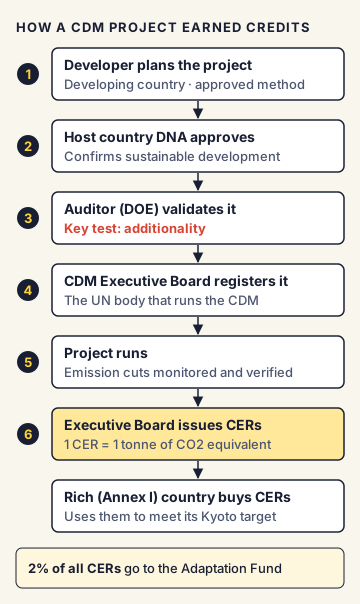
- A project developer in a developing country prepared a project design and chose a UN-approved method to calculate emission cuts.
- The host country's Designated National Authority (DNA) gave approval, confirming the project helped sustainable development.
- An independent auditor, called a Designated Operational Entity, validated the project.
- The CDM Executive Board registered it.
- The project ran and its emission cuts were monitored and verified.
- The Executive Board issued CERs. 1 CER = 1 tonne of CO2 equivalent.
The key test: additionality
A project could earn credits only if it was additional, meaning it would not have happened without the money from carbon credits. For example, if a factory was going to build a solar plant anyway because it was cheap, it should not get credits for it. Proving additionality was the CDM's hardest and most debated test.
Share of proceeds
2% of CERs issued for each project went to the Adaptation Fund, to help developing countries adapt to climate change. This was the first-ever "levy" on a carbon market to pay for adaptation.
Scale
By April 2015, 7,629 projects had been registered worldwide. China hosted the most projects, and India was second, with 1,564 registered projects at that time. Most projects were renewable energy, energy efficiency, methane capture and industrial gas destruction.
India's position and Indian examples
India set up its National Clean Development Mechanism Authority (NCDMA) in December 2003 under the Ministry of Environment and Forests, chaired by the Environment Secretary. It gave "host country approval" to Indian projects. Indian CDM projects included wind and small hydro power, biomass power in sugar mills, waste heat recovery in steel and cement plants, and efficient lighting programmes.
India's early lead in the CDM (it had the most registered projects in 2007) built a large pool of carbon market experts, which India now uses for its own Carbon Credit Trading Scheme.
Commonly confused concepts
- CDM vs Joint Implementation (JI): Both were Kyoto mechanisms. The CDM was for projects in developing countries (no targets). JI (Kyoto Article 6) was for projects between two developed countries (both with targets); its units were called ERUs (Emission Reduction Units).
- CDM vs International Emissions Trading (Kyoto Article 17): Emissions trading let developed countries buy and sell their spare allowed emissions (called AAUs, Assigned Amount Units) directly, without any project.
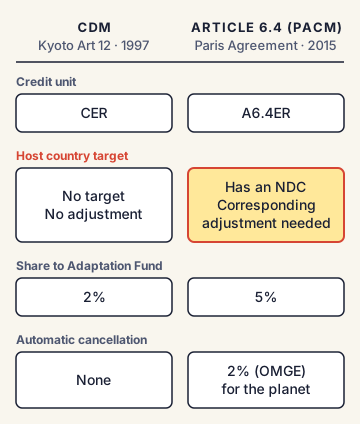
- CDM vs Article 6.4 (PACM): The PACM is the CDM's successor. Key differences: all countries now have targets (NDCs), so the host country must make a corresponding adjustment when credits are sold abroad; there is a 2% automatic cancellation for the planet; and the Adaptation Fund share is 5% instead of 2%.
- CER vs A6.4ER vs ITMO: CER = Kyoto CDM credit; A6.4ER = Paris Article 6.4 credit; ITMO = Paris Article 6.2 traded unit.
Issues, criticism and the way forward
- Weak additionality: Studies found many CDM projects, especially large hydro and wind projects, would probably have been built anyway.
- Perverse incentives (HFC-23 case): HFC-23 is a waste gas from making refrigerant gases and is about 11,700 times stronger than CO2. Factories earned so many credits for destroying it that some were accused of making more of it to earn more credits. The European Union banned credits from such industrial gas projects in its carbon market from May 2013.
- Uneven spread: Most projects went to a few big economies (China, India, Brazil), while Africa and the poorest countries got very few.
- Price crash: After 2012, rich countries' demand fell and CER prices collapsed to almost nothing, leaving many projects stranded.
- Human rights: Some projects, like large dams, were linked to displacement of local people without a proper complaint system.
- Way forward: These lessons shaped the Article 6.4 rules: stricter baselines, the 2% OMGE, an appeal and grievance process, and sustainable development safeguards. The current Myanmar cookstove dispute shows that critics fear old CDM weaknesses are being carried into the new system through transitioned projects.
Concepts to Know
- Kyoto Protocol: The 1997 climate treaty that gave legally binding emission cut targets to developed countries for 2008 to 2012 (and later 2013 to 2020). It came into force in 2005.
- Annex I countries: The developed countries and economies in transition listed in Annex I of the UNFCCC, which took on emission targets under Kyoto.
- Baseline: The amount of emissions that would have happened without the project. Credits = baseline emissions minus actual emissions. A too-high baseline means too many credits.
- Methane capture: Collecting methane gas, for example from rubbish dumps or animal waste, and burning it or using it for energy, so it does not escape into the air where it traps much more heat than CO2.
- Programme of Activities (PoA): A way to register many small similar projects (like thousands of cookstoves) under one umbrella, so each small one does not need separate approval.
- Created by Article 12 of the Kyoto Protocol (1997); detailed rules in the Marrakesh Accords (2001).
- Supervised by the CDM Executive Board; credits = Certified Emission Reductions (CERs), 1 CER = 1 tonne CO2e.
- First registered project: NovaGerar landfill gas project, Brazil, 18 November 2004.
- 2% of CERs went to the Adaptation Fund as share of proceeds.
- 7,629 projects registered by April 2015; India second with 1,564 (China first).
- India's National CDM Authority: set up December 2003, chaired by the Environment Secretary.
- EU banned credits from HFC-23 and N2O industrial gas projects in its ETS from May 2013.
- CERs from projects registered on or after 1 January 2013 can be used only towards a country's first NDC.
● Tracked since October 08, 2026 · last seen October 08, 2026 · updates as the daily brief publishes