Central Electricity Authority (CEA)
India's Power Sector Planner
The Central Electricity Authority (CEA) is the Central Government's top technical body for electricity. It plans how much electricity India will need in the future, sets technical and safety standards for power plants and power lines, collects power sector data and advises the government. It works under the Ministry of Power and gets its powers from the Electricity Act, 2003. It does not fix electricity prices; that job belongs to separate regulators.
Why does India need such a body?
Electricity cannot be stored easily in large amounts, so it must be produced at the same moment it is used. A large power plant or a long transmission line takes five to ten years to build. So someone must look ahead and ask: how much power will India need in 2032 or 2047, from which sources, and through which lines?
Without such planning, the country could face power cuts, or it could waste money on plants that sit idle. Someone must also make sure that a transformer bought in Kerala and a power line built in Punjab follow the same technical rules, so that the whole national grid works safely as one machine. The CEA does this planning and standard-setting job.
Where did it come from?
The CEA was first set up under Section 3(1) of the Electricity (Supply) Act, 1948. It started as a part-time body in 1951 and became a full-time body in 1975. In 2003, Parliament replaced the old electricity laws with the Electricity Act, 2003. Section 70 of this new Act continued the CEA, with its existing staff and officers. Today the CEA's main powers and duties come from Sections 70 to 75 of the 2003 Act, along with some other sections.
How is it made up?
Section 70 of the Electricity Act, 2003 lays down its structure:
- It can have not more than 14 members, including the Chairperson. Of these, not more than 8 can be full-time members.
- All members are appointed by the Central Government. The government can appoint the Chairperson directly or name one of the full-time members as Chairperson.
- Members must have ability, integrity and experience. At least one member must come from each of several fields named in the Act, such as generation engineering, transmission engineering, applied research and economics or finance.
- The Chairperson and members hold office during the pleasure of the Central Government. This means the government can remove them at any time, without a fixed term protecting them.
- The Chairperson is the Chief Executive of the CEA. Its headquarters is in Delhi. A Secretary, appointed with the Centre's approval under Section 72, assists it.
What does the CEA do?
Section 73 of the Act lists its functions. The most important ones are:
- Advise the Central Government on the National Electricity Policy and make short-term and long-term plans for developing the power system.
- Set technical standards for building power plants, power lines and connections to the grid.
- Set safety requirements for building, running and maintaining plants and lines.
- Set grid standards for running transmission lines, and conditions for installing meters.
- Collect and publish data on how electricity is generated, transmitted, traded, distributed and used, and study cost and efficiency.
- Promote research, skill development of power sector workers, and timely completion of power projects.
- Advise State Governments, power companies and regulators on technical matters.
The Act also gives the CEA other duties: preparing the National Electricity Plan (Section 3), giving concurrence (formal approval) to large hydro projects (Section 8), and making regulations (Section 177).
The National Electricity Plan: the CEA's biggest job
Under Section 3(4) of the Electricity Act, 2003, the CEA prepares a National Electricity Plan in line with the National Electricity Policy and notifies it once every five years. A draft is first published for public comments, and the plan needs the Central Government's approval. Think of it like a family planning its budget for the next ten years: how much it will earn, what it will spend on, and what it must save for.
The plan estimates future demand and works out how much coal, gas, hydro, nuclear, solar, wind and storage capacity India must add. The CEA notified the plan for 2022-32 (generation volume) in May 2023. It projected an all-India peak demand of 366.4 GW in 2031-32, based on the 20th Electric Power Survey. The Electric Power Survey is the CEA's regular study that forecasts electricity demand state by state.
Hydro projects need CEA approval
Under Section 8, a company that wants to build a hydroelectric power station costing more than a limit fixed by the Central Government must send its scheme to the CEA for concurrence. The CEA checks things like the best use of the river, dam safety and the design. Most other power plants, such as coal or solar plants, do not need this approval after the 2003 Act removed the old licensing system for generation.
Capacity vs generation: why the CEA cares about "firm" power
This idea is important for the nuclear debate.
- Installed capacity is the maximum power a plant can produce at any moment, measured in megawatts (MW) or gigawatts (GW).
- Generation is the actual electricity produced over time, measured in units (kilowatt-hours) or billion units.
- A solar plant produces only when the sun shines, so in a year it may produce only about one-fifth of its full capacity. A nuclear or coal plant can run almost all day and night.
- So a GW of solar and a GW of nuclear do not give the same amount of electricity. Power that is available round the clock, whenever needed, is called firm power or baseload power. Planners need enough firm power to meet the evening peak, when solar output falls to zero.
India's position and Indian examples
Electricity is in the Concurrent List (Entry 38) of the Seventh Schedule, so both the Centre and the states make laws and run power companies. This makes the CEA's coordination role very important. Its plans guide central companies like NTPC and the Nuclear Power Corporation of India Limited (NPCIL), state power companies and private developers.
Its standards decide how new power lines are built and how smart meters are installed. India has set a target of 100 GW of nuclear capacity by 2047, under the Nuclear Energy Mission announced in the Union Budget 2025-26, and the CEA's plans include this nuclear path.
Commonly confused concepts
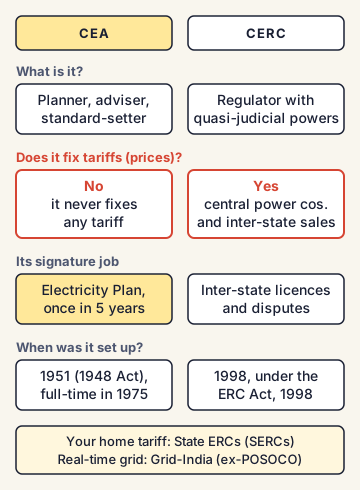
- CEA vs CERC: The CEA is a planner, adviser and standard-setter. The Central Electricity Regulatory Commission (CERC) is a regulator with quasi-judicial powers (powers like a court). CERC fixes tariffs (prices) for central power companies and inter-state power sales, grants inter-state licences and settles disputes. CERC was first set up in 1998 under the Electricity Regulatory Commissions Act, 1998, and now works under the 2003 Act.
- CEA vs State Electricity Regulatory Commissions (SERCs): SERCs fix the electricity tariff you pay at home. The CEA does not fix any consumer tariff.
- CEA vs Grid Controller of India (Grid-India): Grid-India (earlier called POSOCO, renamed in November 2022) runs the grid minute by minute through the National Load Despatch Centre and Regional Load Despatch Centres. The CEA plans for the future; Grid-India operates the system in real time.
- CEA vs Ministry of Power: The Ministry makes policy and decisions. The CEA gives technical advice and prepares plans, which the government approves.
- National Electricity Policy vs National Electricity Plan: The Policy is made by the Central Government (Section 3(1)) and gives broad direction. The Plan is prepared by the CEA (Section 3(4)) and gives detailed numbers on demand and capacity.
Issues, criticism and the way forward
- Limited independence: Members hold office at the pleasure of the Central Government. Critics say this can weaken the CEA's ability to give frank technical advice. Others argue that a planning body should stay close to the government, since it only advises.
- Forecasting is hard: Demand projections can go wrong. Overestimates can lead to idle, costly plants; underestimates can lead to shortages, as seen during heatwave peaks. The rapid rise of solar, storage, electric vehicles and data centres makes forecasting even harder.
- Planning for a clean but reliable grid: With more solar and wind, planners must add storage, flexible plants and firm sources like nuclear and hydro. Balancing cost, reliability and climate goals is a key challenge.
- Centre-state coordination: Since electricity is a Concurrent subject and most distribution companies are state-owned and often loss-making, central plans depend heavily on state action.
- Way forward: Experts suggest better data and digital tools (including AI for forecasting), regular updating of plans, stronger technical staff, and closer coordination with regulators and states.
Concepts to Know
- Gigawatt (GW) and megawatt (MW): Units of power capacity. 1 GW = 1,000 MW. One GW of capacity can power several lakh homes at the same time.
- Peak demand: The highest amount of electricity used in the country at any single moment, usually on a hot summer afternoon or evening.
- Transmission: Carrying electricity over long distances on high-voltage lines from power plants to cities and towns. Distribution is the last step, delivering it to homes and shops.
- Concurrence: Formal agreement or approval from an authority before a project can go ahead.
- Quasi-judicial body: A body that is not a court but can hear cases and give binding decisions, like a court.
- Grid: The connected network of power plants, lines and substations across the country. It must stay balanced: supply must equal demand at every moment.
- Originally set up under Section 3(1) of the Electricity (Supply) Act, 1948; part-time body in 1951, full-time in 1975
- Now continued under Section 70 of the Electricity Act, 2003; functions under Section 73
- Up to 14 members including the Chairperson; up to 8 full-time; all appointed by the Central Government; hold office at the government's pleasure
- Chairperson is the Chief Executive; headquarters in Delhi
- Section 3(4): CEA prepares the National Electricity Plan, notified once in five years
- National Electricity Plan 2022-32 (generation) notified May 2023: peak demand projection 366.4 GW for 2031-32 (20th Electric Power Survey)
- Section 8: CEA concurrence needed for hydro projects above a cost limit fixed by the Centre
- Electricity is in Entry 38, Concurrent List; CERC (tariff regulator) set up in 1998
● Tracked since April 08, 2026 · last seen October 14, 2026 · updates as the daily brief publishes