Cellular Jail
The Andaman Penal Settlement
The Cellular Jail is a colonial-era prison in Sri Vijaya Puram (formerly Port Blair), the capital of the Andaman and Nicobar Islands. The British built it to hold Indian freedom fighters in strict solitary confinement, far away from the mainland. Indians called it "Kala Pani" ("black water"), because being sent across the sea to it was feared as a punishment that cut a person off from home, family and society. Today it is a National Memorial and the best-known part of the old Andaman penal settlement.
Why did the British want a prison in the Andamans?
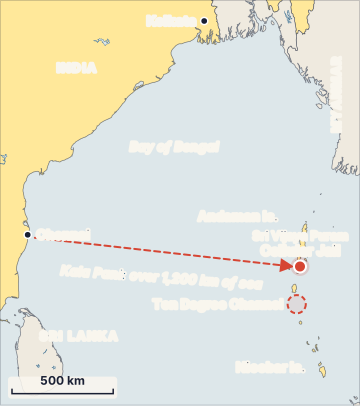
After the Revolt of 1857, the British had thousands of rebels to punish. They wanted a place so far away that prisoners could not escape or inspire others. The remote Andaman Islands, about 1,200 km from the mainland across the Bay of Bengal, were ideal for this. In 1858, the British set up a penal settlement (a prison colony) in the Andamans. The first batch of about 200 rebel prisoners arrived in March 1858 [Unverified].
How did the penal settlement grow?
The settlement was not one building but a system spread across several islands:
- Ross Island (now Netaji Subhas Chandra Bose Dweep) became the administrative headquarters, where the British Chief Commissioner and officers lived.
- Viper Island had an early jail and gallows, used before the Cellular Jail was built. It was known for its harsh treatment of prisoners.
- Chatham Island had a large saw mill, where prisoners worked.
- The Cellular Jail, built later, became the main high-security prison.
These four places together form the "Colonial Penal Settlement of Andaman Islands" serial entry on India's Tentative List.
How was the Cellular Jail built?
Construction began in 1896 and was completed in 1906. The British felt the earlier system was not a strong enough punishment, so they built a jail designed for complete isolation. It followed the panopticon design: seven wings spread out from a central watchtower, like the spokes of a cycle wheel. From the tower, guards could watch every wing.
The wings were arranged so that the front of one wing faced the back of the next. This meant prisoners could not see or talk to each other. The jail had about 690 small single cells (records give slightly different counts), each with one tiny ventilator high up on the wall. That is why it was called "Cellular": every prisoner had his own cell.
What was life like for prisoners?
Prisoners did hard labour, such as grinding coconuts to extract oil in an oil mill, pulling a heavy mill like a bullock, and clearing forests. Failing to meet daily targets brought punishments such as flogging, chains and bad food. Many prisoners fell ill or died. Protests were common. In 1933, prisoners went on a hunger strike against the harsh conditions.
Three of them, Mahavir Singh, Mohan Kishore Namadas and Mohit Moitra, died after being force-fed. After strong protests across India, the British sent political prisoners back to the mainland in 1937 to 1938.
Who were the famous prisoners?
- Vinayak Damodar Savarkar and his brother Ganesh Damodar Savarkar
- Batukeshwar Dutt, associate of Bhagat Singh in the 1929 Central Legislative Assembly bomb case
- Barindra Kumar Ghosh and Ullaskar Dutt of the Alipore Bomb Case (1908)
- Fazl-e-Haq Khairabadi, a scholar sent to the Andamans after the 1857 revolt (he died there in 1861, before the Cellular Jail was built)
- Many prisoners from the Ghadar movement
What happened during the Second World War?
Japan occupied the Andaman and Nicobar Islands from 1942 to 1945. On 30 December 1943, Subhas Chandra Bose, leader of the Azad Hind Government and the Indian National Army (INA), hoisted the Indian tricolour at Port Blair. He named the Andaman Islands "Shaheed Dweep" and the Nicobar Islands "Swaraj Dweep". The Japanese period was itself very harsh for local people.
What happened after independence?
The jail was damaged by an earthquake in 1941, and two wings were pulled down during the Japanese occupation. Two more wings were demolished after independence to build a hospital. Today only three wings and the central tower remain. The jail was declared a National Memorial in 1979. It now has a museum and an evening sound and light show on the prisoners' lives.
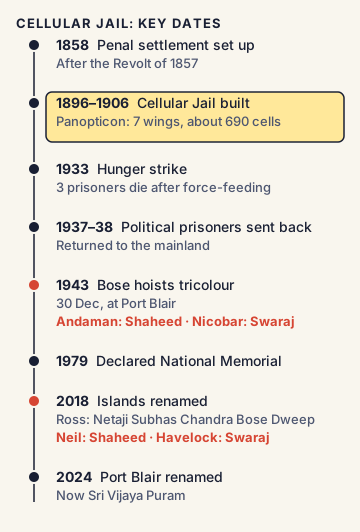
In December 2018, Ross Island was renamed Netaji Subhas Chandra Bose Dweep, Neil Island Shaheed Dweep and Havelock Island Swaraj Dweep. In September 2024, Port Blair was renamed Sri Vijaya Puram.
Commonly confused concepts
- Kala Pani (transportation) vs ordinary imprisonment: "Transportation for life" meant being shipped overseas to a penal colony, which was considered harsher than jail on the mainland because of the total cut-off from home.
- Cellular Jail vs Andaman penal settlement: The penal settlement began in 1858 and spread over several islands. The Cellular Jail came later (1896 to 1906) and was only one part of it.
- Shaheed Dweep and Swaraj Dweep (1943 vs 2018): In 1943, Bose gave these names to the whole Andaman and Nicobar groups. In 2018, the names were given to two specific islands, Neil and Havelock.
- Andaman Islands vs Nicobar Islands: They are two groups separated by the Ten Degree Channel. The Cellular Jail is in the Andaman group.
Issues, criticism and the way forward
- Whose memory? Historians point out that thousands of ordinary prisoners, not only famous leaders, suffered here, and that the islands' indigenous people (such as the Great Andamanese) suffered greatly from the settlement through disease, loss of land and conflict. A complete account should include them.
- Fragile heritage: Ross, Viper and Chatham islands are exposed to sea, rain and storms. Their buildings are in different stages of decay and are looked after by different agencies.
- Tourism vs conservation: Heavy tourist numbers can damage the fragile sites and the island ecology. Experts suggest visitor limits and one joint management plan across heritage, forest, wildlife and tourism departments.
- Way forward: For a World Heritage nomination, India will need to show integrity (all key parts preserved), a clear buffer zone and a working management system for all four islands together.
Concepts to Know
- Penal settlement (penal colony): A place, often far away or on an island, where convicts are sent to live and work under guard as punishment.
- Panopticon: A prison design, suggested by the English thinker Jeremy Bentham, in which a central tower can watch all cells, so prisoners feel they are always being watched.
- Solitary confinement: Keeping a prisoner alone in a cell with no contact with other prisoners.
- Ghadar movement: A movement started in 1913 by Indians living in North America to overthrow British rule in India through armed revolt.
- Azad Hind Government: The Provisional Government of Free India, set up by Subhas Chandra Bose in Singapore in October 1943.
- Andaman penal settlement set up: 1858, after the Revolt of 1857
- Cellular Jail built: 1896 to 1906; panopticon design; 7 wings from a central tower; about 690 single cells
- Only 3 wings survive today; declared National Memorial: 1979
- 1933 hunger strike: Mahavir Singh, Mohan Kishore Namadas and Mohit Moitra died
- Political prisoners sent back to the mainland: 1937 to 1938
- Japanese occupation: 1942 to 1945; Bose hoisted the tricolour at Port Blair: 30 December 1943
- Ross Island renamed Netaji Subhas Chandra Bose Dweep: December 2018; Port Blair renamed Sri Vijaya Puram: September 2024
- Tentative List serial entry (May 2026): Chatham Island, Ross Island, Viper Island, Cellular Jail (one system, 1858 to 1945)
● Tracked since October 05, 2026 · last seen October 05, 2026 · updates as the daily brief publishes