Capital Gains Tax in India
Long-Term and Short-Term Capital Gains
Capital gains tax is the tax you pay on the profit you make when you sell something valuable, such as shares, a house, gold or mutual fund units, for more than you paid. If you buy shares for ₹1 lakh and sell them for ₹1.5 lakh, your capital gain is ₹50,000, and that profit is taxed. India splits these profits into short-term and long-term gains, depending on how long you held the asset, and taxes them at different rates.
Why does it exist?
A tax system tries to tax all kinds of income, not only salary. A person who earns ₹50,000 from a job pays income tax, so a person who earns ₹50,000 by selling shares should also pay something. Capital gains tax brings this kind of income into the tax net. It also raises a large amount of money: LTCG collections were about ₹1.29 lakh crore in 2024-25, up from about ₹72,000 crore in 2023-24.
What is a "capital asset" and a "capital gain"?
A capital asset is property you own as an investment, such as shares, bonds, land, a house, gold or jewellery. Things you hold for daily personal use (your clothes, furniture, personal car) are not capital assets. The capital gain is:
- Sale price, minus
- The cost of buying the asset (cost of acquisition), minus
- Any cost of improving it, and
- Expenses directly linked to the sale (like brokerage).
If the result is negative, you have a capital loss instead.
Short-term vs long-term: the holding period
How long you keep an asset before selling decides which type of gain it is. Since 23 July 2024, India has just two holding periods:
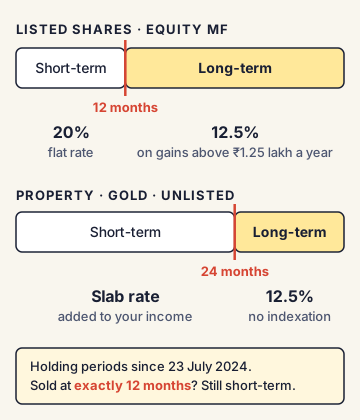
- Listed securities (shares listed on a stock exchange, equity mutual fund units): held for more than 12 months = long-term; 12 months or less = short-term.
- Everything else (property, gold, unlisted shares): held for more than 24 months = long-term.
Think of it like this: if you sell shares within a year, the law sees you as more of a trader; if you hold longer, you are seen as an investor, and you are taxed less.
How has the tax on shares changed over time?
The story of capital gains tax on listed shares has three big turns:
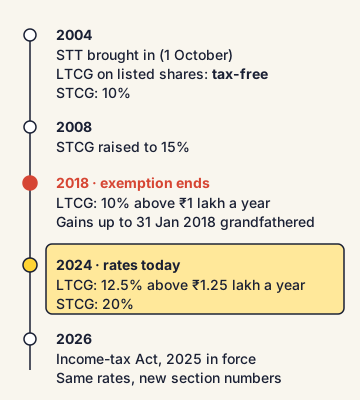
- 2004: The government brought in the Securities Transaction Tax (STT) from 1 October 2004. In return, LTCG on listed shares sold with STT paid was made fully tax-free (Section 10(38) of the Income-tax Act, 1961). Short-term gains were taxed at a lower special rate of 10% (Section 111A), later raised to 15% in 2008.
- 2018: The Finance Act, 2018 ended this 14-year exemption. A new Section 112A taxed LTCG on listed shares above ₹1 lakh a year at 10%. Gains made up to 31 January 2018 were protected ("grandfathered"), meaning the share price on that date was treated as the buying cost.
- 2024: The Budget presented on 23 July 2024 raised the LTCG rate on listed shares to 12.5% and the tax-free limit to ₹1.25 lakh a year. The short-term rate on listed shares went up from 15% to 20%. For other assets like property and gold, the LTCG rate was cut from 20% to 12.5%, but the benefit of indexation (explained below) was removed.
Current rates at a glance (as of October 2026)
| Type of gain | Listed shares and equity mutual funds | Other assets (property, gold, unlisted shares) |
|---|---|---|
| Short-term | 20% | Added to your income and taxed at your normal slab rate |
| Long-term | 12.5% on gains above ₹1.25 lakh a year | 12.5% without indexation |
For listed shares, the surcharge (an extra tax on very high incomes) on capital gains is capped at 15%, and a 4% health and education cess is added. So the highest effective LTCG rate on listed shares comes to nearly 15%.
The new Income-tax Act, 2025
From 1 April 2026, the Income-tax Act, 2025 replaced the Income-tax Act, 1961. The rates stayed the same, but the section numbers changed. Under the new Act, LTCG on listed shares (old Section 112A) is in Section 198, STCG on listed shares (old Section 111A) is in Section 196, and other LTCG (old Section 112) is in Section 197.
What is indexation?
Inflation means a house bought for ₹20 lakh in 2010 may sell for ₹60 lakh today, but part of that rise is just prices going up, not real profit. Indexation lets you raise your buying cost using a government price index (the Cost Inflation Index) so that only the "real" gain is taxed. Since July 2024, indexation is no longer available for new calculations, and a flat 12.5% applies instead.
Individuals selling land or buildings bought before 23 July 2024 can choose either 12.5% without indexation or 20% with indexation, whichever is lower.
Setting off losses
If you make a loss on one sale, you can use it to reduce tax on gains:
- A short-term capital loss can be set off against both short-term and long-term gains.
- A long-term capital loss can be set off only against long-term gains.
- Unused capital losses can be carried forward for 8 years.
How are foreign investors taxed?
FPIs pay the same 12.5% LTCG and 20% STCG rates on Indian listed shares as Indian investors. Their gains are calculated in rupees. So if the rupee falls against the dollar, a foreign investor may owe tax in India on a rupee "gain" even if, in dollar terms, they made little profit or a loss.
Some foreign investors once avoided Indian capital gains tax by investing through countries like Mauritius and Singapore under tax treaties, but India changed those treaties in 2016, so gains on shares bought from 1 April 2017 are taxable in India. In January 2026, the Supreme Court held that Tiger Global's gains from selling its Flipkart stake to Walmart were taxable in India, which further limited such treaty benefits.
In June 2026, the Union Cabinet approved an ordinance removing capital gains tax for FPIs on government securities (bonds), with effect from 1 April 2026; shares were not covered.
India compared with other markets
Many large markets (such as the US, UK, Singapore and Hong Kong) generally do not charge non-residents capital gains tax on listed shares traded there. Each country taxes its own residents differently, though: the US taxes its own citizens' long-term gains at up to 20%, for example. So the comparison that matters to an FPI is the total cost of investing: capital gains tax plus transaction taxes like STT.
Commonly confused concepts
- Capital gains tax vs STT: Capital gains tax is charged only on profit, and only when you sell. STT is charged on the value of every trade, whether you make a profit or a loss.
- LTCG vs STCG: The difference is only the holding period (12 months for listed shares, 24 months for others), not the size of the gain.
- Capital gain vs dividend: A capital gain is profit from selling an asset. A dividend is a share of a company's profit paid to you while you still hold the share. Dividends are added to your income and taxed at your slab rate.
- Grandfathering vs indexation: Grandfathering protects gains made before a cut-off date (31 January 2018). Indexation adjusts the buying cost for inflation.
Issues, criticism and the way forward
- Attracting foreign money: Critics point out that India's taxes on equity (LTCG, STCG and STT together) are higher than in many rival markets, which may push FPIs away when global conditions are already tough.
- Revenue needs: The government's position is that capital gains tax is a growing and important source of revenue. Any cut has a fiscal cost when spending on subsidies and welfare is rising.
- Fairness and parity: Exempting only FPIs could treat Indian investors worse than foreign ones. It could also encourage round-tripping, where Indian money is sent abroad and brought back as "foreign" money to avoid tax.
- Fairness between incomes: Some economists argue that gains from wealth should be taxed like salary income, since wealthier people earn more from capital. Others argue that low taxes on long-term investment encourage saving and the growth of companies.
- Stability: Market experts often stress that predictable tax rules matter as much as low rates. Frequent changes (2004, 2018, 2024) make long-term planning harder for investors.
- Possible paths: Ideas under discussion include FPI-specific exemptions balanced by higher STT, calculating FPI gains in dollar terms, or a lower LTCG rate for everyone.
Concepts to Know
- Listed shares: Shares of a company that are bought and sold on a recognised stock exchange such as the NSE or BSE.
- Equity-oriented mutual fund: A mutual fund that puts most of its money (at least 65%) into shares of Indian companies.
- Surcharge and cess: Extra percentages added on top of income tax. A surcharge applies only to high incomes; the 4% health and education cess applies to everyone who pays income tax.
- Slab rate: The normal income tax rates that rise as your income rises, used for salary and other regular income.
- Fiscal cost: The money the government gives up when it cuts a tax, which it must then make up by borrowing more or spending less.
- Tax treaty (DTAA): An agreement between two countries that decides which country can tax a certain income, so the same income is not taxed twice.
- Ordinance: A temporary law made by the President (on the Union Cabinet's advice) under Article 123 when Parliament is not in session. Parliament must approve it within six weeks of meeting again.
- Holding periods (since 23 July 2024): listed securities, more than 12 months = long-term; other assets, more than 24 months = long-term
- LTCG on listed shares: 12.5% on gains above ₹1.25 lakh a year (was 10% above ₹1 lakh)
- STCG on listed shares: 20% (was 15%; 10% when introduced in 2004)
- LTCG on other assets: 12.5% without indexation (was 20% with indexation)
- Listed equity LTCG exempt from 1 October 2004 (Section 10(38)) to 31 March 2018; taxed again by Finance Act, 2018 (Section 112A), with grandfathering up to 31 January 2018
- Income-tax Act, 2025 in force from 1 April 2026: Section 196 (STCG on listed equity), Section 197 (other LTCG), Section 198 (LTCG on listed equity)
- Surcharge on capital gains from listed equity capped at 15%; effective top LTCG rate nearly 15%
- Capital losses can be carried forward for 8 years
- LTCG collections: about ₹1.29 lakh crore (2024-25) vs about ₹72,249 crore (2023-24)
● Tracked since October 27, 2026 · last seen October 27, 2026 · updates as the daily brief publishes