C5+1 Format
The US-Central Asia Diplomatic Platform
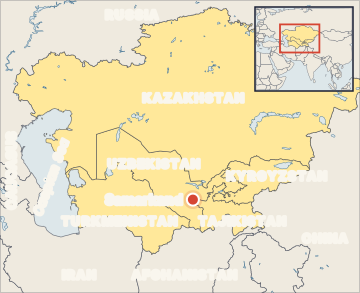
The C5+1 is a meeting format in which the five Central Asian countries ("C5") sit together with one outside country ("+1"), which is the United States. The five countries are Kazakhstan, Kyrgyzstan, Tajikistan, Turkmenistan and Uzbekistan. Instead of meeting each country one by one, the US meets all five together to discuss shared issues like trade, energy, water and security. It is a dialogue platform, not a treaty or a military alliance.
Why does it exist?
The five Central Asian countries were part of the Soviet Union until 1991. They sit between Russia, China, Afghanistan and Iran. Many of their problems cross borders: shared rivers, transport routes, terrorism and drug smuggling from Afghanistan. Meeting all five together helps solve these regional problems. For the US, the format is also a way to stay present in a region where Russia and China have strong influence.
Where did it come from?
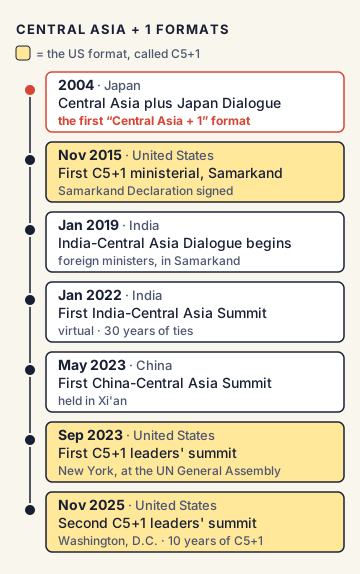
The format was set up in 2015. US and Central Asian foreign ministers first met in this format at the UN General Assembly in September 2015. The first formal C5+1 ministerial was held in Samarkand, Uzbekistan, on 1 November 2015. There, the six countries signed a Joint Declaration of Partnership and Cooperation, also called the Samarkand Declaration.
The format was raised to the level of heads of state in September 2023, when the first C5+1 leaders' summit was held on the sidelines of the UN General Assembly in New York. The second leaders' summit, the first held in Washington, D.C., took place on 6 November 2025, marking ten years of the format.
How does it work?
The format works at several levels:
- Leaders' summits: Presidents of all six countries meet, which is rare.
- Ministerial meetings: Foreign ministers meet regularly to set priorities.
- Working groups: Officials work on themes, mainly the economy and trade, energy and environment, and security.
- Business links: US companies join delegations to sign trade and investment deals.
At the 2025 Washington summit, critical minerals were a major theme. Kazakhstan and Uzbekistan signed agreements with US partners on mining and rare earth metals.
Why does Central Asia matter?
The region is rich in energy and minerals:
- Kazakhstan is the world's largest producer of uranium and has large oil reserves.
- Turkmenistan has some of the largest natural gas reserves in the world.
- Uzbekistan has large deposits of gold, uranium and other metals.
- All five countries are landlocked: none has a coastline on the open ocean (the Caspian Sea, which touches Kazakhstan and Turkmenistan, is itself closed). Uzbekistan is one of only two double-landlocked countries in the world (the other is Liechtenstein in Europe), meaning it is surrounded only by other landlocked countries. So transport corridors matter a lot to the region.
India's own Central Asia format
India runs a similar format with the same five countries:
- India-Central Asia Dialogue: a foreign ministers' meeting started in January 2019 in Samarkand. The fourth round was held in New Delhi in June 2025.
- India-Central Asia Summit: the first was held virtually on 27 January 2022, marking 30 years of India's diplomatic ties with the region. The leaders agreed to hold the summit every two years.
- India's interests include connectivity through Chabahar Port and the International North-South Transport Corridor (INSTC), energy (uranium from Kazakhstan), and fighting terrorism linked to Afghanistan.
Commonly confused concepts
- C5+1 vs "Central Asia plus" formats of other countries: Many countries now use a "Central Asia + 1" format. Japan was the first, with the Central Asia plus Japan Dialogue in 2004. China holds a China-Central Asia Summit (first in Xi'an, May 2023; second in Astana, June 2025). India has the India-Central Asia Summit. The name "C5+1" is used mainly for the US format.
- C5+1 vs Shanghai Cooperation Organisation (SCO): The SCO is a permanent organisation with a secretariat and member countries including India, China, Russia and four Central Asian states (not Turkmenistan). C5+1 is only a dialogue format with no secretariat.
- Central Asia vs Caucasus: The Caucasus (Georgia, Armenia, Azerbaijan) lies west of the Caspian Sea. Central Asia lies east of it.
- Landlocked vs double-landlocked: A landlocked country has no coastline. A double-landlocked country is surrounded only by landlocked countries.
Issues, criticism and the way forward
- Great power competition: Central Asian countries try to balance Russia, China, the US and others, and avoid being seen as taking sides. Some analysts call this a "multi-vector" foreign policy.
- Distance and access: The US has no land route to the region, so trade depends on corridors through Russia, China, Iran or the Caspian Sea.
- Consistency: Critics say US interest in the region has risen and fallen with events in Afghanistan. The regular summits since 2023 are seen as an attempt to make engagement steadier.
- Way forward: Experts point to critical minerals, transport corridors, water management and private investment as areas where the format can produce concrete results.
Concepts to Know
- Ministerial: A meeting of ministers, usually foreign ministers, of the countries in a group.
- Landlocked country: A country with no coastline, which depends on neighbours to reach the sea for trade.
- Critical minerals: Minerals like lithium, cobalt and rare earths that are vital for batteries, electronics and defence, but whose supply is at risk.
- Sidelines (of a meeting): Smaller meetings held during a bigger international event, like the UN General Assembly.
- C5 countries: Kazakhstan, Kyrgyzstan, Tajikistan, Turkmenistan, Uzbekistan; "+1" is the United States
- First C5+1 ministerial: Samarkand, 1 November 2015; Samarkand Declaration (Joint Declaration of Partnership and Cooperation)
- First C5+1 leaders' summit: September 2023, New York (UN General Assembly sidelines)
- Second leaders' summit: 6 November 2025, Washington, D.C. (10th anniversary)
- India-Central Asia Dialogue: started January 2019, Samarkand; 4th round in New Delhi, June 2025
- First India-Central Asia Summit: 27 January 2022 (virtual)
- Central Asia plus Japan Dialogue: 2004; China-Central Asia Summit: 2023 (Xi'an), 2025 (Astana)
● Tracked since October 14, 2026 · last seen October 14, 2026 · updates as the daily brief publishes