Budapest Memorandum (1994)
Security Assurances and Ukraine
The Budapest Memorandum is a set of political promises signed on 5 December 1994 in Budapest, Hungary. Russia, the United States and the United Kingdom promised to respect the independence and borders of Ukraine, Belarus and Kazakhstan. In return, these three countries gave up the nuclear weapons left on their land after the Soviet Union broke up, and joined the Nuclear Non-Proliferation Treaty (NPT) as countries without nuclear weapons.
The memorandum is today the main example used to show the difference between a weak "assurance" and a strong "guarantee".
Why was it needed?
When the Soviet Union broke up in December 1991, its nuclear weapons were spread across four new countries: Russia, Ukraine, Belarus and Kazakhstan. Ukraine suddenly held the third-largest nuclear arsenal in the world. It had about 1,900 strategic warheads, 176 intercontinental ballistic missiles (ICBMs) and 44 strategic bombers. The world did not want three new nuclear powers.
More nuclear states would mean more risk of war, theft or accidents. But Ukraine worried that without these weapons, it would be at the mercy of its big neighbour. The memorandum tried to solve both worries: Ukraine would give up the weapons, and the big powers would promise to respect its security.
It is worth knowing that Ukraine did not have full control of these weapons. The launch codes and command systems were in Moscow. Keeping them working would also have been very costly. So the choice was less simple than it looks today.
Where did it come from?
It was the last step in a chain of deals.
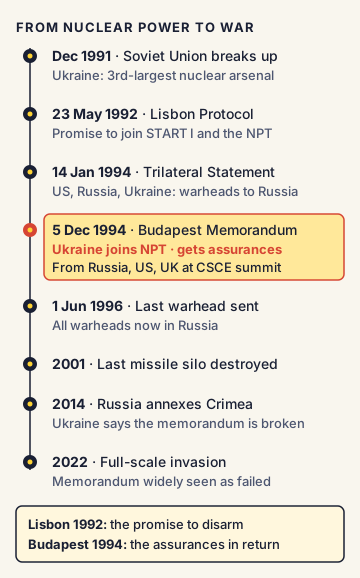
- Lisbon Protocol (23 May 1992): Ukraine, Belarus and Kazakhstan agreed to join the START I treaty (a US-Soviet treaty to cut long-range nuclear weapons) and to join the NPT as non-nuclear states.
- Trilateral Statement (14 January 1994): the US, Russia and Ukraine agreed on how the warheads would be moved to Russia. Ukraine was to get nuclear fuel for its power plants in return.
- Budapest Memorandum (5 December 1994): signed at the summit of the CSCE (Conference on Security and Co-operation in Europe, today's OSCE) in Budapest, when Ukraine joined the NPT. Similar but separate memorandums were signed for Belarus and Kazakhstan.
- 1996: Ukraine sent its last nuclear warhead to Russia by 1 June 1996. Its last missile silo was destroyed in 2001.
- France and China gave Ukraine separate, weaker assurances in their own documents.
What did the signatories promise?
The memorandum has six main commitments by Russia, the US and the UK.
- Respect Ukraine's independence, sovereignty and existing borders, in line with the Helsinki Final Act (1975).
- Not threaten or use force against Ukraine's territorial integrity or political independence, except in self-defence or as the UN Charter allows.
- Not use economic pressure to force Ukraine to give up its sovereign rights.
- Seek immediate UN Security Council action to help Ukraine if it becomes a victim of aggression, or threat of aggression, in which nuclear weapons are used.
- Not use nuclear weapons against Ukraine, except in certain cases of attack by a state allied to a nuclear power.
- Consult one another if a question arises about these commitments.
Why is it called an "assurance" and not a "guarantee"?
This is the key point. An assurance is a promise to respect something and not to attack. A guarantee is a promise to come and defend you if you are attacked. The memorandum gave only assurances. Nobody promised to send troops to defend Ukraine. Even the promise in point 4 was only to go to the UN Security Council, where Russia itself holds a veto.
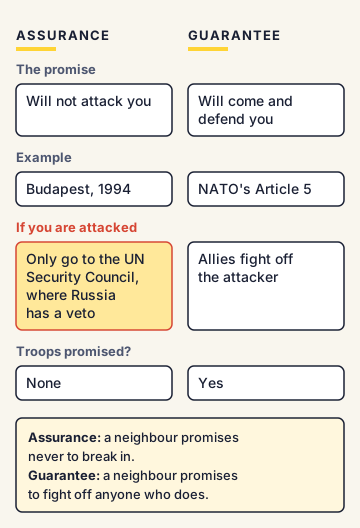
A simple comparison: an assurance is like a neighbour promising never to break into your house. A guarantee is like a neighbour promising to come and fight off anyone who does.
Is it legally binding?
This is debated.
- The US and the UK have described it as a political commitment, not a legally binding treaty. It was never sent to the US Senate for approval as treaties are.
- It was, however, circulated as an official UN document. Some Ukrainian scholars argue it meets the test of a treaty under the Vienna Convention on the Law of Treaties (1969).
- Whatever its legal status, its promises not to use force repeat duties that already exist under Article 2(4) of the UN Charter.
What happened in 2014 and after?
When Russia annexed Crimea in 2014, Ukraine said Russia had broken the memorandum. The US, UK and other Western countries agreed. Russia's position was that it had not broken it. It said the memorandum mainly concerned not using nuclear weapons, and that events in Ukraine in 2014 had created a new situation. Russia also accused the West of breaking the spirit of the deal by supporting the change of government in Kyiv. After the full-scale invasion in 2022, the memorandum is widely described as having failed.
India's position and Indian examples
India has never signed the NPT. It calls the treaty unfair, because it lets five countries keep nuclear weapons while asking all others to give them up. India's nuclear doctrine (2003) is based on No First Use and credible minimum deterrence. India has pointed to Ukraine's experience only indirectly, but strategic experts in India often cite it to argue that only a country's own strength gives lasting security.
India's official stand on Ukraine stresses respect for sovereignty and territorial integrity, which are also the core promises of the memorandum.
Commonly confused concepts
- Security assurance vs security guarantee: an assurance is a promise not to attack (Budapest, 1994). A guarantee is a promise to defend (NATO's Article 5).
- Negative vs positive security assurances: a negative assurance is a nuclear power's promise not to use nuclear weapons against a non-nuclear state (point 5). A positive assurance is a promise to help a non-nuclear state if it is attacked with nuclear weapons (point 4, through the UN Security Council).
- Memorandum vs treaty: a memorandum is usually a political promise. A treaty is legally binding and normally needs ratification. The label alone does not decide the legal status; the words and intent do.
- Budapest Memorandum vs Minsk agreements: Budapest (1994) was about nuclear disarmament and borders. Minsk (2014-15) was about a ceasefire in the Donbas.
- Lisbon Protocol vs Budapest Memorandum: Lisbon (1992) was the promise to disarm and join the NPT. Budapest (1994) was the set of security assurances given when Ukraine actually joined the NPT.
Issues, criticism and the way forward
- A lesson for non-proliferation: critics argue that the failure of the memorandum tells other countries that giving up nuclear weapons is risky. This could make it harder to persuade countries like North Korea or Iran to disarm.
- The other side of the debate: others argue Ukraine could not have kept or used the weapons safely, and that the deal brought it Western help and recognition in the 1990s.
- Vague wording: the memorandum had no clear steps or enforcement if someone broke it. The only action point led to the UN Security Council, where a veto can block everything.
- Designing new guarantees: today's talks about Ukraine try to fix this weakness. Ideas include a NATO-like promise of defence (sometimes called "Article 5-style"), a multinational force on Ukrainian soil after a ceasefire, long-term military aid and joint monitoring. The 2026 Paris Declaration by the "Coalition of the Willing" is one such attempt.
- Way forward: experts say any new deal must spell out who will do what, when, and with what forces if the ceasefire is broken, so that the promise is believable to both Ukraine and Russia.
Concepts to Know
- Nuclear Non-Proliferation Treaty (NPT): a treaty of 1968 (in force since 1970) that recognises only five nuclear-weapon states (US, Russia, UK, France, China) and asks all others not to build nuclear weapons. India, Pakistan, Israel and South Sudan have never joined; North Korea announced it was leaving in 2003.
- Strategic warhead: a nuclear bomb meant for long-range missiles or bombers, able to hit another country's cities or bases far away.
- ICBM (Intercontinental Ballistic Missile): a missile that can fly more than 5,500 km, from one continent to another.
- Helsinki Final Act (1975): a Cold War agreement among European countries, the US and Canada, which included respecting each other's existing borders.
- Deterrence: stopping an enemy from attacking by making it clear the attack will cost it too much.
- Signed: 5 December 1994, Budapest, at the CSCE (now OSCE) summit.
- Assurance-givers: Russia, the US and the UK; receivers: Ukraine, Belarus, Kazakhstan (separate memorandums); France and China gave separate assurances.
- Ukraine's inherited arsenal: about 1,900 strategic warheads, 176 ICBMs, 44 strategic bombers (third-largest in the world).
- Lisbon Protocol: 23 May 1992; Trilateral Statement: 14 January 1994; last warhead sent to Russia: 1 June 1996.
- Six commitments: respect borders, no force, no economic coercion, seek UNSC action in case of nuclear aggression, no nuclear use, consult.
- US and UK view it as a political, not legally binding, commitment.
● Tracked since November 09, 2026 · last seen November 09, 2026 · updates as the daily brief publishes