Biological Diversity Act, 2002
The Biological Diversity Act, 2002 is India's main law for protecting the variety of life (plants, animals, microbes) and the knowledge that local people hold about them. It controls who can take India's biological resources and use them for research or business. It also makes sure that the people and communities who protected these resources get a fair share of the profits.
To do all this, it set up a three-level system: a national authority, a board in every state and a committee in every local body.
Why was this law needed?
India is one of the world's 17 megadiverse countries, which means it holds a very large share of the world's plants and animals. For centuries, villagers and tribal communities have known which plant cures fever or which seed survives drought. In the 1990s, there were cases of foreign companies trying to patent such Indian knowledge.
A well-known case was the US patent on turmeric for wound healing (granted 1995, cancelled 1997 after India's Council of Scientific and Industrial Research challenged it). Another was the European patent on a neem-based fungicide, which was later revoked. Such cases are called biopiracy. India needed a law to stop resources and knowledge from being taken away without permission or payment.
Where did it come from?
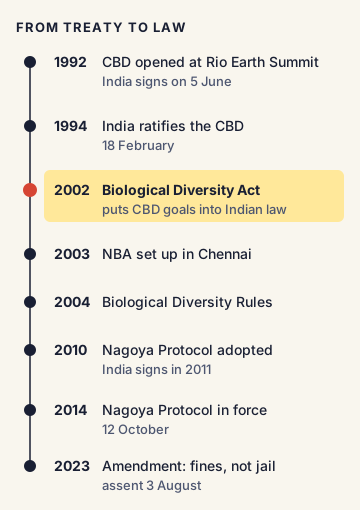
The law comes from an international treaty. The Convention on Biological Diversity (CBD) was opened for signing at the Earth Summit in Rio de Janeiro in 1992. India signed it on 5 June 1992 and ratified it (formally agreed to be bound by it) on 18 February 1994. The CBD has three goals:
- Conservation of biological diversity
- Sustainable use of its parts (using it without using it up)
- Fair and equitable sharing of benefits arising from the use of genetic resources
Parliament passed the Biological Diversity Act in 2002 to put these goals into Indian law. The Biological Diversity Rules, 2004 gave the detailed procedures. Later, the CBD's Nagoya Protocol (2010) set global rules on access and benefit-sharing. India signed it in 2011 and the Union Cabinet approved ratification in October 2012. The Protocol came into force on 12 October 2014. India implements it through this Act.
The three-tier structure
The Act works like a three-storey building:
- National Biodiversity Authority (NBA): set up in 2003 under Section 8, headquartered in Chennai. It is a statutory body (created by a law). It has a chairperson, ex officio members from Union ministries and non-official expert members. It gives approvals for foreign access, advises the Centre, and can oppose wrongful patents abroad.
- State Biodiversity Boards (SBBs): set up under Section 22 by each state. They advise the state government and handle requests from Indian users of biological resources. In Union Territories, the NBA does the SBB's work.
- Biodiversity Management Committees (BMCs): set up under Section 41 by every local body (village panchayat, municipality or corporation). They are the "ground floor" of the system.
How does access work?
The Act treats foreign and Indian users differently.
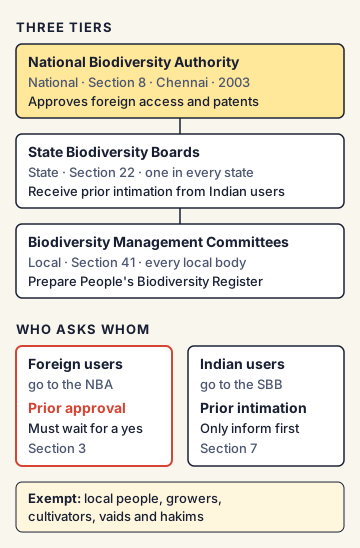
- Foreign users (foreign citizens, non-resident Indians, foreign companies) need prior approval of the NBA before obtaining any biological resource or related knowledge from India for research or commercial use (Section 3).
- Indian users need only give prior intimation (advance information) to the State Biodiversity Board before using a resource commercially (Section 7). The SBB can restrict the activity if it harms conservation.
- Patents: Anyone who wants an intellectual property right (such as a patent) on an invention based on Indian biological resources or knowledge needs NBA approval (Section 6).
- Exemptions: Local people and communities, including growers and cultivators, and vaids and hakims (traditional healers) can use resources without these permissions.
What is benefit-sharing?
When a company makes money from a biological resource, it must share some of the benefit (Section 21). This is called Access and Benefit Sharing (ABS). The benefit can be money, a share in royalties, technology transfer or joint research. The money goes into biodiversity funds at the national, state and local levels and is used for the communities and for conservation.
Think of it like a family recipe: if a hotel chain earns money by selling your grandmother's pickle recipe, part of that profit should come back to your family.
What does a BMC do?
The BMC's main job is to prepare a People's Biodiversity Register (PBR) with the help of local people. A PBR records the local plants, animals, crops and the traditional knowledge about their uses. It acts as proof that this knowledge belongs to the community, which helps in fighting biopiracy. The BMC is also consulted by the NBA and SBBs before they decide on access to resources from its area.
Other important provisions
- Biodiversity Heritage Sites (Section 37): the state government, in consultation with local bodies, can notify areas of special biodiversity importance as Biodiversity Heritage Sites (BHS). The state must frame schemes to compensate people economically affected by such a notification. The first BHS in India was the Nallur Tamarind Grove in Karnataka (2007).
- Threatened species (Section 38): the Central Government, in consultation with the state, can notify species that are on the verge of extinction and regulate or ban their collection.
- Normal trade exemption: biological resources traded as commodities (normal goods like rice or spices bought and sold in the market) are kept outside some controls, so ordinary trade is not disturbed.
The 2023 amendment
The Biological Diversity (Amendment) Act, 2023 received the President's assent on 3 August 2023. Its main changes:
- It decriminalised offences. Earlier, violations could lead to jail. Now most are punished with fines, in the range of ₹1 lakh to ₹50 lakh.
- It exempted codified traditional knowledge (knowledge written in old texts, such as Ayurveda books), cultivated medicinal plants and AYUSH practitioners from certain benefit-sharing and intimation requirements.
- It eased rules for Indian companies, including those with some foreign investment, so that they mainly need to give prior intimation to the SBB rather than seek NBA approval.
India's position and examples
Every state now has a State Biodiversity Board. Kerala set up its board in 2005. Kerala's board reports that People's Biodiversity Registers have been prepared for all 1,034 local bodies in the state (941 gram panchayats, 87 municipalities and 6 corporations). Across India, lakhs of BMCs have been formed, though many exist mostly on paper.
Commonly confused concepts
- Biological Diversity Act, 2002 vs Wildlife (Protection) Act, 1972: The Wildlife Act protects listed animals and plants from hunting and trade, and creates protected areas like National Parks. The Biodiversity Act regulates access to biological resources and knowledge, and benefit-sharing. One protects living things from harm; the other protects the right to use them fairly.
- Biodiversity Heritage Site vs Protected Area: A National Park or Sanctuary is under the Wildlife Act and puts strong limits on people's activities. A BHS under the Biodiversity Act is meant to work with local communities; normal community use is not expected to be restricted.
- NBA vs National Board for Wildlife (NBWL): The NBA (Chennai) works under the Biodiversity Act on access and benefit-sharing. The NBWL is chaired by the Prime Minister under the Wildlife Act and clears projects in and around protected areas.
- Prior approval vs prior intimation: Approval means you must wait for a "yes" (needed from the NBA by foreign users). Intimation means you only inform in advance (needed by Indian users with the SBB).
Issues, criticism and the way forward
- Weak BMCs: Many BMCs and PBRs were created in a hurry to meet deadlines, often with little real community involvement or follow-up.
- Low benefit-sharing: The amount of money actually reaching local communities has been small compared to the size of the herbal and biotech industries.
- Debate on the 2023 amendment: The government says the changes reduce red tape, encourage research and help the AYUSH and herbal sector grow. Critics, including environmental groups, argue that the exemptions let large companies avoid paying communities, and that removing jail terms weakens deterrence against biopiracy.
- Way forward: Experts suggest giving BMCs real funds and training, using PBRs actively in local planning, making benefit-sharing data public, and using new tools like ecosystem-level assessments to guide conservation.
Concepts to Know
- Biodiversity: The variety of all life in an area: different species, the genetic differences within a species, and different ecosystems.
- Biological resources: Plants, animals, microbes and their parts or genetic material that have real or possible value. Human genetic material is not included.
- Biopiracy: Taking a country's biological resources or traditional knowledge, often to patent them, without permission or sharing profits with the people who held them.
- Megadiverse country: One of 17 countries that together hold most of the world's species. India is one of them.
- Ratification: The formal step by which a country agrees to be legally bound by a treaty it has signed.
- Decriminalisation: Changing a law so that an act is punished with a fine instead of a criminal case and jail.
- AYUSH: Ayurveda, Yoga and Naturopathy, Unani, Siddha and Homoeopathy: India's traditional systems of medicine.
- CBD: opened for signature at Rio, 1992; India signed 5 June 1992, ratified 18 February 1994
- Biological Diversity Act passed in 2002; Biological Diversity Rules, 2004
- Three tiers: NBA (Section 8, Chennai, set up 2003) → SBBs (Section 22) → BMCs (Section 41)
- Section 3: foreign users need NBA approval; Section 6: NBA approval for IPR on Indian bio-resources; Section 7: Indian users give prior intimation to SBB; Section 21: benefit-sharing
- Section 37: Biodiversity Heritage Sites (state government); first BHS: Nallur Tamarind Grove, Karnataka (2007)
- Section 38: Centre can notify threatened species
- BMC's main task: People's Biodiversity Register
- Nagoya Protocol (2010): India signed 2011, Cabinet approved ratification October 2012; in force 12 October 2014
- Biological Diversity (Amendment) Act, 2023: assent 3 August 2023; fines ₹1 lakh to ₹50 lakh; AYUSH and codified traditional knowledge exemptions
- Kerala State Biodiversity Board: constituted 2005; PBRs for all 1,034 local bodies
● Tracked since March 09, 2026 · last seen October 14, 2026 · updates as the daily brief publishes