BHAVYA-Rasayan Scheme
Chemical Parks for India
BHAVYA-Rasayan is a central government scheme to build three large, ready-to-use industrial parks only for the chemical industry. Its full name is Bharat Audyogik Vikas Yojana Rasayan ("Rasayan" means chemicals in Hindi). The Centre helps states build shared facilities inside each park, such as waste treatment plants, water and steam supply, pipelines and warehouses. A chemical company can then set up its factory there quickly and cheaply, without building all of this on its own.
Why does India need chemical parks?
Chemicals are the "raw material of raw materials". Fertilisers, medicines, paints, plastics, textiles, soaps, electronics and car parts all need chemicals. Yet many Indian chemical units are small and spread out. Each one has to arrange its own land, water, power and pollution control, which raises costs. Think of a food court in a mall: each stall does not build its own kitchen, washroom and parking. The mall provides them once, for everyone. A chemical park works the same way for factories.
How big is India's chemical sector?
India is the 6th largest chemical producer in the world and 3rd largest in Asia. Even so, it is still a net importer. A NITI Aayog report of July 2025, titled Chemical Industry: Powering India's Participation in Global Value Chains, found that India had only about a 3.5% share in global chemical value chains and a chemical trade deficit of about US$31 billion in 2023.
This means India buys far more chemicals from abroad than it sells. Much of this is costly feedstock (basic raw materials) and specialty chemicals (high-value chemicals made for a special use).
Where did the scheme come from?
- In its July 2025 report, NITI Aayog suggested building world-class chemical hubs, both by improving old clusters and creating new ones. It set a vision of a US$1 trillion chemical sector and a 12% global value chain share by 2040.
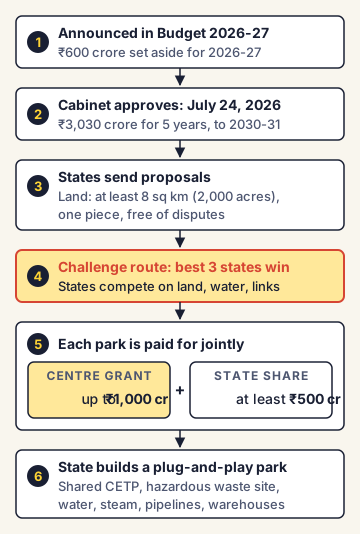
- The Union Budget 2026-27 announced a scheme to help states set up three dedicated chemical parks through a challenge route, on a cluster-based, plug-and-play model. The Budget set aside ₹600 crore for it in 2026-27.
- The Union Cabinet approved the scheme on July 24, 2026. It was notified in the Gazette on August 10, 2026, and states were asked to send proposals by November 30, 2026.
How does the money work?
The total outlay is ₹3,030 crore for five years (2026-27 to 2030-31):
- ₹3,000 crore for common infrastructure and basic utilities inside the parks
- ₹30 crore for administrative costs (running the scheme)
The Centre gives a grant of up to ₹1,000 crore per park. A grant is money that does not have to be paid back. In return, the host state must put in at least ₹500 crore of its own. So the cost is shared, and the state has a strong reason to make its park succeed.
How will parks be chosen? The challenge route
The Centre does not simply pick three states. All states can send proposals, and the best three win. This is called the challenge route or challenge method. It makes states compete on land readiness, connectivity, water supply and policy support. Each park must have at least 8 sq km (about 2,000 acres) of contiguous land (one continuous piece) that is encumbrance-free (no legal disputes, loans or claims on it). The state governments develop the parks.
What will a park contain?
The parks offer plug-and-play infrastructure. This means a company can "plug in" its factory and start working, like plugging a device into a ready socket. Facilities include:
- Common Effluent Treatment Plants (CETPs) to clean polluted waste water from all units together
- Treatment, Storage and Disposal Facilities (TSDFs) for hazardous waste
- Water supply, steam networks and pipeline links between units
- Solvent recovery units, so that costly liquid chemicals can be cleaned and used again
- Logistics and warehousing
Shared pipelines matter a lot in chemicals. The waste or product of one plant is often the raw material of another. When they sit side by side, they save on transport and energy.
How does it fit with other "park" schemes?
India has used this cluster model before:
- Petroleum, Chemicals and Petrochemicals Investment Regions (PCPIRs) (policy of 2007): very large regions of about 250 sq km, now active in Gujarat, Andhra Pradesh and Odisha
- Bulk Drug Parks (notified 2020, ₹3,000 crore): three parks in Gujarat, Himachal Pradesh and Andhra Pradesh, with up to ₹1,000 crore per park, run by the Department of Pharmaceuticals
- Plastic Parks, also under the Ministry of Chemicals and Fertilizers
- PM MITRA Parks: seven mega textile parks with an outlay of ₹4,445 crore
Commonly confused concepts
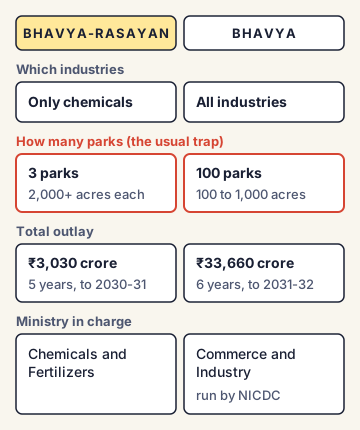
- BHAVYA-Rasayan vs BHAVYA: The Bharat Audyogik Vikas Yojana (BHAVYA), approved in 2026, is a separate and much larger scheme of ₹33,660 crore for 100 plug-and-play industrial parks (100 to 1,000 acres each) for all industries. It runs from 2026-27 to 2031-32 and is carried out by the National Industrial Corridor Development Corporation (NICDC) under the Ministry of Commerce and Industry. BHAVYA-Rasayan is only for three chemical parks, under the Ministry of Chemicals and Fertilizers.
- Chemical Park vs PCPIR: A PCPIR is a huge planned region of about 250 sq km, built around an "anchor" refinery or cracker. The Centre's role there is mainly to build outside links such as roads, rail and ports. A BHAVYA-Rasayan park is smaller (minimum 8 sq km), and the Centre directly pays for common facilities inside the park.
- Chemical Park vs Special Economic Zone (SEZ): An SEZ is mainly about special tax and customs rules for exporters. A chemical park is mainly about shared physical infrastructure. A park may or may not be an SEZ.
- Bulk Drug Park vs Chemical Park: Bulk drug parks make Active Pharmaceutical Ingredients (APIs, the main ingredients of medicines). Chemical parks serve the wider chemical and petrochemical industry.
Issues, criticism and the way forward
- Land: Finding 2,000 acres of dispute-free land in one piece is hard. Land acquisition often meets local opposition, especially where farmland is involved.
- Pollution and safety: Chemical units handle toxic and hazardous materials. Accidents like the Bhopal gas tragedy (1984) and the Visakhapatnam LG Polymers gas leak (2020) show the risks. Strong safety rules and well-run CETPs are essential.
- Lessons from PCPIRs: Older chemical regions moved slowly. Of the four PCPIRs approved, only Dahej in Gujarat became a real success, and Tamil Nadu dropped its PCPIR. The new scheme tries to avoid this with direct grants and a contest between states.
- Scale: Three parks are a small step compared to the size of the need. NITI Aayog also recommended better ports, faster environmental clearances, operating-cost support, new technology and skilling.
- Way forward: Quick clearances, reliable feedstock supply, good connection to ports, and strict environmental monitoring will decide whether the parks succeed.
Concepts to Know
- Feedstock: The basic raw material that a factory converts into a product. For petrochemicals, feedstock is usually crude oil products or natural gas.
- Specialty chemicals: High-value chemicals made in smaller amounts for a special use, such as dyes, pesticides or flavours. Commodity chemicals, in contrast, are made in bulk at low margins.
- Global value chain (GVC): The chain of steps, spread across many countries, needed to make a product, from raw material to final good. A higher GVC share means a country does more of these steps.
- Common Effluent Treatment Plant (CETP): A shared plant that collects and cleans the dirty waste water of many small factories together, which is cheaper than each factory having its own.
- Import substitution: Making at home what a country now buys from abroad, so it spends less foreign currency.
- Outlay: The total amount of money the government plans to spend on a scheme.
- Full name: Bharat Audyogik Vikas Yojana Rasayan (BHAVYA-Rasayan); Ministry of Chemicals and Fertilizers
- Announced: Union Budget 2026-27 (₹600 crore set aside for 2026-27)
- Cabinet approval: July 24, 2026; Gazette notification: August 10, 2026
- Outlay: ₹3,030 crore (₹3,000 crore infrastructure + ₹30 crore administration)
- Period: 5 years, 2026-27 to 2030-31
- Centre: grant of up to ₹1,000 crore per park; state: at least ₹500 crore per park
- Number of parks: 3, chosen through the challenge route
- Land: at least 8 sq km (about 2,000 acres), contiguous and encumbrance-free
- India: 6th largest chemical producer in the world, 3rd in Asia
- NITI Aayog (July 2025): GVC share about 3.5%; chemical trade deficit about US$31 billion (2023); target US$1 trillion sector and 12% GVC share by 2040
● Tracked since October 06, 2026 · last seen October 06, 2026 · updates as the daily brief publishes