Bay of Bengal Industrial Growth Belt (BIG-B)
Japan's Plan for Bangladesh and the Region
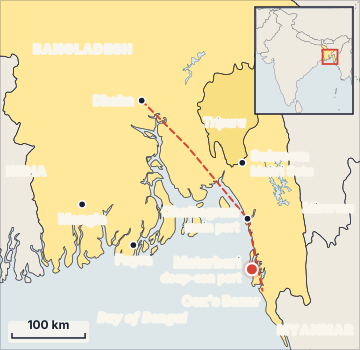
The Bay of Bengal Industrial Growth Belt, or BIG-B, is a Japanese plan to help Bangladesh grow into a manufacturing and trading hub. It focuses on the coastal strip running from Dhaka to Chattogram (Chittagong) and Cox's Bazar in the south-east of Bangladesh. Its heart is a new deep-sea port and an energy hub at Matarbari, an island off the coast of Cox's Bazar district. Japan funds most of it through low-interest loans given by its aid agency, JICA.
Why does BIG-B exist?
Bangladesh has a big and young workforce and a strong garment industry. But it has long lacked three things that factories need: a deep port, steady electricity and good roads and railways. Its main port, Chattogram, sits on a river mouth. It is shallow: until 2023 only ships with a draught of up to 9.5 metres could berth, and today the limit is about 10 metres.
So large ocean ships cannot dock there. Cargo has to be moved to smaller ships first at ports like Singapore or Colombo. This adds time and cost to every shipment. BIG-B tries to fix these gaps in one planned zone so that investors, including Japanese companies, want to set up factories there.
Where did it come from?
The plan was announced in 2014.
- In May 2014, Bangladesh's Prime Minister visited Tokyo. Japan's Prime Minister Shinzo Abe pledged about 600 billion yen (around US$6 billion) of aid over four to five years, mainly as ODA loans. This aid was tied to the BIG-B idea.
- In September 2014, Abe visited Dhaka. The two sides repeated the pledge in a joint statement.
- Over the next decade, the plan grew into the Moheshkhali–Matarbari Integrated Infrastructure Development Initiative (MIDI), which bundles ports, power plants, industrial zones and townships in the Moheshkhali–Matarbari area.
- In March 2023, Japan's then Prime Minister Fumio Kishida, speaking in New Delhi, proposed the Bay of Bengal–Northeast India industrial value chain concept. He said Japan would view Bangladesh and the areas to its north as one economic zone, in cooperation with India and Bangladesh.
The three pillars of BIG-B
JICA describes the plan around three main areas:
- Industry and trade: build the Matarbari deep-sea port and economic zones so goods can flow in and out cheaply.
- Energy: turn Matarbari into a base for importing and using coal, LNG (liquefied natural gas) and oil, and build power plants. Bangladesh's own natural gas is running down, so it needs new energy sources.
- Transport: strengthen the Dhaka–Chattogram–Cox's Bazar road and rail corridor and extend it towards neighbouring countries.
Alongside these, Japan supports a better investment climate, for example the Araihazar Special Economic Zone near Dhaka for Japanese firms, and city projects like Dhaka Metro Rail Line 6.
How does the Matarbari port work?
The story of the port is unusual. Japan first built a 1,200 MW coal power plant at Matarbari (two units of 600 MW each, run by the state-owned Coal Power Generation Company Bangladesh Limited). To bring big coal ships to it, a 14.3 km long navigation channel was dug into the sea. Planners then realised the same channel could serve a commercial port. So the deep-sea port reuses this channel.
- The first phase is designed for ships with a draught of about 16 metres, far deeper than Chattogram. Container terminals are planned to handle ships of around 8,000 TEU.
- The port is built by the Chittagong Port Authority with Bangladesh's Roads and Highways Department, which builds the road link.
- Japanese firms (Penta-Ocean and TOA) were picked for the first phase of the terminal. Officials have aimed for operations by about 2029, with the full port by 2041. These dates have slipped before, so treat them as targets.
- The first phase costs about Tk 6,197 crore, of which JICA lends about Tk 5,427 crore. Estimates for the whole port are around Tk 24,000 crore (roughly US$2 billion).
You can think of it like a city building a big wholesale market at the edge of town, with a wide highway leading to it. Factories then come up around the market, because selling and buying become cheap.
Why does this matter for India?
India's eight northeastern states are landlocked. They connect to the rest of India mainly through the narrow Siliguri Corridor (often called the "Chicken's Neck", about 20 to 22 km wide at its narrowest). Goods from Tripura or Mizoram often travel over 1,500 km by road to reach Kolkata port. But Matarbari is only a few hundred kilometres from southern Tripura. If roads and rail through Bangladesh are linked, the Northeast could get a short route to the sea.
- Japan's 2023 value-chain plan has three parts: develop Matarbari under BIG-B; improve roads, railways and bridges in Assam, Mizoram, Tripura and nearby states; and invite Japanese and other private companies to set up factories and supply hubs.
- India already has the right to use Bangladesh's Chattogram and Mongla ports for transit cargo to the Northeast, under an agreement signed in 2018. Trial runs have been held since 2020.
- The Maitri Setu bridge over the Feni river (opened in 2021) links Sabroom in Tripura to Bangladesh, and is only about 80 km from Chattogram port.
- Japan already funds roads and bridges in the Northeast through the India-Japan Act East Forum (set up in 2017).
Where does BIG-B fit in the bigger picture?
BIG-B is part of Japan's Free and Open Indo-Pacific (FOIP) vision. Japan offers what it calls "quality infrastructure": projects with clear rules, fair loans and high building standards. Many analysts see this as Japan's alternative to China's Belt and Road Initiative (BRI). Bangladesh, however, also works with China and India, and tries to keep good ties with all.
Commonly confused concepts
- BIG-B vs BIMSTEC: BIG-B is a Japanese aid plan for Bangladesh. BIMSTEC is a regional group of seven Bay of Bengal countries (Bangladesh, Bhutan, India, Myanmar, Nepal, Sri Lanka and Thailand). Japan is not a member of BIMSTEC.
- Matarbari vs Payra vs Chattogram vs Mongla: Chattogram is Bangladesh's main existing port (on the Karnaphuli river). Mongla is its second port, in the south-west near the Sundarbans. Payra is a newer port in the south, which China and others have been involved with. Matarbari is the Japanese-funded deep-sea port near Cox's Bazar.
- Matarbari vs Sonadia: Sonadia island was an earlier proposed deep-sea port site, linked to Chinese interest. That plan was shelved, and Matarbari went ahead instead.
- BIG-B vs Bay of Bengal–Northeast India value chain: BIG-B (2014) is about Bangladesh's own growth belt. The value-chain concept (2023) widens it to include India's Northeast, and in some plans Nepal and Bhutan, as part of one economic zone.
- ODA loan vs grant: An ODA loan must be paid back, but at very low interest over a long time. A grant does not need to be paid back.
Issues, criticism and the way forward
- Coal and climate: The Matarbari power plant uses imported coal. Environmental groups have criticised Japan for funding coal at a time of climate change. At the G7 in 2021, Japan agreed to end new direct support for unabated coal power abroad, though projects already under way, like Matarbari, continued.
- Debt and payments: Large loans add to Bangladesh's foreign debt. Reports have also shown that the power plant faced delays in getting paid for the electricity it supplied, because of a cash crunch in the power sector.
- Delays and politics: Timelines have slipped many times. Political change in Bangladesh and slow land acquisition have added to delays.
- Connectivity gaps: The port alone cannot help the Northeast. It needs roads, railways, customs rules and transit permissions across the border, which depend on India-Bangladesh relations.
- Local impact: Land acquisition has affected salt farmers and fishing families in Moheshkhali. The coast is also prone to cyclones and storm surges.
- Way forward: Experts suggest a trilateral (India-Japan-Bangladesh) mechanism, faster border trade and transit rules, cleaner energy at Matarbari, and strong protection for people who lose land.
Concepts to Know
- Deep-sea port: A port with water deep enough for very large ocean ships to dock directly, without moving cargo to smaller ships first.
- Draught (draft): How deep a ship sits below the water line. A port must be deeper than a ship's draught for that ship to enter safely.
- TEU (Twenty-foot Equivalent Unit): A standard unit for measuring container ship capacity. One TEU is one 20-foot long container.
- Transhipment: Moving cargo from one ship to another at a middle port before it reaches its final destination. It adds cost and time.
- JICA (Japan International Cooperation Agency): Japan's government agency that gives aid and low-interest loans to developing countries.
- ODA (Official Development Assistance): Aid given by governments to help developing countries grow. It can be loans on easy terms or grants.
- Value chain: All the steps needed to make and sell a product, from raw materials to factory to port to the customer. A regional value chain spreads these steps across nearby countries.
- Landlocked: A region with no coastline of its own, which must use another region's ports to trade by sea.
- Free and Open Indo-Pacific (FOIP): Japan's foreign policy vision for a rules-based, connected and open Indian and Pacific Ocean region. Shinzo Abe announced it in 2016.
- BIG-B announced in 2014; Japan pledged about 600 billion yen (around US$6 billion) at the Tokyo summit of May 2014; Abe visited Dhaka in September 2014
- Three pillars: industry and trade (Matarbari port), energy (power and fuel hub), transport (Dhaka–Chattogram–Cox's Bazar corridor)
- Matarbari: island in Moheshkhali upazila, Cox's Bazar district, south-east Bangladesh
- 1,200 MW (2 × 600 MW) coal power plant at Matarbari; 14.3 km channel dug for it, now reused for the port
- Port first phase: about 16 m draught; first phase cost about Tk 6,197 crore (JICA loan about Tk 5,427 crore); operations targeted around 2029, full port by 2041
- Bay of Bengal–Northeast India industrial value chain concept proposed by Japan in New Delhi, March 2023
- India-Bangladesh agreement (2018) lets India use Chattogram and Mongla ports for transit cargo to the Northeast
- Chattogram port draught limit: about 10 m (raised from 9.5 m in 2023), too shallow for the largest ships
● Tracked since October 17, 2026 · last seen October 17, 2026 · updates as the daily brief publishes