Balanced Fertilisation and the NPK Ratio
Updated 12 Nov 2026: Added how NBS sets a per-kg subsidy for each nutrient, and the rabi 2026-27 rise in the sulphur rate to ₹10.42 per kg.
Plants need many nutrients from the soil, just as people need a mix of foods. Balanced fertilisation means giving the soil the right nutrients, in the right amounts and the right proportion, based on what the soil lacks and what the crop needs. The best-known measure of balance is the NPK ratio: how much nitrogen (N), phosphorus (P) and potassium (K) farmers use compared to each other.
For Indian conditions, the commonly accepted ideal for the country as a whole is about 4:2:1, but India actually uses far more nitrogen than this.
Which nutrients do plants need?
Scientists put plant nutrients into three groups. Think of them like a diet: some foods we need in big plates, some in small bowls, and some only as a pinch of salt.
- Primary nutrients (needed in large amounts): nitrogen (N), phosphorus (P) and potassium (K).
- Secondary nutrients (needed in medium amounts): calcium, magnesium and sulphur.
- Micronutrients (needed in tiny amounts, but still essential): zinc, boron, iron, manganese, copper, molybdenum, chlorine and nickel.
What does each main nutrient do?
- Nitrogen makes leaves green and helps fast growth. Urea is the main source.
- Phosphorus helps roots grow strong and helps flowers and seeds form. DAP is the main source.
- Potassium (called potash in fertiliser language) helps the plant use water well, resist disease and produce good-quality grain and fruit. MOP (muriate of potash) is the main source.
- Sulphur helps form proteins and oils. It matters a lot for oilseeds like mustard and groundnut.
Why does balance matter?
A simple rule in soil science, called Liebig's Law of the Minimum, explains it. A crop grows only as well as its scarcest nutrient allows. Picture a wooden bucket made of planks of different heights: water spills out at the shortest plank. If soil lacks zinc or potash, adding more urea will not raise the yield. It only wastes money and pollutes the land, water and air.
How did India's imbalance start?
During the Green Revolution of the 1960s and 70s, high-yielding seeds needed lots of fertiliser, and nitrogen gave quick, visible results. Over time, fertiliser policy split into two tracks:
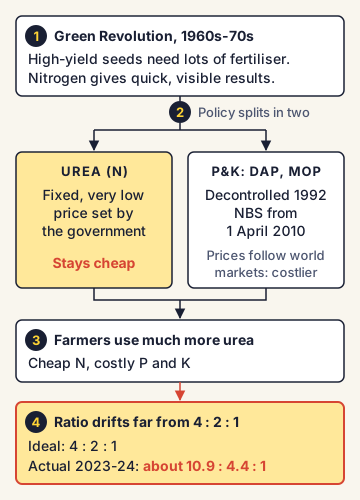
- Urea got a fixed, very low price set by the government.
- P&K fertilisers were decontrolled in 1992 and later moved to the Nutrient Based Subsidy (NBS) system from 1 April 2010, so their prices follow world markets.
Because urea stayed very cheap while DAP and MOP became costlier, farmers started using much more urea. The ratio drifted far from 4:2:1.
What is the actual ratio?
Figures vary by year and season, but nitrogen use is always far above the ideal.
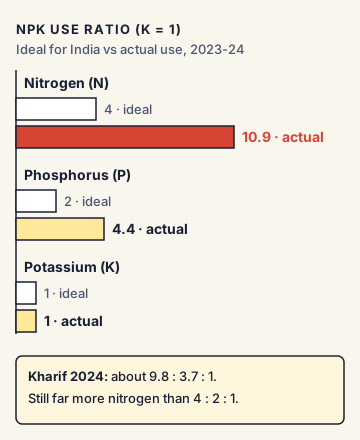
- One estimate puts the national NPK use ratio for 2023-24 at about 10.9 : 4.4 : 1.
- For kharif 2024, it was about 9.8 : 3.7 : 1, down from about 10.9 : 4.9 : 1 in kharif 2023.
- Intensive rice-wheat states such as Punjab and Haryana show some of the most nitrogen-heavy use.
What harm does imbalance cause?
- Low efficiency: Plants absorb only a part of the nitrogen given. In rice, only about 30 to 40% of applied fertiliser nitrogen is taken up. The rest is washed away or escapes into the air.
- Water pollution: Extra nitrate seeps into groundwater. High nitrate in drinking water is a health risk, especially for infants.
- Air and climate: Some nitrogen escapes as nitrous oxide, a greenhouse gas far more powerful than carbon dioxide.
- Hidden hunger in soils: Continuous one-sided use drains other nutrients. About 48.5% of Indian soils have been reported deficient in zinc, and many soils lack sulphur and boron. Zinc-poor soils also give zinc-poor grain, which affects human nutrition.
- Falling response: Each extra kilogram of fertiliser now produces much less extra grain than it did in the 1970s.
- Fiscal cost: Overuse of a subsidised product raises the subsidy bill for the government.
How does the government try to fix it?
India has used several tools, each attacking a different part of the problem.
- Soil Health Card Scheme (2015): Launched in February 2015 at Suratgarh, Rajasthan. Each card reports the soil's status on 12 parameters (major nutrients, secondary nutrients, micronutrients and physical properties like pH) and recommends the right dose. Over 25 crore cards have been issued.
- Nutrient Based Subsidy: Gives subsidy on sulphur too, and supports fortified fertilisers (for example, those coated with zinc or boron), to encourage a fuller mix of nutrients. The government fixes a subsidy rate for each kilogram of N, P, K and sulphur, and revises it every season. For rabi 2026-27 (1 October 2026 to 31 March 2027), the sulphur rate was raised sharply, from ₹2.87 to ₹10.42 per kg, to make sulphur-bearing fertilisers cheaper.
- Neem-coated urea (100% since 2015): A thin neem-oil coating slows down the release of nitrogen, so plants absorb more and less is wasted. It also stops urea from being diverted to factories.
- Smaller urea bag (45 kg from March 2018): A nudge to use less urea per acre.
- Nano fertilisers: Liquid nano urea and nano DAP, sprayed on leaves, are notified under the Fertiliser Control Order, 1985, and aim to reduce bulk use.
- PM-PRANAM (2023): Approved on 28 June 2023. States that cut chemical fertiliser use (compared to their average of the previous three years) get 50% of the subsidy saved as a grant.
- Integrated Nutrient Management (INM): Mixing chemical fertilisers with organic manure, compost, green manure and bio-fertilisers.
Commonly confused concepts
- Balanced fertilisation vs more fertilisation: Balance is about the right proportion, not higher doses. A field can be over-fertilised with nitrogen and still be starved of zinc.
- 4:2:1 is a national guide, not a rule for every field: The right ratio changes with soil type and crop. That is why soil testing matters.
- Phosphorus (P) vs phosphate (P₂O₅), potassium (K) vs potash (K₂O): Fertiliser figures are usually written as P₂O₅ and K₂O, not pure P and K. Students should not be confused when reports say "phosphate" or "potash".
- DAP vs NPK complex fertilisers: DAP (18:46:0) has only nitrogen and phosphorus. NPK complexes like 10:26:26 contain all three in one bag.
- Bio-fertilisers vs organic manure: Bio-fertilisers are living microbes (like Rhizobium or Azotobacter) that fix or free nutrients. Organic manure is decomposed plant and animal matter.
Issues, criticism and the way forward
- Price signals: Many experts and policy research reports have argued that urea's frozen price is the root cause. Bringing urea under a nutrient-based system is often suggested, but it is politically and socially sensitive because it would raise urea prices for small farmers.
- Weak use of soil cards: Farmers often get a soil health card but do not follow its advice, because of low awareness, weak extension services and lack of the right fertiliser in local shops.
- Import dependence: India imports almost all its potash and much of its phosphate. When world supply is disrupted, P&K fertilisers become scarce and costly, which pushes farmers even more towards cheap urea.
- Way forward: Suggestions include direct benefit transfer of fertiliser subsidy to farmers, customised and fortified fertilisers based on soil maps, wider use of organic and bio inputs, precision tools like drones and leaf-colour charts, and stronger farm extension.
Concepts to Know
- Kharif and rabi: India's two main crop seasons. Kharif crops (like rice) are sown with the monsoon around June-July; rabi crops (like wheat and mustard) are sown in winter around October-November.
- Green Revolution: The period from the mid-1960s when India used high-yielding seeds, irrigation and chemical fertilisers to sharply raise wheat and rice production.
- Decontrol: When the government stops fixing the price of a product and lets the market decide it.
- Nitrate: A form of nitrogen that dissolves easily in water. Too much of it in drinking water is harmful.
- Nitrous oxide (N₂O): A gas released from soils when extra nitrogen breaks down. It traps heat in the atmosphere much more strongly than carbon dioxide.
- Fortified fertiliser: A regular fertiliser with a small added amount of another nutrient, such as zinc-coated urea or boronated single super phosphate.
- Ideal national NPK ratio for India: about 4:2:1
- Actual ratio: about 10.9 : 4.4 : 1 (2023-24 estimate); about 9.8 : 3.7 : 1 (kharif 2024)
- Primary nutrients: N, P, K; secondary: calcium, magnesium, sulphur; micronutrients include zinc, boron, iron, manganese, copper, molybdenum
- Nitrogen recovery in rice: only about 30 to 40% of applied fertiliser N
- About 48.5% of Indian soils reported zinc-deficient
- P&K fertilisers decontrolled in 1992; NBS from 1 April 2010
- Soil Health Card Scheme: February 2015, Suratgarh (Rajasthan); 12 parameters; over 25 crore cards issued
- 100% neem-coated urea since 2015; 45 kg urea bag from 1 March 2018
- PM-PRANAM approved 28 June 2023: states get 50% of the fertiliser subsidy they save
- Nano fertilisers are notified under the Fertiliser Control Order, 1985
- 12 Nov 2026Added how NBS sets a per-kg subsidy for each nutrient, and the rabi 2026-27 rise in the sulphur rate to ₹10.42 per kg.
● Tracked since November 11, 2026 · last seen November 11, 2026 · updates as the daily brief publishes