Agriculture Infrastructure Fund (AIF)
Cheap Loans for Farm Storage and Processing
The Agriculture Infrastructure Fund, or AIF, is a central government scheme that helps farmers, farmer groups and agri-businesses borrow money cheaply to build things like warehouses, cold storage rooms and small processing units. The government does not give the building money itself. Instead, banks give the loan, and the government pays part of the interest and guarantees the loan. The scheme has a financing facility of ₹1 lakh crore. It is a Central Sector Scheme run by the Ministry of Agriculture and Farmers Welfare.
Why does it exist?
India grows huge amounts of food, but a large part is lost after harvest. Fruits and vegetables rot because there is no cold storage nearby. Grain gets damp because there is no proper warehouse. Farmers are also forced to sell right after harvest, when prices are lowest, because they have nowhere to store the crop.
If a farmer could store onions for two months, she could sell them when prices are better. Building such facilities needs long-term loans, and small farmers and village groups find these loans costly or hard to get. The AIF was created to fill this gap in post-harvest infrastructure (facilities needed after the crop is cut).
Where did it come from?
The Union Cabinet approved the AIF in July 2020, as part of the economic package announced during the COVID-19 pandemic. It was formally launched in August 2020. Later changes:
- The time for giving out new loans was extended up to 2025-26, and the overall scheme period up to 2032-33. This means interest help and guarantees continue till 2032-33 for loans already given.
- In 2024, the Union Cabinet widened the scheme. It now also covers community farming assets, integrated primary and secondary processing projects, links with PM-KUSUM Component A (solar power plants on farmland), and credit guarantee for Farmer Producer Organisations (FPOs) through NABSanrakshan, a NABARD guarantee trust.
How does it work, step by step?
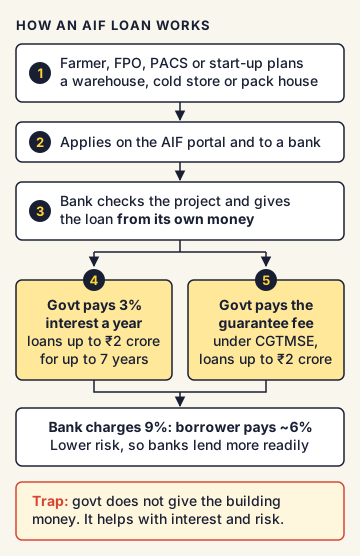
- A farmer, FPO or entrepreneur prepares a plan for a project, such as a 500-tonne warehouse.
- They apply on the AIF online portal and to a lending bank.
- The bank checks the project and gives the loan, using its own money.
- The government pays 3% of the interest every year on loans up to ₹2 crore, for up to 7 years. So if the bank charges 9%, the borrower effectively pays about 6%. For bigger loans, the 3% help is given only on the first ₹2 crore.
- The government also pays the fee for a credit guarantee on loans up to ₹2 crore under the CGTMSE (Credit Guarantee Fund Trust for Micro and Small Enterprises). If the borrower fails to repay, the trust covers much of the bank's loss. This makes banks more willing to lend.
- Loans can have a moratorium (a starting period when the borrower does not repay the principal) of between 6 months and 2 years.
Who can borrow?
Farmers, Farmer Producer Organisations (FPOs), Primary Agricultural Credit Societies (PACS), marketing cooperatives, Self Help Groups (SHGs), Joint Liability Groups, agri-entrepreneurs, start-ups, Agricultural Produce Market Committees (APMCs), and central or state agencies running public-private partnership projects. One beneficiary can get support for up to 25 projects in different locations.
What projects qualify?
- Post-harvest management: warehouses, silos, cold storage and cold chains, pack houses, sorting and grading units, ripening chambers, e-marketing platforms, supply chain services.
- Community farming assets: projects that groups use together, like organic input production, bio-stimulant units, and infrastructure for smart and precision agriculture.
- Processing: primary processing (cleaning, drying, grading) and, since 2024, integrated primary-plus-secondary processing. Standalone secondary processing (for example, only making jam from fruit pulp) stays under the Ministry of Food Processing Industries' schemes.
India's position and Indian examples
By late 2026 the government reported about ₹1.75 lakh crore of investment in more than 2.28 lakh projects under the AIF. PACS have been a major user: many village cooperatives have used AIF loans to build godowns, which also fits with the government's plan for grain storage in the cooperative sector.
Commonly confused concepts
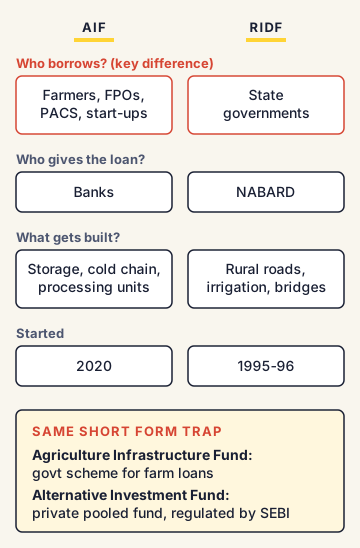
- AIF (Agriculture Infrastructure Fund) vs AIF (Alternative Investment Fund): Same short form, very different things. The Alternative Investment Fund is a private pooled investment fund regulated by SEBI. Exam questions may use this trap.
- AIF vs RIDF: The Rural Infrastructure Development Fund (RIDF), set up in 1995-96 with NABARD, gives loans to state governments for rural roads, irrigation and bridges. The AIF supports individual farmers, groups and businesses through banks.
- AIF vs Agri-Marketing Infrastructure: The AIF is a loan-support scheme (interest subvention plus guarantee). Some other schemes give direct capital subsidy (a one-time grant on part of the project cost).
- Interest subvention vs interest subsidy on crop loans: The Modified Interest Subvention Scheme for Kisan Credit Card (KCC) loans helps with short-term crop loans. The AIF's 3% subvention is for medium and long-term infrastructure loans.
Issues, criticism and the way forward
- Uneven spread: A large share of projects and money has gone to a few states, while some poorer, farm-heavy states have used it less.
- Larger players benefit more: Entrepreneurs and bigger agri-businesses find it easier to prepare project plans and get bank approval than small farmers.
- Bank caution: Even with a guarantee, banks may ask for collateral or delay approvals.
- Usage of built assets: Some warehouses and cold stores run below capacity because they are far from farms or markets.
- Way forward: Experts suggest stronger hand-holding for FPOs and PACS, better location planning based on crop clusters, linking with e-NAM markets and warehouse receipt finance, and regular checks on whether facilities are actually in use.
Concepts to Know
- Post-harvest loss: Crop that is lost or spoiled after it is harvested, during storage, transport or handling.
- Interest subvention: The government pays part of the interest on a loan, so the borrower pays a lower rate.
- Credit guarantee: A promise by a trust or the government to repay the bank a large share of the loan if the borrower cannot. It lowers the bank's risk.
- FPO (Farmer Producer Organisation): A company or group formed by farmers to buy inputs and sell produce together, so they get better prices.
- PACS (Primary Agricultural Credit Society): A village-level cooperative that gives short-term farm loans and, increasingly, runs storage and other services.
- Primary vs secondary processing: Primary processing is the first, simple step (cleaning, drying, sorting grain). Secondary processing turns it into a new product (wheat into flour or biscuits).
- Approved by the Union Cabinet in July 2020; launched in August 2020; Central Sector Scheme under the Ministry of Agriculture and Farmers Welfare
- Financing facility: ₹1 lakh crore
- 3% per year interest subvention on loans up to ₹2 crore, for a maximum of 7 years
- Credit guarantee on loans up to ₹2 crore under CGTMSE, fee paid by the government; FPOs also covered by NABSanrakshan (2024 expansion)
- New loans till 2025-26; interest subvention and guarantee support till 2032-33
- Up to 25 projects per eligible entity in different locations
- 2024 expansion: community farming assets, integrated primary-secondary processing, convergence with PM-KUSUM Component A
- As of late 2026: about ₹1.75 lakh crore invested in more than 2.28 lakh projects
● Tracked since March 08, 2026 · last seen October 29, 2026 · updates as the daily brief publishes